

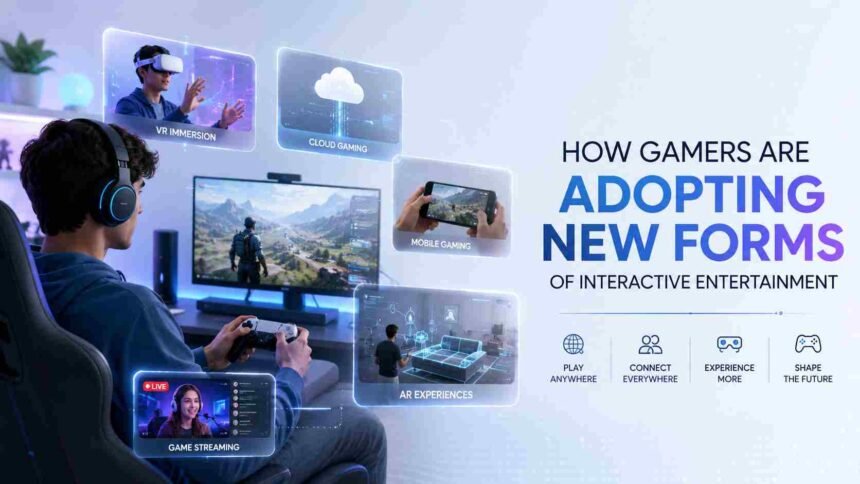
Interactive entertainment has entered a period of quiet rearrangement. Not loud revolutions, not sudden ruptures, but a steady reorientation of what players expect from games, platforms, and even peripheral tools. Sites focused on input responsiveness and controller behavior highlight this shift indirectly.
Gamers now think in terms of friction, latency, feel, and feedback loops, rather than spectacle alone. Consequently, entertainment becomes mechanical, sensory, and cognitive at the same time. That fusion changes habits, preferences, and attention spans across genres.
Moreover, this shift reflects the maturation of gaming as a practiced activity and not just a pastime. Players invest time learning systems, not merely consuming content. As a result, interactivity itself becomes the entertainment product. Story matters, visuals matter, yet the physical interaction increasingly defines satisfaction. Therefore, players gravitate toward formats that reward precision and agency.
Expansion Beyond Traditional Game Loops
While console and PC games still dominate, new interactive formats attract attention. Sandbox social spaces, experimental simulations, and skill-based digital games enter daily rotation. In this context, even platforms such as an online Solana casino gain traction due to transparent mechanics and real-time feedback, which mirror game design principles admired by competitive players. The appeal rarely centers on gambling alone. Instead, logic clarity, input immediacy, and measurable outcomes drive curiosity.
Additionally, these formats reduce narrative overhead. Players engage quickly, test strategy, then exit on their terms. That behavior aligns with modern play patterns shaped by mobile usage and limited time windows. Therefore, interactive entertainment increasingly favors modular engagement rather than marathon sessions. This flexibility supports experimentation.
Tools And Calibration As Entertainment Literacy
Input testing platforms reveal another trend. Gamers now treat hardware tuning and performance analysis as part of the entertainment ecosystem. Calibration stops feeling technical only. It becomes a preparatory ritual. Checking dead zones, stick drift, or latency produces a sense of readiness similar to pre-match routines in sports.
Accordingly, players build literacy around responsiveness and ergonomics. This literacy influences platform choice and genre preference. Fast interaction genres thrive among users sensitive to input quality. Conversely, slower-paced formats appeal to those prioritizing narrative rhythm. Both outcomes illustrate stratification rather than fragmentation. The market diversifies without collapsing.
Comparative View Of Interactive Formats
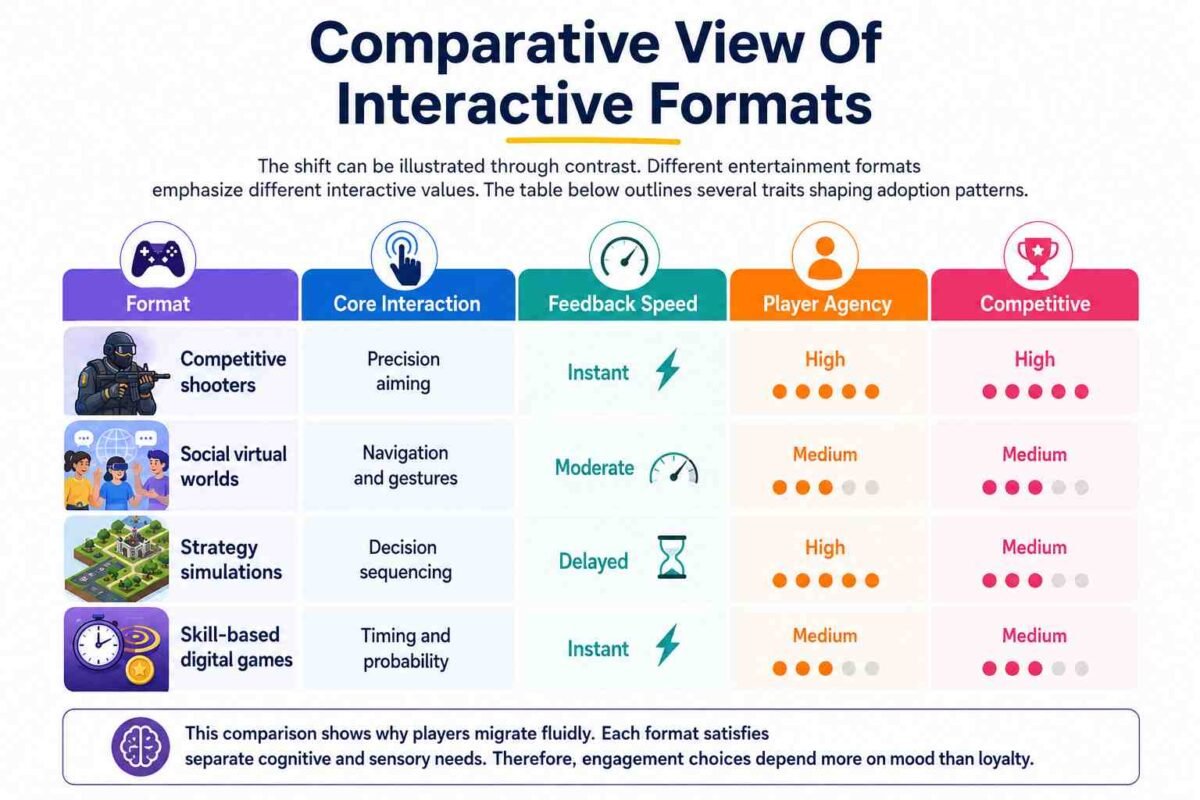
The shift can be illustrated through contrast. Different entertainment formats emphasize different interactive values. The table below outlines several traits shaping adoption patterns.
| Format | Core Interaction | Feedback Speed | Player Agency |
| Competitive shooters | Precision aiming | Instant | High |
| Social virtual worlds | Navigation and gestures | Moderate | Medium |
| Strategy simulations | Decision sequencing | Delayed | High |
| Skill-based digital games | Timing and probability | Instant | Medium |
This comparison shows why players migrate fluidly. Each format satisfies separate cognitive and sensory needs. Therefore, engagement choices depend more on mood than loyalty.
Fragmented Attention, Deeper Engagement
Paradox emerges here. Attention appears fractured across formats. Yet engagement deepens within each session where players enter with intent. They know what interaction they want. Consequently, entertainment becomes more purposeful. The absence of forced progression strengthens this effect.
Furthermore, creators respond by designing systems that respect player autonomy. Games expose mechanics. Platforms highlight responsiveness metrics. Even casual products display underlying structures. Transparency builds trust. Trust sustains engagement.
At the same time, this environment pressures creators. Poor input handling or unclear feedback encounters swift rejection. Reviews center on feel as often as content. That trend elevates technical execution to narrative parity.
Social Signaling Through Interaction Style
Play style now signals identity. Precision-focused gamers discuss controllers. Strategy-oriented players compare the system’s depth. Casual explorers share emergent moments. Interaction preference becomes cultural shorthand within communities.
However, this signaling remains fluid. Players shift identities easily. They choose contexts rather than labels. That flexibility encourages cross-pollination between formats. As a result, innovation borrows from unexpected sources. Casino-style interfaces adopt game mechanics. Games integrate statistical transparency.
All the while, players evaluate experiences through an increasingly analytical lens. That does not diminish enjoyment. Instead, it reframes it.
Implications For Future Entertainment Ecosystems
Interactive entertainment is now trending toward ecosystems rather than products. Hardware, software, analytics, and community feedback coalesce. Adoption hinges more on responsiveness and agency than on brand loyalty. Therefore, entrants succeed by respecting player intelligence.
Moreover, monetization adapts. Systems reward skill, understanding, and engagement. Passive consumption loses ground. Consequently, players accept new formats if they offer clarity and control.
The enduring lesson remains simple. Interaction quality defines value.
Interactivity Over Spectacle As The New Baseline
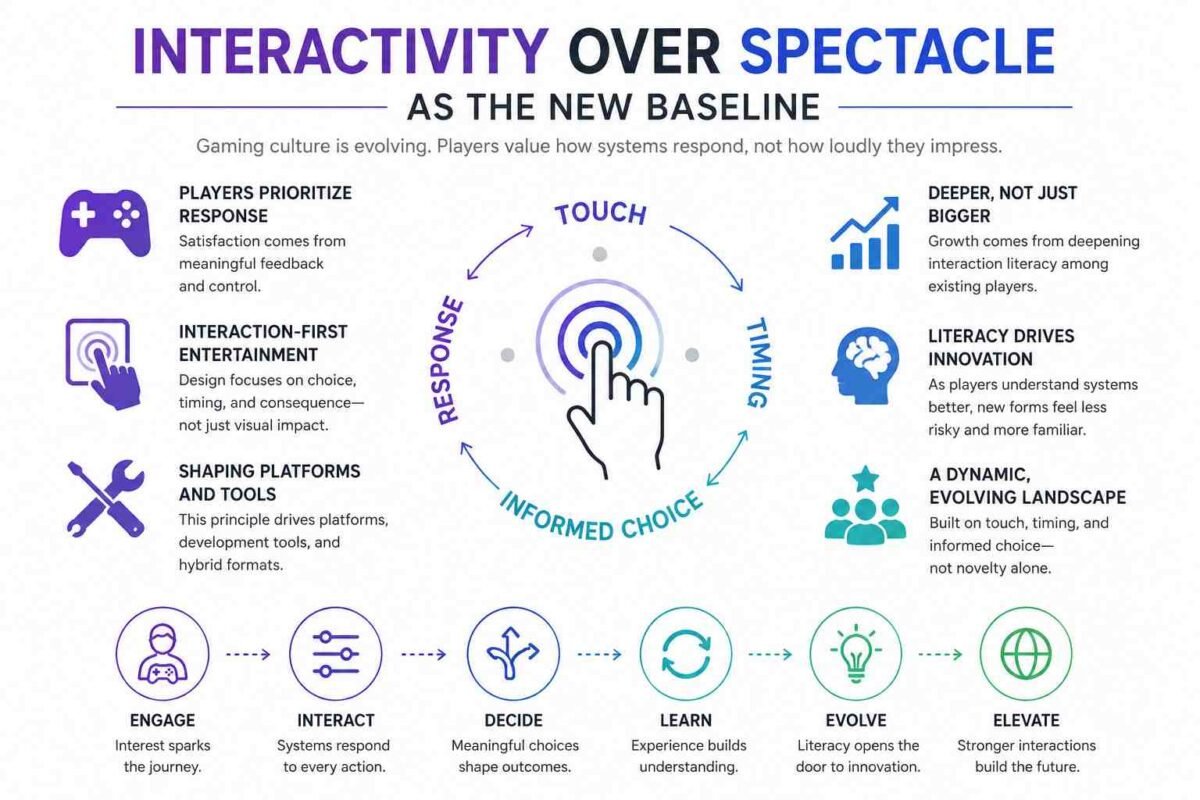
The current wave of adoption confirms a broader recalibration across gaming culture. Gamers prioritize how systems respond, not how loudly they impress. Entertainment shifts toward interaction-first thinking. That principle shapes platforms, tools, and hybrid formats alike.
Ultimately, interactive entertainment grows not by expanding audiences only, but by deepening interaction literacy among existing players. As that literacy spreads, new forms feel less risky and more familiar. The result is a dynamic, evolving landscape driven by touch, timing, and informed choice rather than novelty alone.
Conclusion
Interactive entertainment is no longer defined by visuals, storylines, or big releases alone. Players now care deeply about how a system feels, how quickly it responds, and how much control it gives them. From competitive games and social virtual worlds to calibration tools and skill-based platforms, the modern gaming experience is becoming more focused on precision, feedback, and player agency.
As gamers become more aware of latency, input quality, mechanics, and transparency, entertainment platforms must offer smoother, clearer, and more responsive experiences. The future of interactive entertainment will likely belong to systems that respect player intelligence, support flexible engagement, and make every interaction feel meaningful.
Disclaimer
This article is for informational and educational purposes only. It does not promote gambling, financial risk-taking, or any form of underage participation in restricted platforms. Readers should follow the laws and age requirements in their own country or region before using any gaming, casino, blockchain, or real-money entertainment platform.
Any mention of online casino-style platforms, cryptocurrency, or skill-based digital games should not be taken as financial, legal, or gambling advice. Users should make careful decisions, understand the risks involved, and seek professional guidance where needed. Minors should not access gambling or age-restricted services.