

There is a particular kind of tension that builds when you watch a jackpot counter tick upward in real time. Every fraction of a second it nudges higher, and somewhere in the back of your mind a quiet voice suggests that the next spin, your spin, might be the one that lands it. That feeling is the whole appeal of a progressive jackpot, and it is also the reason these games deserve a clear-headed look rather than a hopeful one. Whether you are exploring progressive slots through NV casino online or simply want to understand how these prizes work, knowing the mechanics behind them is far more valuable than relying on luck alone.
Behind the glowing counter sits a fairly precise machine. Money moves in defined proportions, prizes reset to planned figures, and the odds of triggering a win are fixed long before you ever load the game. Understanding that machinery will not make you win, but it will make you a sharper player, and it will help you tell the genuine excitement apart from the marketing gloss.
Contribution Model That Feeds Every Pool
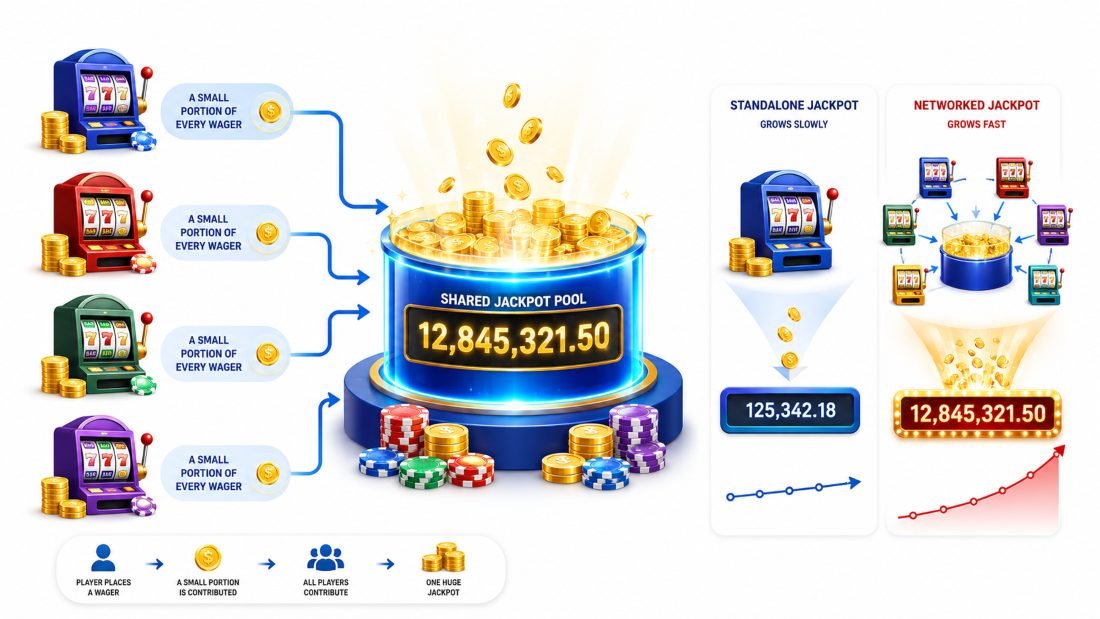
A progressive jackpot grows because a small slice of every qualifying wager is redirected into a shared prize fund. The typical skim sits somewhere between 1 and 5 percent of each stake. That portion never touches the game’s ordinary payouts. It is taken off the top and quietly added to the headline figure you see climbing on screen.
This is worth sitting with for a moment, because it explains a trade-off that many players miss. The slice that feeds the jackpot is carved out of the game’s return to player, the long-run percentage a slot is designed to pay back. A progressive slot therefore tends to run a slightly leaner base game than a comparable fixed prize title. You are, in effect, funding the dream with a thinner day-to-day return.
Why Some Jackpots Climb Faster Than Others
Two forces decide how quickly a pool swells: the contribution rate and the number of people feeding it. A game skimming 3 percent played by thousands of people across many sites will outpace a quiet standalone slot taking 1 percent inside a single room. This is why the famous networked progressives reach sums that read like typos. Microgaming’s Mega Moolah, for instance, holds a Guinness World Record for the largest online slot payout, a single win of nearly 18 million euros back in 2015. Numbers like that are only possible because an entire network pours into one pot.
Seed Values, And What Happens After A Win
No progressive ever displays zero. The moment a jackpot is claimed, it resets to a seed value, a guaranteed minimum funded by the game provider or the operator. Seeds vary wildly; some restart near €10,000, others at €500,000 or more. The logic is commercial rather than generous. A healthy seed keeps a game attractive the instant after a payout, so player traffic holds steady, and the pool starts climbing again without delay.
Three kinds of Progressive Jackpots
Not every progressive behaves the same way, and the type shapes both the likely prize size and how often it pays.
- Standalone progressives are tied to a single game and funded only by bets placed on that title. Pools grow slowly but tend to trigger more often.
- Local progressives link several games within one operator. The shared pool builds faster than a standalone can.
- Wide area network progressives connect dozens or hundreds of sites at once. These produce the headline sums, and they carry the longest odds by far.
The pattern is consistent. The bigger the potential prize, the rarer the moment it lands.
What Actually Triggers A Payout
Triggering mechanics differ by design, but most fall into three families.
| Trigger type | How it works | Often seen in |
|---|---|---|
| Random | Any spin can trigger the jackpot, regardless of the symbols appearing on the reels | Mega Moolah and similar networked progressive slots |
| Symbol combination | Specific symbols must align on an active payline to activate the jackpot | Classic progressive slots |
| Bonus selection | Players choose from hidden options within a bonus game to reveal the jackpot prize | Multi-tier jackpot titles |
One detail matters more than most players realise. Many progressives weight the jackpot odds to the size of your stake, which means a larger bet can carry a better chance of triggering the prize. It is not a loophole, and it is certainly not free money. It simply means the game is quietly asking you to risk more for a shot at the top tier.
There is a psychological layer underneath all of this. Decades of study into the design of slot machines suggest these features are not neutral, and that the structural characteristics of a game can reinforce and sustain play in their own right (Griffiths, 1993). The near miss is the clearest example. When the reels settle just short of the jackpot, laboratory work has found that this near win can heighten the urge to keep going and light up the same reward circuitry in the brain that a real win does, even though nothing was actually paid out (Clark et al., 2009).
Random Number Generators And The Fairness Question
Every outcome on a legitimate slot is decided by a random number generator, an algorithm producing sequences that no operator, provider, or player can predict. In regulated markets these systems are not taken on trust. They are audited against recognised statistical standards, such as the randomness test suites published by the United States National Institute of Standards and Technology, and then certified by independent laboratories.
Two names dominate that work. eCOGRA, a London-based testing house founded in 2003, checks RNG integrity and payout accuracy, while Gaming Laboratories International runs similar engineering-led testing across dozens of jurisdictions. A regulator such as the UK Gambling Commission will not let a game go live until its RNG has passed this kind of independent review. A certification badge on a site is, in plain terms, a promise that someone with no stake in the outcome checked the maths.
Polish Picture, And Why It Matters
Here is where a lot of casino writing quietly misleads readers, so it is worth being exact. Poland does not run an open, multi-operator online casino market. Under the country’s Gambling Act, online casino games are a state monopoly, and the only licensed online casino is Total Casino, operated by the state-owned Totalizator Sportowy. The Polish Ministry of Finance supervises the market and keeps a blocklist of blocked domains, and it has been tightening the rules further rather than loosening them.
That reality carries two practical consequences. First, the progressive jackpots a Polish player can legally chase online live inside the state platform. A player from the Lublin region reportedly won more than 9 million zloty from a 5 zloty spin on a jackpot slot at Total Casino, which shows the state operator does carry genuine progressives. Players interested in other casino games can find additional information at https://nv.casino/pl/category/blackjack. Second, the many offshore sites that market themselves to Polish players sit outside that licensing system, which brings legal and financial risk that no jackpot counter ever mentions.
Playing With A Plan, Not A Prayer
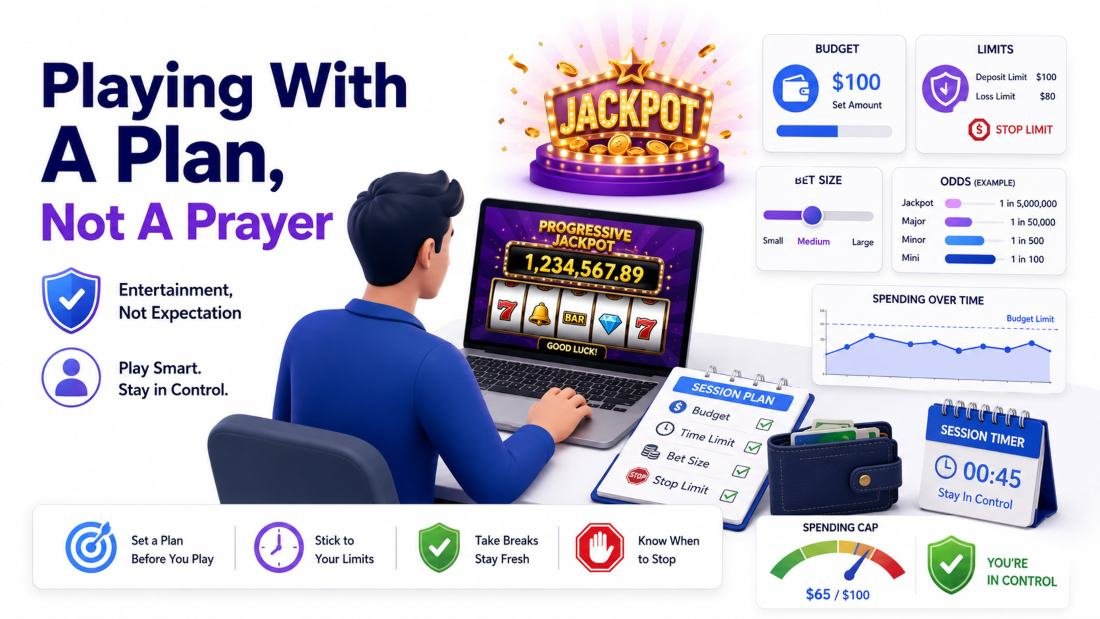
Chasing a progressive without a plan tends to drain a bankroll faster than ordinary slots, precisely because that contribution slice thins the base game. A few habits keep the experience where it belongs, as entertainment.
- Set a session budget that is entirely separate from money you need for anything else.
- Check whether the specific game rewards higher stakes with better jackpot odds before you decide how to bet.
- Treat the jackpot as a remote bonus possibility, never as an expected outcome.
- Decide your limits before you start. The information and self-assessment tools at BeGambleAware can help you set them honestly.
These are not merely comforting slogans. When researchers followed the most intense online gamblers on a real money platform, the players who chose to set their own voluntary money limits went on to gamble notably less than those who did not (Auer & Griffiths, 2013).
A Closing Thought
Progressive jackpots endure because anticipation is genuinely fun, and a growing pool taps into something very human. The healthiest way to enjoy them is to pair that thrill with clear eyes. Know how the pool is fed, know that the odds are fixed and independently checked, and know the legal ground you are standing on. If the fun ever starts to feel like a need, free and confidential support is available through services such as GamCare. Let any win be a welcome surprise, and let the game stay a game.
Disclaimer
This article is provided for general information and educational purposes only. It is not financial, legal, or professional gambling advice, and nothing in it is meant to encourage anyone to gamble. Gambling always carries a real risk of losing money; the odds are structured in favour of the operator, and no system, strategy, or amount of knowledge can turn a progressive jackpot into a dependable outcome. Age and eligibility rules apply, and because online casino play in Poland is limited to the state-licensed operator, readers should check and follow the laws that apply where they live. Gambling harm reaches past the individual and can affect families and whole communities as well (Langham et al., 2016). If gambling is starting to feel like a problem for you or someone close to you, the support services linked earlier in this article offer free and confidential help.
References
- Griffiths, M. D. (1993). Fruit machine gambling: the importance of structural characteristics. Journal of Gambling Studies, 9(2), 101 to 120. https://doi.org/10.1007/BF01014863
- Clark, L., Lawrence, A. J., Astley-Jones, F., & Gray, N. (2009). Gambling near-misses enhance motivation to gamble and recruit win-related brain circuitry. Neuron, 61(3), 481 to 490. https://doi.org/10.1016/j.neuron.2008.12.031
- Auer, M., & Griffiths, M. D. (2013). Voluntary limit setting and player choice in most intense online gamblers: an empirical study of gambling behaviour. Journal of Gambling Studies, 29(4), 647 to 660. https://doi.org/10.1007/s10899-012-9332-y
- Langham, E., Thorne, H., Browne, M., Donaldson, P., Rose, J., & Rockloff, M. (2016). Understanding gambling-related harm: a proposed definition, conceptual framework, and taxonomy of harms. BMC Public Health, 16, 80. https://doi.org/10.1186/s12889-016-2747-0