


Bilibili Gaming defeated G2 Esports 3-1 in São Paulo on March 22, 2026, to win an international League of Legends title early in the season. It was the second edition of an annual competition Riot Games had introduced a year earlier, giving regional teams another occasion to meet internationally.
The tournament comes before the Mid-Season Invitational, usually shortened to MSI, in Riot’s annual international calendar. Its result has consequences beyond its own trophy: BLG’s victory gave China’s LPL a seeding benefit at MSI, connecting the March competition to the next international event.
The First Stand tournament (FST) brings together teams qualifying through regional competition. Its inaugural edition combined that international contest with Fearless Draft, a rule that prevented champions from being reused within a series.
A Regional Contest With An MSI Consequence

Teams compete under their organizations’ names, but they also represent the leagues through which they qualified. China’s League of Legends Pro League, or LPL, is one of those leagues. A team’s result can therefore have a consequence for another representative from the same league.
In 2026, BLG’s victory allowed the LPL’s second MSI seed to bypass the Play-In Stage and enter the Bracket Stage directly. A seed identifies a qualifying team’s position within its region. The award changed the entry stage for whichever team qualified as the LPL’s second seed. BLG still had to qualify for MSI through regional competition.
FST opens Riot’s annual international calendar before MSI and the World Championship, commonly called Worlds. Each event awards its own title. Winning in March establishes a champion at that point in the season; teams still have to qualify and compete separately for the later international trophies.
How Fearless Draft Works
A tournament contains matches between teams, and those matches can be played as series of several games. In a best-of-five series, the first team to win three games wins the series. A 3-1 final therefore consists of four games, with a new draft before each one.
During the draft, teams choose champions, the characters their players will use, and ban options they want removed from selection. Riot’s 2025 format primer explains the additional restriction used at the inaugural event: champions selected in previous games became unavailable to both teams for the rest of that series.
The usual 10 bans across both teams still applied separately during every game’s draft. Those bans removed options for the current game; Fearless restrictions accumulated from champions actually played earlier in the series. Ordinary bans did not themselves become permanent exclusions for subsequent games.
After the opening game, its 10 selected champions were unavailable. By a fifth game, 40 previously played champions were excluded, alongside that game’s 10 standard bans.
Those restrictions reset when a new series began. Within a series, however, teams’ choices had to extend beyond repeating the same lineup. A player’s champion pool, the characters they can use effectively, became relevant across successive drafts as the available selection narrowed.
Inaugural Edition In Seoul
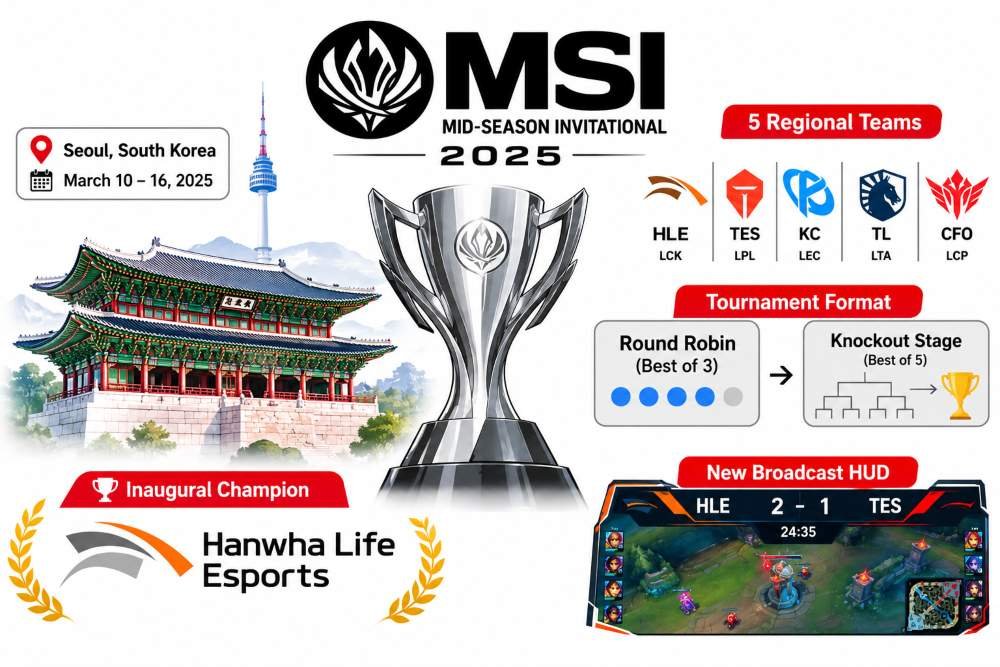
The first edition ran from March 10 to 16, 2025, at LoL Park in Seoul, with five regional representatives. South Korea’s LCK sent Hanwha Life Esports, China’s LPL sent Top Esports, and Europe’s LEC sent Karmine Corp. Team Liquid Honda represented the Americas’ LTA, while CTBC Flying Oyster represented the Asia-Pacific LCP.
They began in a single round robin: every team played each other team once, in best-of-three series. The first team to win two games won each series. Elimination depended on the final standings, with the fifth-place team leaving and the other four moving into the knockout stage.
That stage used best-of-five series and single elimination. The first-place team faced fourth place, and second faced third, based on opening-stage standings. A semifinal defeat ended a team’s tournament, while the winners advanced to the final. Hanwha Life Esports became the inaugural champion.
The change in series length also affected how far Fearless Draft could progress. A deciding third game in the round robin excluded 20 champions already played. A fifth game in the knockouts excluded 40. The ordinary bans operated alongside those restrictions in both stages, but the longer knockout format required more distinct champion lineups to win a series that went the distance.
Riot announced a new broadcast heads-up display, or HUD, for the inaugural event. This is the on-screen layer presenting information about the match. The company said its aims included making key information easier for new viewers to follow and allowing the display to change alongside the action. The new event therefore accompanied changes to both champion selection and the presentation of matches.
A Second Champion In São Paulo
The following year’s final took place at Riot Games Arena in São Paulo. G2 won the opening game, with mid laner Rasmus “Caps” Borregaard Winther finishing without a death. BLG answered by winning the next three games. Inven Global’s match report described BLG using Pantheon and Galio to apply pressure across the map in game two, then taking game three through strong laning from Zhuo “knight” Ding and Chen “Bin” Zebin.
The winning organization changed between editions, but one player appeared on both championship teams. Bot laner Park “Viper” Do-hyeon won the inaugural title with Hanwha Life Esports in 2025, then won again with BLG in 2026.
Disclaimer
This article is for general information only. Tournament details, formats and results are based on published reports and official Riot Games material available at the time of writing, and formats can change from one season to the next. This site is not affiliated with or endorsed by Riot Games or by any team or league named here. League of Legends, LoL Esports, First Stand and the Mid-Season Invitational are trademarks of Riot Games, Inc.