

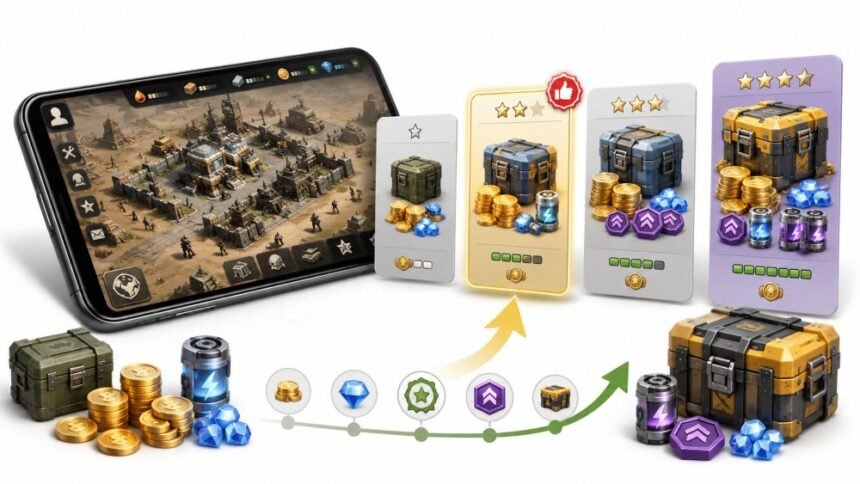
Every Last War player eventually has the same experience. You open the store to buy one thing, and forty minutes later you have compared eleven bundles, none of which lists a price per speedup, and you have no idea which one is actually good. So you buy the one with the biggest red discount badge and hope.
That confusion is not a personal failing. It is the product working as designed. Package storefronts in games like this are built to make comparison hard, because comparison is the thing that costs the publisher money.
The good news is that the counter to it is simple and takes about ninety seconds per purchase. What follows is a framework for working out which Last War packages are genuinely worth buying at your budget, what the game actually values at each stage of your account, and how to stop the store from doing your thinking for you.
Why Package Value Is Hard to Judge on Purpose
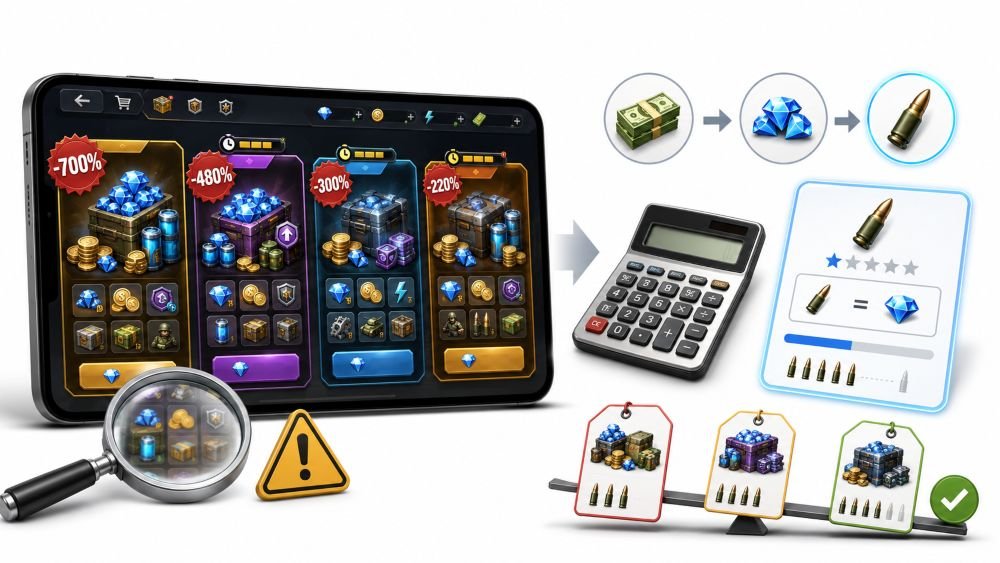
It is worth naming the mechanics, because once you can see them you stop falling for them.
Bundles mix high-value and low-value contents so that per-unit comparison becomes arithmetic rather than a glance. Prices are quoted in diamonds, which you bought with money, which puts a layer between you and the real cost. Discount percentages are calculated against a notional “value” that nobody would ever pay. And the offers are timed, so you are asked to decide quickly.
Regulators have started treating this as a consumer issue rather than a design preference. The EU’s consumer protection network published a set of key principles on in-game virtual currencies in 2025, and the headline requirement is that the real-world money price of in-game content should be shown clearly, so players can see what they are actually spending rather than working in an abstracted currency.
On the interface side, the US Federal Trade Commission’s action against Epic Games over “dark patterns” in Fortnite resulted in a settlement worth more than half a billion dollars, much of it specifically over purchase flows designed to produce charges players did not intend. Different game, same category of problem.
None of this is unique to Last War, and none of it means you should not spend. It means the evaluation work is yours to do, and it is not hard once you have a method.
Method: before any purchase, convert the bundle into one number. Real money divided by the quantity of the single resource you actually want. Ignore everything else in the pack. Compare that number to the last thing you bought. That is it. Filler contents have a habit of making a weak bundle look generous, and pricing your bottleneck resource alone strips that away instantly.
Resource Hierarchy That Actually Applies
Not everything in a Last War pack carries the same weight, and the ranking shifts as your account matures.
- Speedups sit at or near the top for almost everyone. They compress the time cost of every future action rather than delivering a one-off benefit, which means their value compounds across your whole remaining timeline. A speedup applied at HQ 12 is worth more than the same speedup applied at HQ 25, because it accelerates everything that comes after it. Worth knowing that speedups come in types: general, construction, research and training. General speedups are the flexible ones, and most experienced players bank them for research, since tech queues get brutally long later.
- VIP Points are the most undervalued item in the store. More on this below, because the mechanic is widely misunderstood.
- Coins are the sleeper bottleneck. Early on, Food, Iron and Coins all feel abundant. Past roughly HQ 15 the picture changes, and Coins in particular become the constraint that stalls upgrades in the mid and late game. If you have resource choice chests sitting in your inventory, most veterans will tell you not to burn them on Food and Iron unless you actually need them right now.
- Food and Iron sit lower than their pack prominence suggests. They accumulate steadily through normal play, gathering and events, which makes pack-included amounts less impactful per pound spent than speedups of equivalent cost. Keep an eye on your warehouse protection limit too, since anything above it can be plundered, and buying a large resource pack you cannot immediately spend is a way of donating it to a stranger.
- Hero shards climb to the top late. Once hero level caps and skill maxing become the thing separating comparable alliances, universal hero shards and hero development materials are the hardest things to farm and the most directly competitive. Packages loaded with them deliver outsized value at that stage and very little value before it. A player at HQ 12 buying an endgame hero bundle has effectively pre-paid for something they cannot use yet.
- Diamonds are flexible, with one strong caveat. The consensus among established players is to spend them on VIP and VIP Store purchases rather than rushing timers directly. The diamonds-to-time conversion rate for instant-finishing a build is poor enough that it is worth reserving for genuine emergencies.
VIP Detail Most Guides Get Wrong
Here is the part that changes how you read every package with VIP Points in it.
Last War’s VIP system runs on two separate layers. Your VIP Level is permanent. Once you have accumulated enough VIP Points to hit a level, that level and everything it unlocks stays with your account forever. Your VIP Time is temporary, and the percentage bonuses like construction speed and resource production only run while you have active VIP Time on the clock.
These are independent, and the permanent unlocks do not require active VIP Time to keep working. That distinction matters enormously for purchase decisions, because it means VIP Points are one of the only things you can buy that never decays. Speedups get consumed. Resources get spent or plundered. VIP Level does not.
The milestone most players point to is VIP 6, which unlocks a second permanent building queue. Two builders instead of one, permanently, is a compounding advantage that touches every day you play from that point on. If you are early in your account and choosing between a pack heavy on resources and a pack that pushes you meaningfully towards a VIP threshold, the VIP option is usually the better six-month decision even when it looks less impressive in the shop.
A package that quietly adds substantial VIP Points alongside a modest resource load can therefore be better value than a package that looks twice as generous on the tile. Pure resource comparisons miss this every time.
Starter and Growth Packs: Getting the First Purchase Right
The starter and welcome offers that appear in your first days consistently carry the best per-unit value in the game. That is deliberate: they are priced to convert you from a free player into a paying one, and that means the publisher is willing to lose margin on them.
Which makes them the right first purchase, with one condition attached. Buy them only after you have decided you are actually staying with the game. The value is only real if you are around to use it, and a lot of players buy a starter pack in week one and stop playing in week three.
When comparing early offers, weight them towards speedups and VIP Points rather than raw resource counts. Early resources are the easiest thing to farm and the least scarce thing you will own. Speed and VIP are the two things that make everything else faster forever.
Timing Is the Single Biggest Multiplier
If you take one habit away from this article, take this one.
Last War’s event calendar is not decoration. Arms Race and Alliance Duel windows award points for actions you were going to take anyway, which means the same speedup spent inside a scoring window produces the resources or upgrade you wanted plus event rewards, while the same speedup spent on a Tuesday afternoon produces only the upgrade. That is a straightforward multiplier on identical spending.
The same logic applies to purchases. Event periods routinely bring enhanced bundle contents, bonus deliveries on top-ups, and time-limited packs priced better than anything permanently in the store.
The practical habit is to hold a purchase intention rather than a purchase commitment. Decide roughly what you need, then wait. “I need about a week of construction speedups” is an intention. Buying them the moment you notice the shortage is a commitment, and it is usually the worse deal by a meaningful margin.
Players who run this discipline for a full season consistently end up further ahead than players who spent the same money reactively. It is not close, and it costs nothing except patience.
Mid-Budget: Build a Frame, Not a Wishlist
If you have a defined monthly figure rather than unlimited appetite, the structure that works looks like this.
- Set the number first, in real currency, before you look at the store. Not in diamonds. The whole point of a budget is that it exists outside the game’s framing.
- Pick one bottleneck per month. Not three. Concentrated spending on a single constraint moves your account visibly. Spread across everything, the same money disappears without producing anything you can point at.
- Spend inside event windows only. If the month ends and the right event never arrived, roll the budget forward. Unspent budget is not a wasted month, it is a stronger month coming.
- Treat recurring value packs as your baseline. Steady daily deliveries of diamonds and speedups tend to outperform an equivalent one-off spend, because they arrive continuously and can be applied inside whatever event happens to be running.
Where Third-Party Top-Ups Fit
For players whose spending is a recurring line rather than an occasional impulse, buying diamonds through an external marketplace is a normal part of the routine, mainly because regional pricing and platform markups vary considerably.
LootBar handles Last War top up among its supported titles, with competitive pricing, payment coverage across multiple regions, and a self-service model that does not require handing over your account credentials. LootBar also carries strong independent trust ratings and round-the-clock support, which matters more for a recurring commitment than for a one-off purchase.
Two pieces of due diligence apply to any external top-up service, and they are worth knowing rather than discovering.
First, never share account credentials with anyone. Beyond the obvious security risk, Google Play’s refund policy states plainly that if you give your account or payment details to someone else, or fail to protect your account with authentication, a refund usually cannot be issued. Handing over a login can void your recourse even in situations where you would otherwise have had some. Services that deliver against your player ID without needing your password sidestep that problem entirely, which is why the no-credential model is the one to look for.
Second, understand that purchases made outside the platform billing systems sit outside Apple and Google’s refund processes too. That is not a reason to avoid them, but it does mean the service’s own support and dispute handling is what you are relying on, so its track record is the thing worth checking.
High Budget: Buy Outcomes, Not Resources
Above a certain spend level the calculation changes shape. You are no longer buying progression, you are buying competitive results, and those are not the same purchase.
Packages that push march speed, complete specific combat research nodes, or supply the hero skill materials that drive rally and defensive performance translate into outcomes in alliance warfare. Pure resource bundles at the same price do not, because at that budget resources were never the constraint.
The test is simple and slightly uncomfortable: name the specific fight this purchase is meant to change. If you cannot, you are buying inventory rather than capability, and inventory at high spend levels is where money quietly disappears.
Three-Question Filter for Event Bundles
Event framing creates pressure to buy regardless of relevance. Run every bundle through three questions and the pressure stops working.
- Does it address a bottleneck I have right now? Not one I will have in three months. Right now.
- Is the per-unit price on that specific resource better than the standard store? Price the thing you want, ignore the filler.
- Does it fit inside the budget I set before I opened the game?
Three yeses, buy it. Anything else, close the window. The offer will come back, and a version of it will come back with better contents inside the next event.
Keeping the Spending Healthy
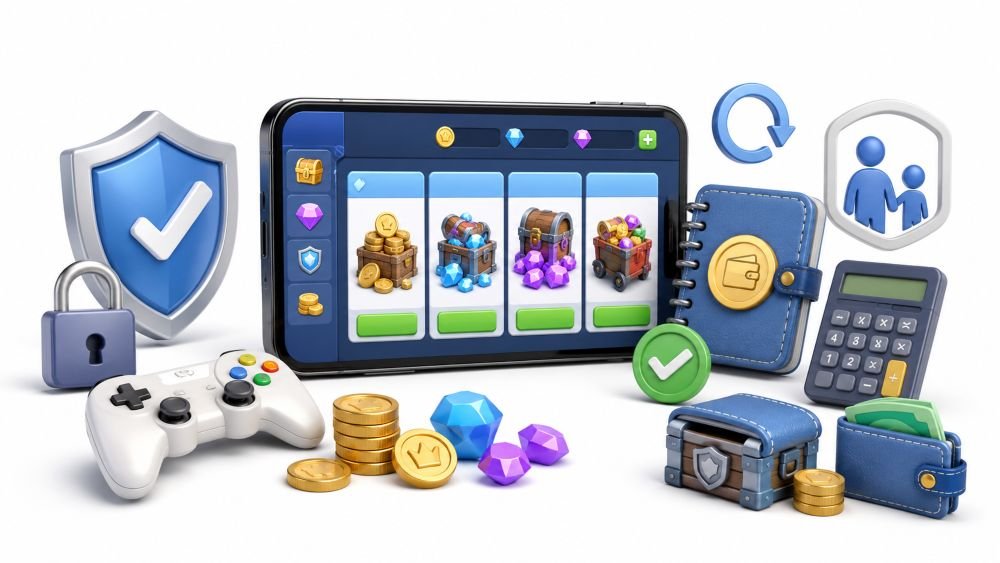
Worth a short, honest section, because articles about maximising value tend to skip it.
Games in this genre lean heavily on randomised rewards, and there is a consistent research finding here that is worth knowing. A replication study published in PLOS One found a significant association between spending on randomised in-game items and problem gambling severity, with non-problem gamblers spending markedly less per month than at-risk and problem gamblers. The relationship is correlational rather than causal, so it does not establish which way the arrow points. What it does establish is that the pattern is real and measurable.
The behavioural marker to watch for is not the amount. It is whether purchases are planned or reactive. A budgeted, event-timed purchase and a frustrated 2am top-up after losing a rally can be the same amount of money and are not the same behaviour.
More broadly, the World Health Organization recognises gaming disorder in the ICD-11, characterised by impaired control over gaming, gaming taking priority over other interests and daily activities, and continuing despite clear negative consequences. Most players will never approach the clinical threshold, but the direction those criteria describe is a useful thing to be able to recognise in yourself.
Practical guardrails, all of which take a couple of minutes:
- Require a password or biometric confirmation for every purchase, so nothing happens by reflex.
- Keep the monthly figure written somewhere outside the game.
- Know your recourse. You can request a refund from Apple through reportaproblem.apple.com, and Google Play’s refund route has a 48-hour window for most in-app purchases before it hands you to the developer. Neither is guaranteed, and both are far easier to use if you act quickly.
- If a purchase was made by a child on your device, set up purchase approvals rather than relying on catching it afterwards.
Short Version
Speedups and VIP Points compound and almost never disappoint. Coins become the bottleneck nobody warns you about. Hero materials are the endgame purchase and a waste of money before then. Starter packs are the best per-unit value in the game, provided you are actually staying. And timing your spending to Arms Race and Alliance Duel windows will do more for your account than upgrading your budget.
The players who build fastest on any given server are rarely the ones spending the most. They are the ones who decided what they needed before the store told them.