

A bathtub that empties slowly is easy to ignore. So is a toilet that gurgles when the washing machine drains, or a sink that backs up once a month and then behaves for weeks. Most people reach for a bottle of drain cleaner and forget about it.
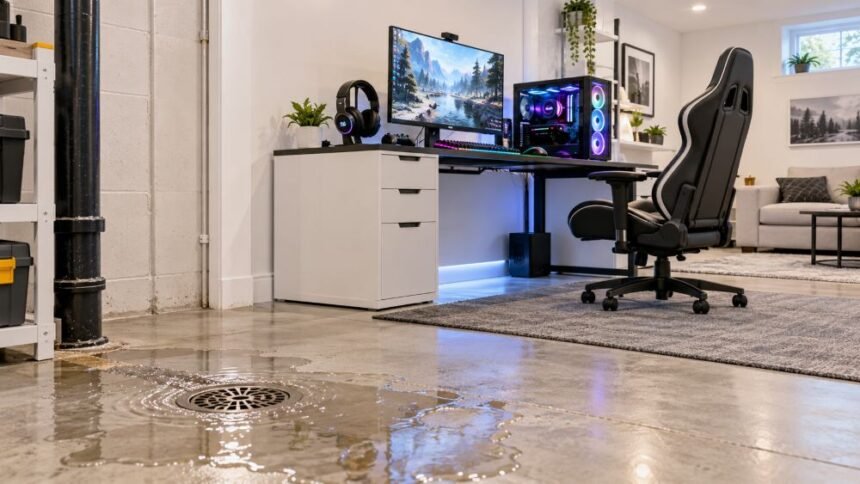
What those symptoms usually mean is that something is narrowing the main line that carries waste away from the house, and in neighbourhoods with mature trees that something is almost always roots. The part that matters for anyone with a setup downstairs is where the water goes when that line finally closes. It does not back up into the kitchen sink. It comes out at the lowest drain in the building, which is in the same room as the tower, the console and everything plugged into the wall near the floor.
How Tree Roots Get Inside A Sewer Line
Older Pipe Materials Give Roots A Way In
Roots are not strong enough to break into a sound modern pipe. They do not need to be. Clay and cast iron lines in older housing stock have joints every few feet, and decades of ground movement leave those joints slightly open. A root finds the gap, works through as a thread, then thickens inside the pipe where there is water and nothing competing with it. Over a few seasons that thread becomes a mat dense enough to catch everything flushed past it.
Live oaks and other established species are efficient at this, which is why the problem clusters in exactly the neighbourhoods people want to live in. The trees are the reason the street looks good and the reason the sewer line is under attack.
Ground Conditions Decide How Fast It Happens
Soil behaviour around the pipe matters as much as the tree above it. Seasonal rainfall swells and shrinks the ground, shifting pipe sections and widening joints that were sealed. Research into groundwater movement and buried wastewater pipes shows how readily water passes between surrounding ground and a line through small defects, and the same openings that let groundwater in let roots in. Understanding the impact of local soil conditions on sewer line vulnerability explains why two houses on the same street with the same trees can have completely different outcomes.
Warning Signs Worth Acting On
What To Watch For
Slow drains across several fixtures rather than one. Gurgling from a toilet when another fixture drains. A faint smell near floor drains. Water appearing in a shower tray when nothing upstairs is running. Any of these pointing at more than one fixture suggests the main line rather than a local clog, and a main line problem is the one that ends up on your floor.
Inspection That Shows You The Actual Pipe
Guessing is unnecessary. A camera inspection threads a waterproof head through the line and shows the inside of the pipe on a screen, including exactly where roots have entered and how far along the run they sit. The best practices for sewer line inspection set out what a proper scope should cover and what the report should tell you, which is worth knowing before you pay for one. Hydrostatic testing complements it by sealing the line and measuring whether it holds pressure, which finds cracks that have not yet admitted anything.
Book inspections in spring or early summer when root growth is most active. That timing gives you the most honest picture of what is actually in the pipe.
Why A Sewage Backup Is The Worst Kind Of Water
Clean water from a burst supply pipe is survivable. Hardware that was switched off often dries out and works. A sewer backup is a different problem, because the water is contaminated and everything porous it touches becomes a disposal job rather than a drying job. Carpet, underlay, fabric chairs, foam headset cushions and anything cardboard are gone.
Electronics sit somewhere in between. A console or tower that was powered down may survive, but contaminated water leaves residue inside the chassis as it dries, and that residue keeps conducting where it should not. Anything that was running when the water reached it should be treated as failed until proven otherwise, and nothing should be powered back on to test it while still damp.
Clearing Roots So They Stay Cleared
Cutting Alone Does Not Hold
A mechanical auger cuts through the root mass and restores flow the same day, which feels like a fix. It is a reset rather than a repair. The roots outside the pipe are untouched and regrow toward the same opening, so a line cleared by cutting alone tends to need clearing again on a predictable cycle.
Pairing the cut with a foaming root inhibitor is what changes the cycle. The treatment coats the pipe interior and discourages regrowth at the entry point without killing the tree. Residents arranging Drain Cleaning in North San Antonio often ask for both steps together and schedule the treatment against the local growing season, which is the version that actually buys years rather than months.
Lining And Replacement For Damaged Sections
Where roots have already cracked a section, cleaning is not enough. Trenchless lining inserts a resin coated sleeve that cures into a seamless inner pipe, sealing the joints roots were using without digging up the garden. Badly collapsed runs get replaced outright, usually in PVC, which has no joints for roots to exploit in the same way.
Checking Hardware Once The Room Is Clean
Do not judge gear by whether it powers on. Residue works slowly and the faults it causes look like ordinary wear at first. Controllers show it early because the boards are thin and sit close to the shell.
Run a stick drift test to see whether a stick has started reporting movement at rest, and a full controller benchmark for a single recorded score across sticks, buttons, triggers and connection stability. Keep the exported result. If you end up claiming on insurance for the contents of the room, a dated test result is better evidence than a description.
Conclusion
A slow drain upstairs and an expensive room downstairs are the same problem at two different stages. Get the line scoped while the symptoms are still minor, clear roots with a treatment rather than a cut alone, and keep anything valuable off the floor in a room that sits at the bottom of the house. The inspection costs a fraction of what the room holds.