

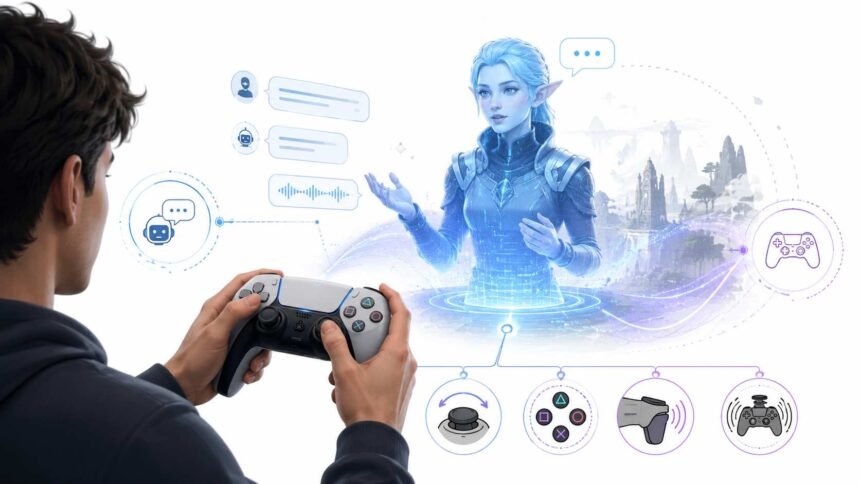
I’ve replayed enough open-world games to know the script by heart. Walk up to a villager, press the interact button, get one of four pre-recorded lines, and walk away. Press it again, same line. It’s a small thing, but it’s the kind of small thing that quietly tells your brain: this isn’t really a world, it’s a set.
That’s been changing, slowly and then all at once. Over the last year or two, conversational AI for gaming has started showing up in actual shipped products, not just tech demos, and NPCs are finally beginning to do something they’ve never really done before: respond to what you say, in real time, in ways that weren’t written in advance. It’s still early, and the rough edges are real. But here’s the part that doesn’t get talked about enough: when an NPC conversation feels off, in a lot of cases, it isn’t the AI that’s broken. It’s the controller in your hands translating that moment into the game with a half-second of lag you’ve stopped noticing.
That’s the angle we want to dig into. Conversational AI is genuinely changing how characters talk back. But the input device sitting in your hands decides whether you actually feel that change or whether the whole thing gets swallowed by drift, dead zones, and dropped inputs you didn’t know you had.
Dialogue Tree Has Always Been a Compromise
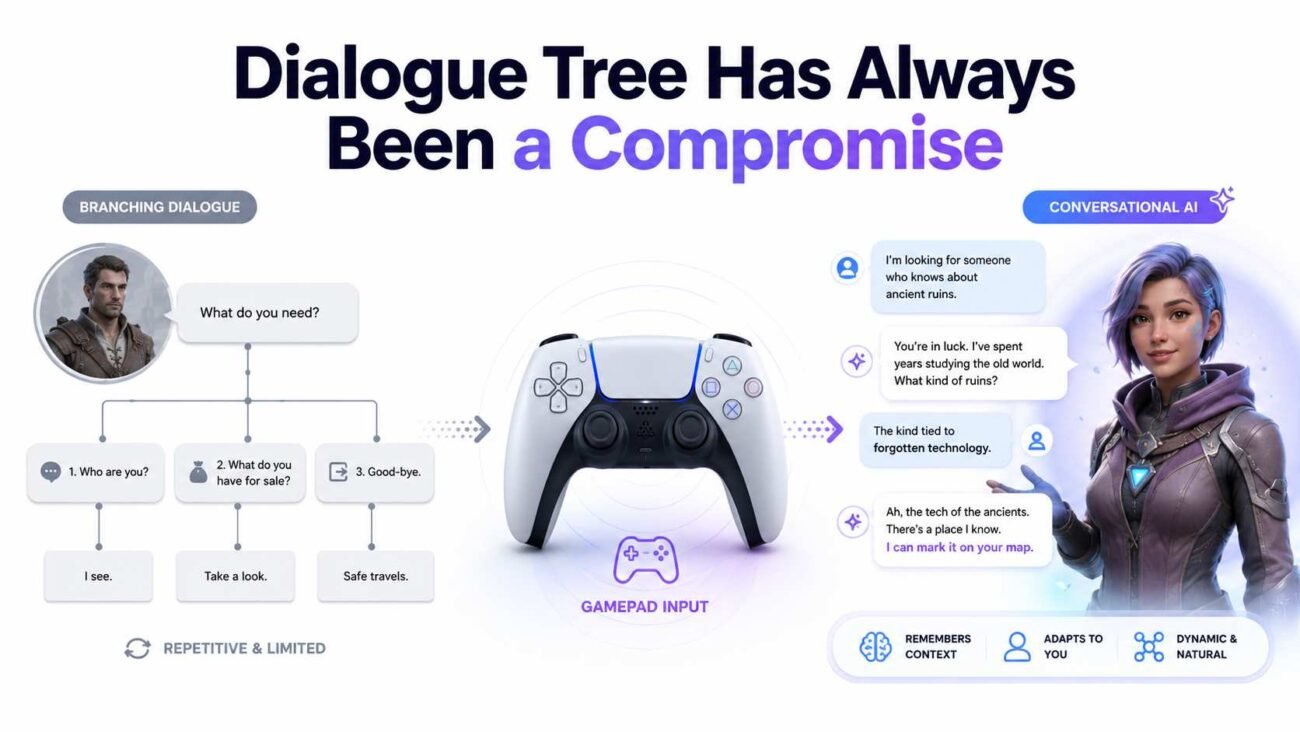
Branching dialogue isn’t bad design. It’s a reasonable answer to a hard constraint: writers and voice actors can only record so many lines, and every single line needs QA, localization, and lip-sync. So studios pick the four or five most useful responses, write barks for the rest, and hope players don’t notice the seams.
Most of us do notice, eventually. You ask an NPC about the thing that just happened in the main quest, and they greet you like it’s day one. You try to have a conversation, and the interaction reminds you, gently but firmly, that you’re selecting from a menu, not talking to a person.
Conversational AI attacks that constraint differently. Instead of authoring every possible line in advance, the character runs on a language model with a defined personality, some memory of what’s happened in the game so far, and a text-to-speech voice layered on top. You talk or type, and it generates a response that fits the character and the moment, and a voice engine speaks it back without anyone having walked into a recording booth to say that specific sentence.
The result isn’t always perfect. But it’s meaningfully different from what we’ve had, and it puts more weight than ever on the thing standing between your intent and the game’s reaction: your gamepad.
What’s Actually Different When You Play It, and What Breaks the Illusion
The thing that strikes you when you first play with a conversational AI character isn’t how smart it is. It’s how unpredictable it is, in a good way.
Ask a traditional NPC a weird question, and you get silence, or a generic “I don’t understand.” Ask a conversational AI character something off-script, needling them about a side quest, asking how they feel about a choice you made three hours ago, and you sometimes get something genuinely surprising. Not always good. Sometimes the character says something a little too generic, or breaks tone in a way a human writer never would. But often enough, it lands, and when it lands, it creates a different kind of immersion than graphics or set pieces give you.
Here’s where the controller comes back into the picture. These systems are built around responsiveness, low-latency voice generation timed so a character answers mid-conversation without an awkward beat. That whole effect can be undone in half a second by a stick that drifts during a dialogue wheel selection, a trigger that double-registers, or a button press that doesn’t land the first time. The game can do everything right on its end, and the moment still feels broken, because the input layer introduced the lag instead of the AI. If you’ve ever blamed a “buggy” conversation system for something that turned out to be a worn analog stick, you’re not alone, and it’s worth ruling out before you assume the tech is the problem. A quick pass through a stick drift test or a button responsiveness check takes less time than it does to notice something feels off mid-session.
Games Already Doing This, and What Players Are Noticing
This isn’t hypothetical anymore. A few concrete examples show what’s actually changed for players:
In-world AI-powered NPCs have been integrated into prototypes by studios including Ubisoft and smaller indie teams, with characters that maintain personality consistency across long play sessions. Players in early tests reported that even minor NPCs felt more worth talking to, not because they said anything profound, but because they responded to context instead of ignoring it.
Skyrim modding communities have been among the first consumer-facing experiments, with mods using AI voice generation to give NPCs dynamic responses. The reception has been genuinely mixed in interesting ways: players love the responsiveness, but notice immediately when a character contradicts established lore. That tells you a lot about what players actually want: responsiveness with consistency, not one at the expense of the other.
VR social games and companion apps have pushed this furthest because, in VR, the illusion of presence is the entire product. When an NPC can actually answer your question in real time instead of breaking the fourth wall with a menu, it changes how the space feels, and in VR, especially, controller and tracking responsiveness make or break that feeling just as much as the dialogue does.
The common thread across all of these: players aren’t wowed by the technology itself. They’re wowed by what it enables, the feeling of a world that responds to them rather than one that displays at them. And that feeling depends on every link in the chain holding up, including the one in your hands.
Voice Layer Is Doing More Work Than People Realize
Text-based AI interaction in games isn’t new. Companion apps and chatbot-style games have used it for years. What’s changed is the voice layer getting good enough that it doesn’t shatter the immersion the moment a character opens their mouth.
Robotic text-to-speech used to be an instant giveaway. Flat intonation, weird pauses, the wrong emphasis on the wrong syllable, all the little tells that remind you you’re hearing a machine read a string of text, which is exactly the wrong feeling when you’re trying to believe in a tavern keeper or a war-weary soldier.
Voice platforms built specifically for real-time conversational use, like Murf’s conversational AI for gaming, focus on closing precisely that gap: natural-sounding speech with low enough latency that an NPC can respond mid-conversation without leaving an awkward beat where the illusion cracks.
That latency number matters more than people expect, and it cuts both ways. A two-second delay before a character answers doesn’t feel like “the character is thinking.” It feels like “the game is loading,” and that’s a completely different experience. But a perfectly timed voice response delivered through a controller with even mild input lag or stick drift produces the same broken feeling from the opposite direction. Getting response time under a second on the AI side only pays off if your input side is just as tight, which is why a lot of players who play long narrative sessions run a quick connection stability test before settling in, the same way you’d check your headset volume before a cutscene.
Where This Gets Genuinely Useful Beyond the Flagship Companions
The flashy use case is always going to be the major companion character, the NPC you’re meant to bond with over forty hours. But the more interesting near-term wins are smaller and more practical.
Background characters with a pulse. Not every NPC needs to be a deep companion. But a town full of people who can answer one or two contextual questions about the quest you just picked up, about something you did yesterday in the game, makes a world feel inhabited instead of decorated. That’s hard to overstate as a quality-of-life improvement in open-world games.
In-game help that doesn’t pull you out of the fiction. Stuck on a puzzle? Confused about how a mechanic works? A guide character that can actually answer follow-up questions is a much smoother experience than alt-tabbing to a wiki mid-session. And it keeps you inside the fiction instead of snapping you out of it, provided your gamepad’s mapping is actually behaving the way you expect when you go to act on the answer.
Replayability without doubling the writing budget. Studios can’t record ten different versions of every conversation. But a system that generates contextually appropriate dialogue means two playthroughs can genuinely sound different without anyone writing ten separate scripts. For games that lean on replayability, roguelikes, open-world RPGs, narrative games with branching paths, that’s a meaningful shift in what’s possible.
Accessibility and onboarding. New players who don’t know the systems can ask an NPC directly. Experienced players who want to skip tutorial sections can do that too. A conversational character that adapts to what you actually need is better at both ends of the experience curve than a scripted helper who says the same thing regardless of context, and a controller that’s been properly calibrated and mapped removes one more barrier for newer players trying to keep up with a more dynamic conversation system.
Honest Downsides
I don’t want to oversell this, because the rough edges are real.
Consistency is hard. A model that’s flexible enough to surprise you is also flexible enough to contradict itself. Characters can break their established backstory, drop out of their established tone, or say something that directly conflicts with the game’s lore. Studios are addressing this with personality guardrails, memory systems, and tighter scope controls over what topics a character can engage with, but it’s an active, unsolved problem, not a footnote.
There’s a cost and tooling gap. Language model calls, real-time voice generation, and low-latency processing aren’t free, and not every studio has the infrastructure to run this across an entire 100-hour RPG. Right now, this tech shows up in flagship companions, well-funded tech demos, and games where conversation is the actual core loop. Treating it as a blanket replacement for every NPC in a large open world isn’t viable yet for most development budgets.
Nobody’s fully answered the design question. How much should a character actually be able to say? Total creative freedom sounds appealing until a player asks something that breaks the fiction completely, or a character improvises lore that directly contradicts the rest of the game. The studios getting this right are the ones treating the AI as a writer’s tool with intentional limits, not as an open mic anyone can walk up to.
Voice acting isn’t going away. For major characters in narrative-driven games, a great human performance still beats a generated one. The emotional specificity of a well-directed voice actor in a pivotal scene is something generative TTS can approximate but not yet reliably match. The interesting design territory is using conversational AI where human-recorded dialogue can’t realistically go, ambient conversation, infinite context-sensitive responses, background world-building, not as a replacement for the craft of voice performance itself.
Why Your Gamepad Is Part of This Conversation Too
It’s easy to think of input hardware as a separate topic from AI dialogue systems, but they’re solving the same problem from opposite ends. Conversational AI is trying to make the world react to you believably. Your controller is the only thing that lets you act on that reaction. A dialogue wheel that mis-registers your selection, a stick that drifts while you’re trying to navigate a conversation menu, or a trigger that sticks at the wrong moment all puncture the same illusion the AI is working hard to build.
Before you write off a game’s NPC system as inconsistent or laggy, it’s worth a five-minute detour to rule out the other half of the equation. Running a full free online gamepad test covers stick drift, button response, trigger sensitivity, and connection stability in one pass, right in your browser, with no download required. For anyone spending long sessions in narrative-heavy or VR titles where these AI systems are showing up first, it’s a habit worth building alongside the usual graphics and audio settings checklist.
What This Means for the Games You’re Actually Playing
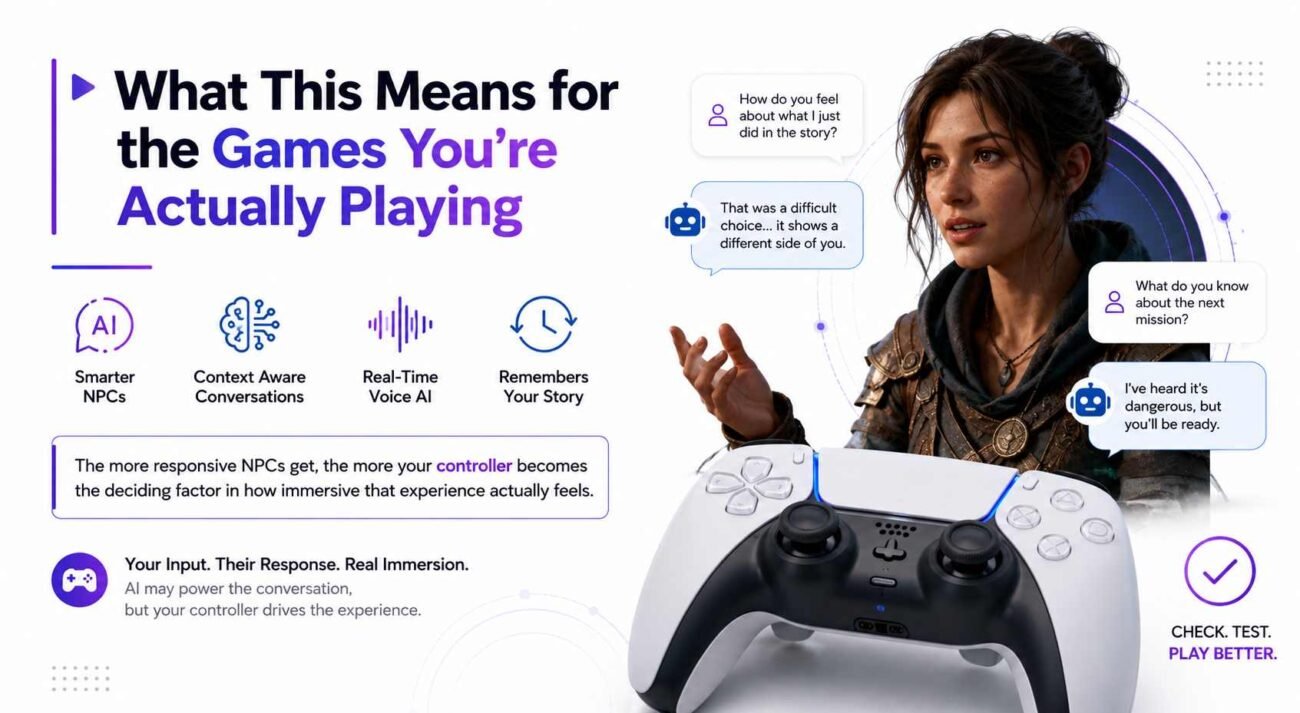
If you play a lot of RPGs or open-world games, you’ve probably already felt the gap this technology is trying to close, even if you never named it. It’s the moment you walked up to a guard after a massive story beat, and he said the same thing he said before any of it happened. It’s the companion who cheerfully talks about the mission you just failed. It’s the side character who had one interesting thing to say and nothing after that.
Conversational AI for gaming doesn’t fix all of that immediately. But it fixes the root cause, the hard limit on authored content, in a way that scripted branching dialogue never can. The more that limit gets pushed back, the more games can feel like worlds that track what you’ve done rather than worlds that display at you until the credits roll. And the more responsive these systems get, the more your own input device becomes the deciding factor in whether you actually feel that responsiveness or lose it to a controller that’s quietly underperforming.
The next couple of years will probably see a lot of sorting out: some games using this well for a few key characters, some using it badly everywhere, and slow industry consensus forming around where voice-driven AI conversation actually makes a game better versus where it’s just a novelty that wears off.
But the direction is right. NPCs that talk back, even imperfectly, even occasionally weirdly, beat NPCs that were never really listening in the first place. And after thirty years of pressing a button to select from four options, that’s not a small thing, as long as the button you’re pressing is registering the way it should.
Have you tried any games with AI-powered NPCs yet? Drop your experience in the comments, and if something felt off mid-conversation, it might be worth a quick controller check before you blame the AI.