

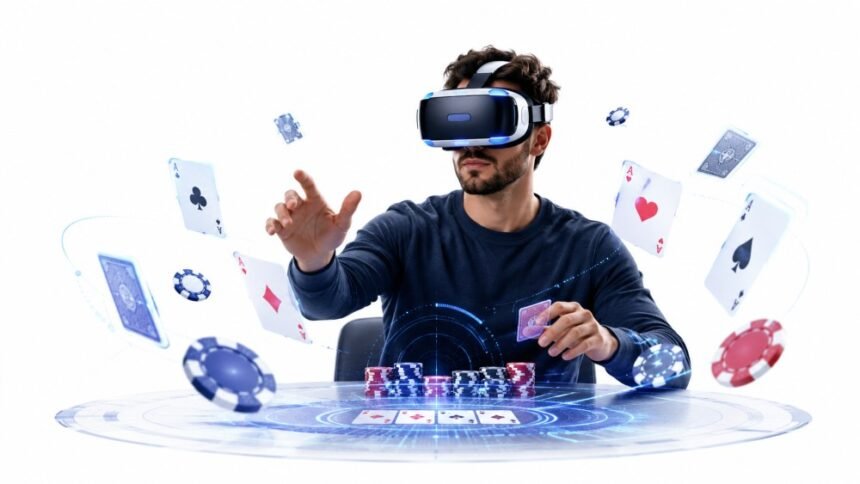
Every couple of years, the prediction comes back around: the flat table in a browser window is finished, and the next wave of players will sit down inside a headset. The 2025 hardware numbers went the other way, and not by a little. That doesn’t settle anything on its own, but it does change the shape of the question worth asking. The useful version isn’t whether poker moves into virtual reality. It’s narrower: which parts of the game are information problems a headset actually solves, which parts it only appears to solve, and whether enough people own the hardware for the answer to matter to anyone building a card room.
A Screen Removes A Body, Not A Game
The arithmetic survives the move online intact. Pot odds are pot odds whether they’re worked out on felt or in a browser tab. What disappears is everything a screen can’t carry: posture, breathing, the tempo of a chip stack being handled, where an opponent’s eyes go after the flop lands, how long a hand hovers before it commits. Two formats, same rules, different skill sets, and two study cultures that barely overlap.
Poker folklore puts the money in the face. The evidence points at the arms. In a study built on clips from the World Series of Poker, viewers shown nothing but players pushing chips forward made judgments that tracked real hand strength. Viewers shown only faces performed worse than chance, which is its own compliment to the professionals involved. Smooth, unhurried motion read as confidence. Stiff motion read as a bluff, and often was one.
That reframes the whole VR question. The channel carrying the most decodable signal at a live table isn’t the face, which a headset buries under plastic anyway. It’s the hands and forearms, the exact thing the hardware was built to watch.
Hand Tracking Is The Part That Gets Closest
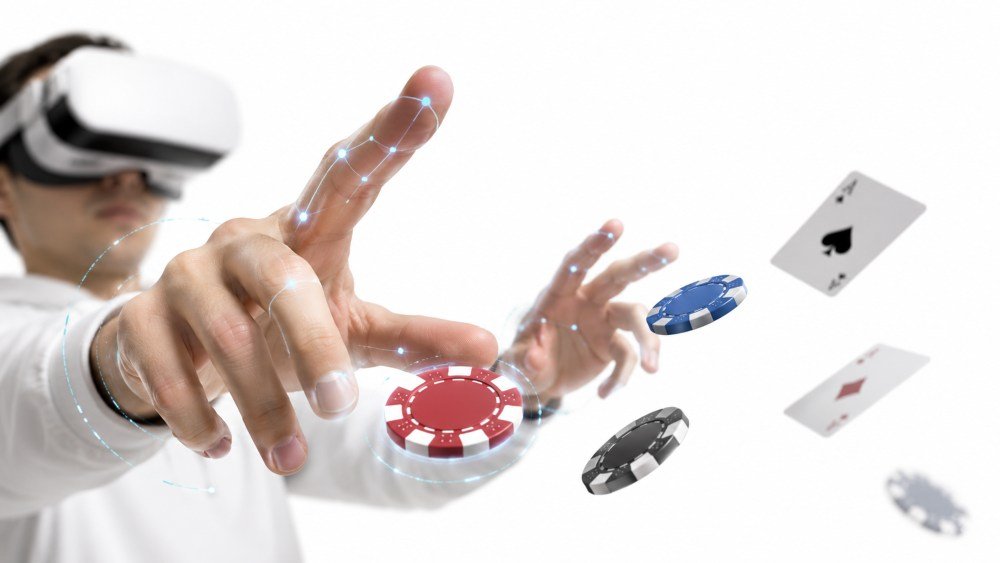
Cutting chips beats dragging a bet slider, and not only for atmosphere. It restores the physical grammar of a decision: the pause, the reach, the commitment. For a player raised on a home game, a headset table is closer to the thing they already know than any two-dimensional lobby has ever been.
The fidelity is the catch. Meta’s own developer documentation on hand tracking is candid about the limits: confidence drops when one hand occludes the other, tracking carries noise, and performance depends on lighting conditions in the player’s actual room. Pinch gestures work reliably as a click. The signal that mattered in that WSOP research was never the click. It was the quality of the motion around it, which is the first thing a reconstruction pipeline smooths away. What arrives at the virtual table is not an opponent’s hand. It’s an estimate of one, with a confidence value attached.
Room Is The Product
Online poker games on a phone reduce an opponent to a username, a seat avatar and a countdown clock. Nothing is hidden that isn’t hidden by design, and the format is enormously successful precisely because it strips the experience down to decisions per hour.
A headset proposes the opposite trade. Research on shared virtual spaces has been consistent for years about what drives the sense of being with someone: behavioural realism outweighs visual polish. Avatars that hold mutual gaze, nod, or otherwise signal awareness of the other person produce a stronger sense of social presence than avatars that merely look expensive. That is the machinery of table talk, of the needle, of the beat before someone calls.
Operators should care about this more than they care about immersion as an aesthetic. A card room is a social product with a betting engine bolted to it, and the social half is what turns a forty-minute session into a four-hour one. A chat box cannot manufacture it. Voice, timing and gesture arriving together can.
Signal That Matters Most Survives The Worst
Eyes are where a headset should win and where it currently doesn’t. A broad review of eye tracking in virtual reality is blunt about the state of consumer hardware: the integrated trackers tend to have high latency, lack precision, and offer no simple calibration routine. Sampling in embedded systems commonly sits between 60 and 200 Hz, with end-to-end delays measured in the tens of milliseconds, reported in the 45 to 81 ms range once the whole pipeline is counted. A tell lasting a quarter of a second reaches the other side of that pipeline in outline only.
Precision is the more damaging half. Without reliable calibration, the same glance can be reported differently across two sessions on the same headset by the same player. A read you can’t reproduce isn’t a read. It’s noise you’ve decided to trust.
Then there’s the problem underneath the problem. A live tell is involuntary information escaping an opponent who would rather it didn’t. Its virtual counterpart is a rendering decision, and rendering decisions belong to the platform. How much gaze gets relayed, how much micro-motion survives smoothing, whether any of it is exposed at all: all of that becomes a setting. Whoever writes the avatar pipeline decides how readable the game is, and could in principle price that legibility, or tune it toward whichever player type keeps the tables full. Information asymmetry at a live table is an accident of biology—in a headset it’s product design, and eventually a regulatory question.
Sessions Are Long. Headsets Aren’t.
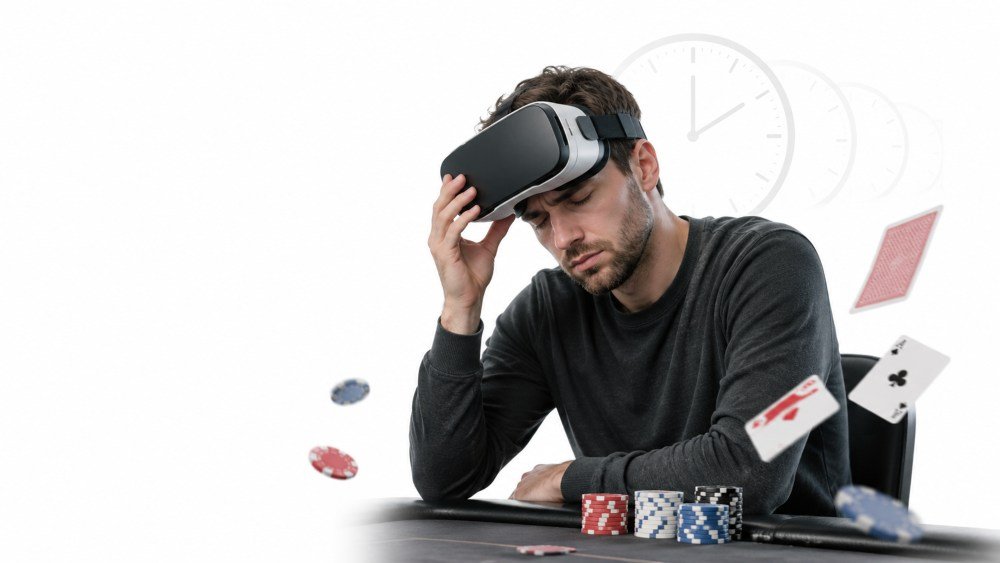
Cybersickness has proven remarkably durable across hardware generations, still affecting an estimated 40 to 70 percent of users despite a decade of improvement in displays and refresh rates. Reporting on VR’s persistent motion sickness problem lands on the same conclusion from the other direction: better hardware has reduced the symptom without removing it, fit and interpupillary distance matter enormously, and poor fit is a large part of why women report higher rates than men. The conflict is in the premise. The eyes are told the body is somewhere the inner ear knows it isn’t.
Poker is played in long sittings, which makes this more than a comfort footnote. Worse, the format collides head-on with the players who generate the most volume. A regular running six tables is doing something a headset cannot express at all, because the whole proposition is one room, one seat, one point of view. The users with the most hours to give are the ones this technology serves worst. That is an awkward place for any product to begin.
What The Money Is Telling Operators
Distribution decides this more than design does, and the distribution picture is not subtle.
Meta’s Reality Labs division remains the category’s underwriter, and the bill keeps growing. In its fourth quarter and full year 2025 results, Meta reported an operating loss of roughly $19.19 billion for the unit against about $2.2 billion in revenue, up from a $17.73 billion loss the year before. The company cut around 10 percent of Reality Labs staff shortly beforehand, and management has been explicit that future investment is weighted toward glasses and wearables rather than headsets.
The shipment data says the same thing in a different accent. IDC’s tracker had mixed and virtual reality headset shipments falling 42.8 percent in 2025 while the rest of the XR market grew triple digits on the back of AI-enabled glasses. Counterpoint recorded VR headset shipments down 14 percent year over year in the first half of 2025, with Meta holding roughly 80 percent of a shrinking category. Apple’s position illustrates the downside risk: after shipping around 390,000 Vision Pro units in its 2024 launch year, production at its manufacturing partner was halted, IDC estimated shipments of about 45,000 units in the 2025 holiday quarter, and Financial Times reporting put the cut to the product’s digital advertising spend above 95 percent.
A category where one vendor holds four-fifths of a declining market is a poor foundation for a development budget. Card rooms have a fixed amount of engineering to spend, and browser and mobile clients are still where the hands are dealt.
Immersion Is Not A Neutral Feature In A Gambling Product
There’s a consideration operators can’t file under user experience. Immersion changes behaviour, and the research on gambling in virtual environments has been flagging this for a while: embodied VR settings amplify the psychological hooks that desktop versions blunt, including sensitivity to near-misses and heightened physiological arousal during play. Poker is a skill game and sits differently from a slot machine, but the design lesson carries. Anything that makes a session feel more like a real card room also makes the guardrails harder to deliver. A deposit prompt in a browser is a dialog box. In a headset, it’s a wall that appears in front of your face. Any operator serious about this format has to build responsible-play tooling for it, not port the existing tooling across. Regulators will ask, and they should.
What Actually Ships
Nothing here rules out a headset client. It rules out a headset flagship. The realistic version for the next three years is a side product: built alongside desktop and mobile, aimed at recreational players and short sessions, priced and marketed as a novelty, while the volume stays in the browser. Latency, comfort and installed base then become questions of timing rather than viability.
Which leaves the more interesting possibility. If the hardware that eventually wins is a pair of glasses with a display rather than an enclosed headset, the table in front of a player doesn’t need to be virtual at all. It only needs to be somewhere other than a phone.
Disclaimer: This article is for informational and educational purposes only. It does not encourage gambling or provide financial or betting advice. Online poker and other gambling activities involve financial risk and may be restricted by age or law depending on your location. If you choose to play, use licensed platforms, understand the rules and risks, set clear spending limits, and never gamble with money you cannot afford to lose.