

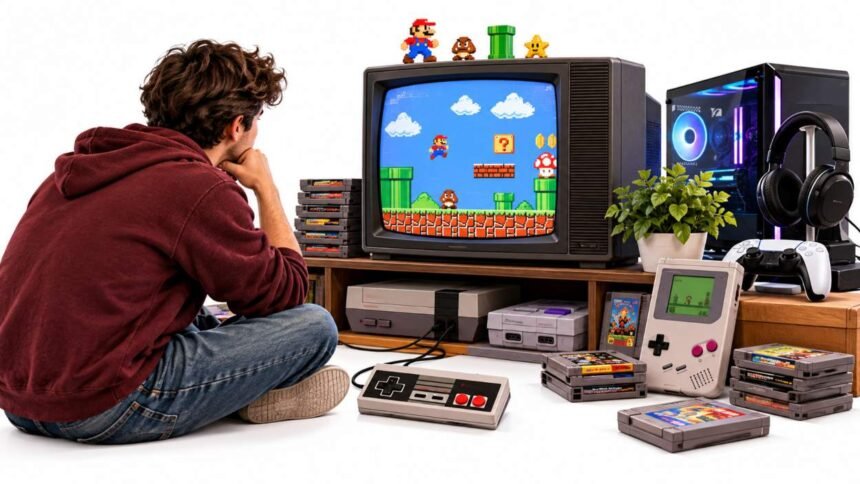
For most of gaming’s history, progress only ran in one direction. Every new console promised sharper textures, smoother faces and lighting closer to a film set, and the unspoken assumption was that this was what everybody wanted. Photorealism was the finish line.
Then something odd happened on the way there. Some of the most talked-about games of the past decade look as though they could have shipped on a cartridge. Whole studios have built their reputations on chunky pixels and chiptune soundtracks, and plenty of people who own the latest hardware spend their evenings with games from the 90s, the 80s and even the 70s.
So what’s going on? A few different forces are pulling in the same direction.
Nostalgia Factor Driving Retro Gaming’s Popularity
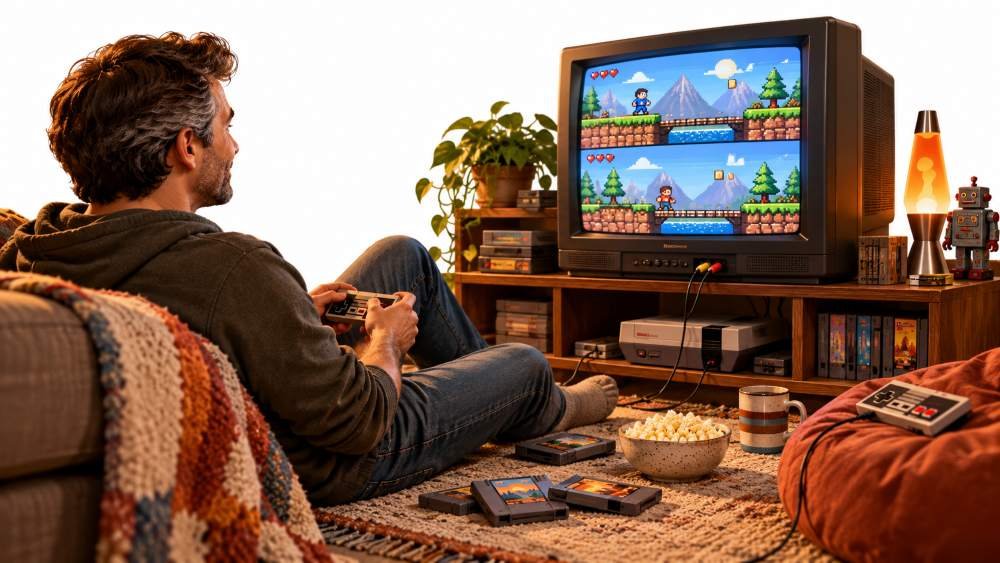
Nostalgia tends to arrive quietly, somewhere in your thirties, and then it never really leaves. You notice it in the playlists you build, the films you rewatch and the way modern digital entertainment now sits happily alongside synthwave, a genre invented to sound like a decade many of its fans barely remember.
Games trigger the feeling more sharply than almost anything else, because you didn’t just watch them. You were there, controller in hand. Ask anyone in their forties about the gun-barrel opening of GoldenEye 007, and you’ll usually get a story about a particular sofa, a particular sibling and a long-running argument over who was allowed to play as Oddjob. The game sold more than eight million copies, and in 2025 it was inducted into the World Video Game Hall of Fame, largely on the strength of its four-player split-screen mode.
That social detail matters. Psychologists at the University of Southampton have found that nostalgia strengthens our sense of continuity between past and present, and that it does so by making us feel more connected to other people. Booting up an old game is rarely about the game alone. It’s a way of briefly sitting back down beside the people you first played it with.
Why Classic Gameplay Still Appeals To Modern Audiences
It’s worth being honest about survivorship bias. We remember Super Mario Bros. 3 and Street Fighter II. We don’t remember the hundreds of muddy licensed platformers that filled the bargain bins beside them. The past looks better than it was because only the good parts are still on display.
That’s true in a literal sense, too. A 2023 study by the Video Game History Foundation found that 87 per cent of classic games released in the United States are out of print. What reaches us today is a thin slice of what was made, and what gets reissued tends to be what was loved.
Even so, the best of those games offer something hard to find now. Tight hardware limits forced designers to be economical: two buttons, one screen and a set of rules you could grasp in ten seconds and spend years mastering. There was no forty-minute tutorial and no skill tree to manage. When a modern blockbuster asks you to memorise a dozen button combinations before the fun starts, half an hour of Tetris can feel like opening a window.
How Modern Technology Has Revived Older Games
The revival wouldn’t have got far if playing these games still meant hunting down a working console and a television old enough to suit it. Emulation changed that. A Raspberry Pi the size of a pack of cards can stand in for a dozen classic systems, while enthusiast devices built around FPGA chips recreate the original circuitry closely enough to satisfy purists. Add a CRT filter, and you even get the soft scanlines that pixel art was drawn for.
Nintendo and Sega have both released official miniature consoles that do a similar job with no setup at all. The results are often better than the real thing, with save states, sharper output and no blowing dust out of a cartridge. One caution: emulators are generally legal, but the games remain under copyright, so stick to titles you own and licensed collections.
Nor do you need any hardware. The Internet Archive’s Internet Arcade lets you play hundreds of coin-op games from the 1970s to the 1990s in a browser tab, free of charge.
The word “arcade” has stretched as well. There’s now a greater diversity of online arcade games than the coin-op era ever imagined, and not all of it is retro. Some sites borrow the bright, quick-fire feel of the arcade for real-money slots and instant-win titles. Those are gambling products for adults aged 18 and over, a very different proposition from an emulated round of Galaga, and best approached with a firm budget.
Influence Of Retro Games On Today’s Industry
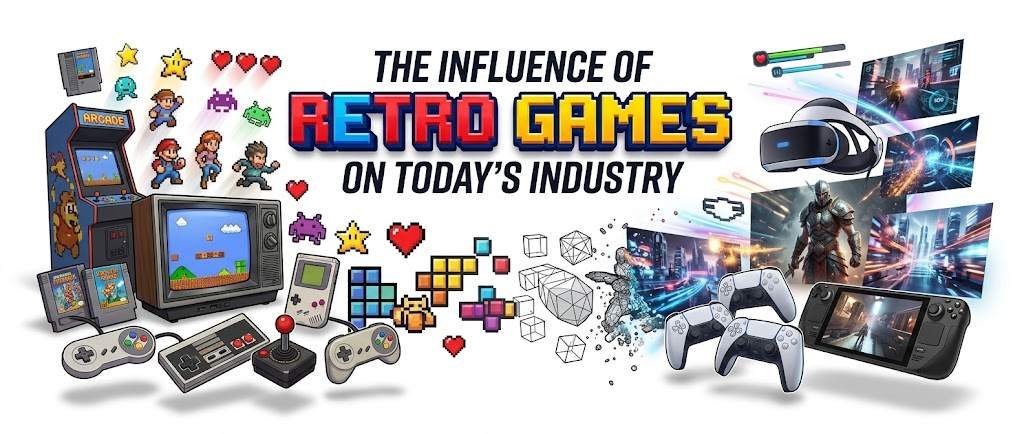
The pixel-art movement is the most visible legacy. Games such as Stardew Valley, Celeste and Shovel Knight have shown that a deliberately old look can carry thoroughly modern design. You can also capture a game screenshot to share its visual style. But the influence runs deeper than a visual style.
A generation of independent developers learned their craft by taking beloved games apart. Some build spiritual successors to series their owners left behind. Others go straight to the source, fixing old flaws and bolting on features the original hardware could never have handled.
Just look at the recent fan-made version of the Mega Drive classic, Altered Beast. Sega’s brawler began life in arcades in 1988 before becoming the game bundled with the Mega Drive in the West. A single fan has now rebuilt it with redrawn visuals, a new soundtrack, extra beast transformations and a boss-rush mode, then released it free for PC, mobile and browsers.
Projects like this sit in a legal grey area, and publishers don’t always look kindly on them. They also show something the industry has slowly come to accept: the audience for old games isn’t passive. It wants to tinker, improve and pass things on.
What The Revival Really Tells Us
Retro gaming isn’t a rejection of progress. Most people replaying Sonic on a handheld also own something capable of ray-traced reflections. It’s closer to what happened with vinyl: once a medium has enough history behind it, the past stops being a museum piece and becomes part of the living catalogue. Photorealism was never the finish line. It was only ever one of the roads.
Disclaimer
This article is for general information and entertainment only. It includes a link to a real-money gaming site intended for adults aged 18 and over. Gambling involves financial risk, so only play with money you can afford to lose. Free, confidential support is available in the UK from GambleAware and GamCare. Laws on emulation and fan-made projects vary by country, so check the rules where you live.
References
- Sedikides, C., Wildschut, T., Cheung, W.-Y., Routledge, C., Hepper, E. G., Arndt, J., Vail, K., Zhou, X., Brackstone, K. and Vingerhoets, A. J. J. M. (2016). Nostalgia fosters self-continuity: Uncovering the mechanism (social connectedness) and consequence (eudaimonic well-being). Emotion, 16(4), 524-539. doi:10.1037/emo0000136
- Salvador, P. (2023). Survey of the Video Game Reissue Market in the United States. Video Game History Foundation and Software Preservation Network. doi:10.5281/zenodo.8161056
- The Strong National Museum of Play (2025). GoldenEye 007. World Video Game Hall of Fame, inducted 2025.
- Internet Archive (2014). The Internet Arcade. Browser-playable collection of coin-operated arcade games, 1970s to 1990s.
- Time Extension (April 2025). Sega’s Altered Beast Gets A Free Fan-Made Remake.