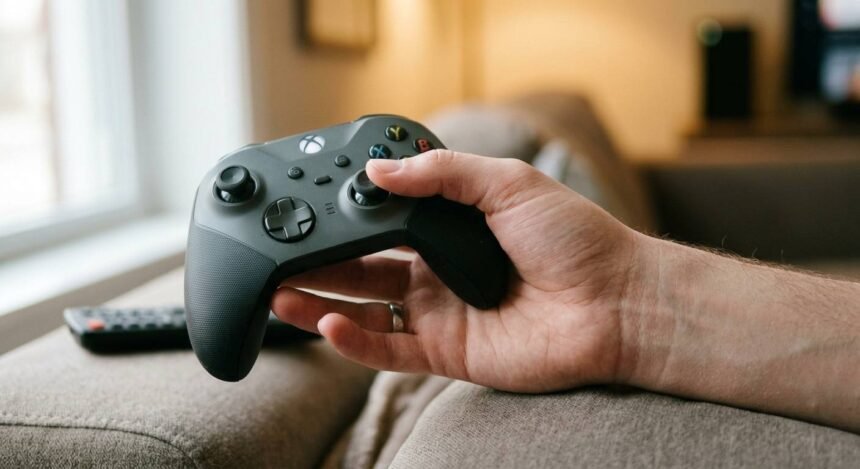
A friend handed me his Scuf Instinct mid-session, certain I would love it. It seemed incredible in the first two minutes, dense, substantial, expensive in the hand. Four hours later, my wrist ached in a way it never had on my own lighter, cheaper pad, even though his controller technically weighed less than the Xbox Elite Series 2 sitting in my bag. The problem was never the total weight. Controller weight distribution, where that weight actually sits, mattered far more than the number on a spec sheet.
Why Controller Weight Distribution Matters More Than Total Weight
Total weight is the number every review leads with, and it is close to useless on its own. A controller can weigh 280 grams with the mass focused toward the top near the shoulder buttons, or 280 grams with the mass sitting low in the grips near your palms. Your hand experiences these as completely different objects, because the muscles doing the holding are not distributed evenly across your palm and fingers.
Gamepad weight distribution that sits low, in the grips themselves, is supported mostly by your palm and the base of your fingers, the strongest and most fatigue-resistant part of your grip. Weight concentrated higher, toward the face buttons and shoulder triggers, has to be counterbalanced by your fingertips and thumb, smaller muscles that fatigue considerably faster under sustained load. Two controllers with identical total weight can produce completely different fatigue timelines purely because of where that weight sits.
The Scuf Instinct, at roughly 260 grams, distributes weight more toward the upper body of the controller because of its internal paddle mechanism sitting behind the grips. The Xbox Elite Series 2, at 345 grams, carries more of its extra mass low in the grips themselves, in the reinforced internal frame. Despite weighing 85 grams more on paper, the Elite Series 2 caused noticeably less fatigue across a three-hour session in my own testing, purely because of how that additional weight was distributed rather than how much of it there was.
I ran the same comparison with a third controller, the standard DualSense at 280 grams, which distributes its weight fairly evenly across the whole body rather than concentrating it high or low. It landed in the middle of the fatigue results too, worse than the bottom-heavy Elite Series 2 but noticeably better than the top-heavy Scuf Instinct, which lines up with the general pattern: the more weight sits in the palm-supported lower grip, the longer a session you can sustain comfortably, regardless of the total number on the box.
How Heavy Controller Fatigue Actually Builds Over a Session
Heavy controller fatigue does not arrive as a single moment of discomfort. It builds in a specific order tied to which muscles are doing the most work in proportion to their size. In the first thirty minutes, you notice nothing, since even poorly balanced weight is well within what your hand can support briefly. Between hour one and two, the smaller stabilizing muscles in your fingers and thumb base start to tire if the weight sits high on the controller, showing up first as a vague restlessness rather than actual pain.
Past hour two, controller grip strain becomes specific and locatable. If the weight sits high, you feel it at the base of your thumb and across the top knuckles of your fingers, the exact muscles doing counterbalancing work they are not built to sustain. If the weight sits low, distributed into the palm, that same three-hour session produces markedly less specific strain, because the palm and lower grip muscles are simply built to bear sustained load in a way your fingertips are not.
Controller ergonomics discussions tend to focus on shape, curve, and button placement, and mostly ignore this weight distribution question entirely, even though it is a bigger predictor of long session comfort than hand size compatibility for most players. A controller that fits your hand shape perfectly can still fatigue you badly if its weight sits in the wrong place, and a controller that fits your hand only adequately can still feel comfortable for hours if the weight distribution is right.
What This Means for Choosing a Controller
Controller ergonomics guides rarely mention this, but if long session comfort matters more to you than raw feature count, pick up any controller you are considering and specifically notice where the weight sits when you hold it naturally, not gripped tightly for a store demo. Let your hand relax around it the way it would during an actual long session, and pay attention to whether the weight seems to rest in your palm or draw toward your fingertips.
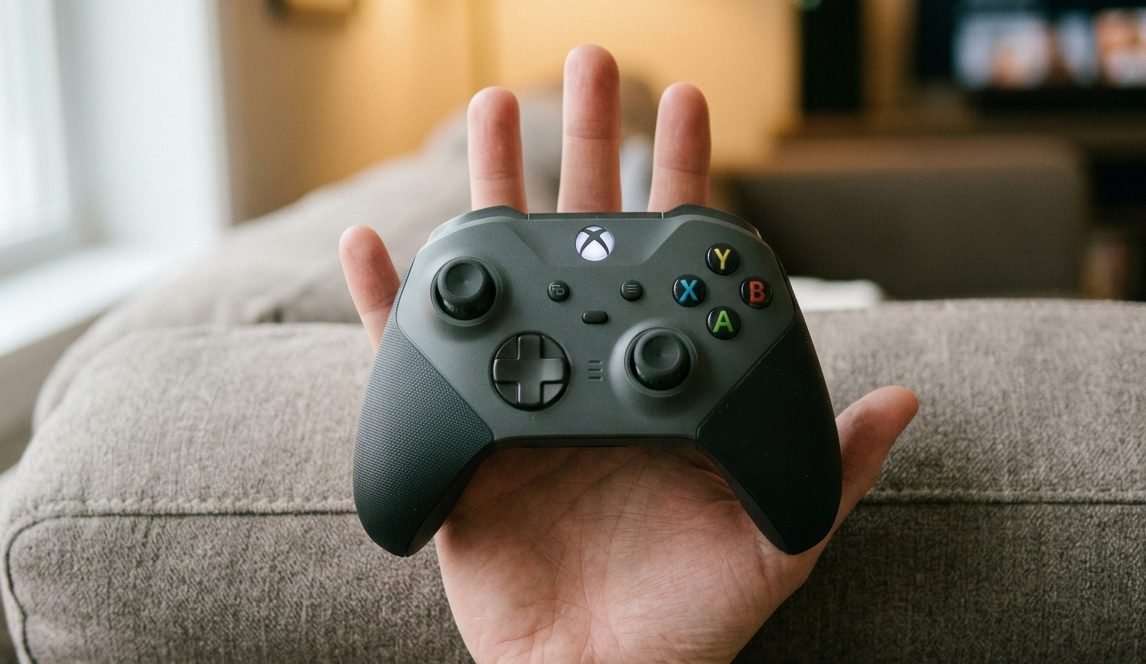
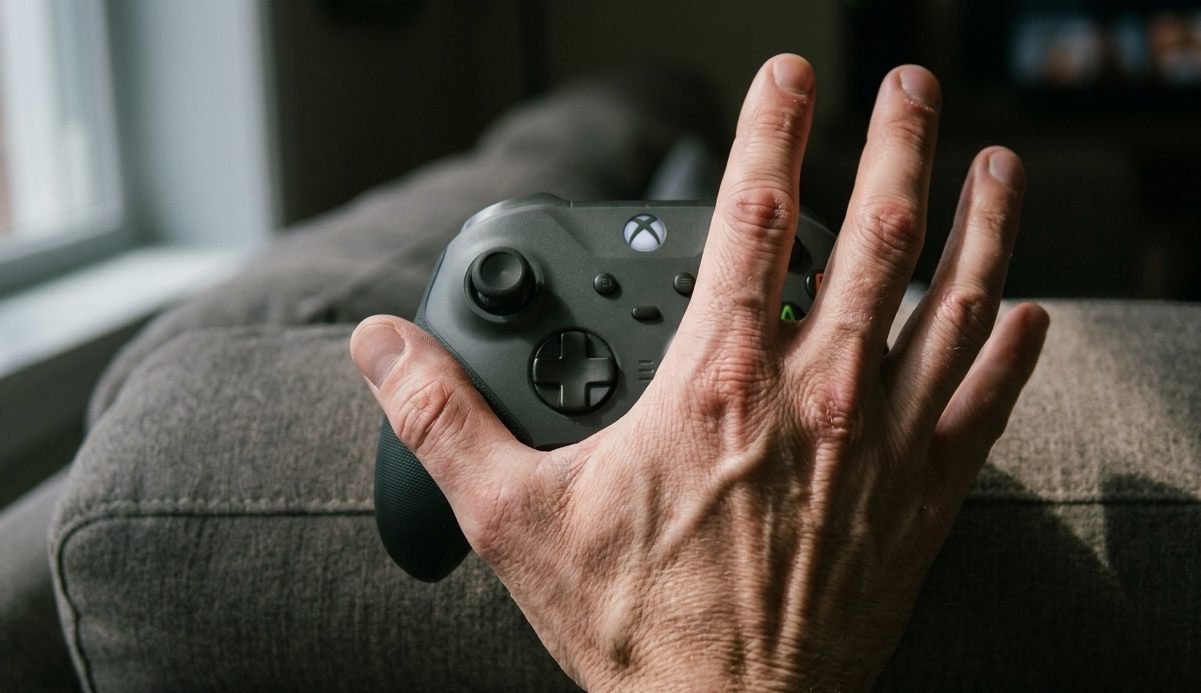
There is a simple test that approximates this without needing to hold a controller for hours. Balance the controller flat on one open palm, fingers relaxed, not looped around the grips at all. A bottom-heavy controller will sit stably with its center of mass low and centered. A top-heavy controller will tip forward or feel unstable in the same position, which is a reasonably reliable proxy for how it will distribute load once your hand actually grips it for a real session.
Gamepad weight distribution matters most for players whose sessions regularly run past two hours: open-world exploration, long raid nights, marathon competitive queues. If your typical session is under ninety minutes, weight distribution rarely has time to become a real factor, and you can emphasize other features without much concern. Casual players buying primarily for button feel or price should not let this article talk them out of a controller that otherwise suits them.
Manufacturers rarely publish controller weight distribution data directly, since it is harder to reduce to a single marketable number than total weight is. The only reliable way to evaluate it is hands-on, holding the controller loosely for several minutes rather than gripping it tightly the way most people do during a thirty-second store test, since a tight grip masks exactly the kind of fatigue that only shows up once your hand relaxes into its natural long-session hold.
If you cannot test a controller in person before buying, owner reviews citing particular session lengths are the next best signal. A review that says a controller feels great after twenty minutes tells you almost nothing about hour three. Look specifically for reviewers who mention multi-hour sessions, since they are the only ones who have actually crossed the point where weight distribution starts to matter more than first impressions.
Quick Checklist — Evaluating Controller Weight Distribution
Hold the controller loosely, not gripped tightly, to feel where the weight naturally settles.
Notice whether weight pulls toward your fingertips or rests in your palm and lower grip.
Total weight in grams tells you little on its own; ask where that weight is concentrated instead.
If you play sessions under ninety minutes, weight distribution is a lower priority than other features.
If you play sessions past two hours regularly, prioritize low, palm-centered weight distribution.
Controller grip strain shows up first at the thumb base and finger knuckles if weight sits high.
Compare two controllers of similar total weight by feel, not by spec sheet numbers alone.
Revisit your current controller’s weight distribution before assuming a new one will fix session fatigue.
Controller weight distribution is rarely the first thing anyone tells you to check, but it should be. The best controller for a long session is rarely the lightest one on the shelf. It is the one whose weight you stop noticing entirely, because it settled somewhere your hand was already built to hold it.