

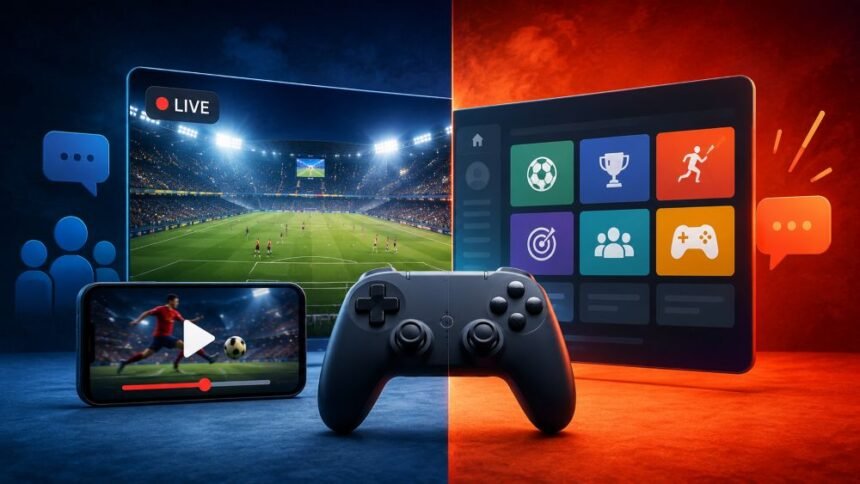
If you already own a controller, the math on sports fandom looks different than it does for someone who only watches. A season pass to your league of choice can cost more across a year than a full game costs once. So the temptation is real. Why pay every month to watch other people play when you can pick up the pad and play yourself.
The honest answer is that a sports game replaces some of the reasons you tune in, but not all of them. It hands you control, repeatable competition, deep familiarity with rosters, and a far clearer read on tactics than any broadcast will teach you. What it cannot manufacture is a real event happening once, at the same moment, for everyone who cares. So the useful question is not whether playing beats watching. It is which part of being a fan you are actually trying to feed.
Fan Who Plays And The Fan Who Watches Are Usually The Same Person
Start with a fact that still surprises people who treat gaming as a niche hobby. The Entertainment Software Association counts more than 200 million Americans playing video games every week, with the average player now in their late thirties. Gaming is not the alternative to sports fandom. For most fans it sits right alongside it.
The overlap shows up in the numbers. Deloitte’s 2026 Digital Media Trends research, based on 3,575 US consumers, found that 75% of people who call themselves sports fans were also gamers, compared with 52% of those who do not follow sports. The same work found that fans rarely stay loyal to a single format. A football, basketball, or racing fan drifts between full matches, quick highlights, group chats, and a few hours on the pad, without ever deciding that any one of those is the real version of supporting a team.
That habit of moving between formats matters, because the viewing world has already fractured. Pew Research Center reports that most Americans now stream while only about a third still pay for cable or satellite. Following a sport is no longer one bill. It is a set of choices, and a game is one of them.
What Each Way Of Following A Sport Gives You
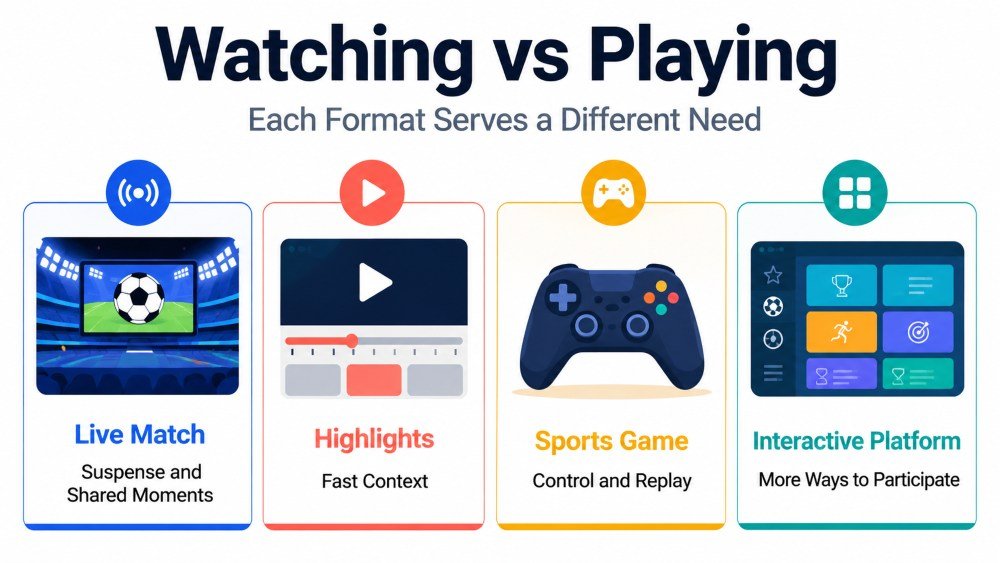
A live broadcast, a highlight reel, and a sports game can all revolve around the same teams. They feel different because each one answers a different craving: uncertainty, control, learning, shared attention, or the freedom to run it back.
Put plainly, a game lets you steer the athletes, repeat a scenario until it clicks, and test what happens when you change the plan. A broadcast keeps the outcome truly unknown and ties you to the same instant as millions of other people. Neither one is trying to do the other’s job, which is why swapping one straight for the other always leaves something missing.
Where Betting And Other Interactive Platforms Fit
There is a third category that references sport without ever showing you the match. A destination such as Lucky Rebel is a broad sportsbook and casino homepage, and it is worth naming as an example of taking part from outside the broadcast rather than a way to watch the fixture itself. It does not reproduce the control of a game or the shared suspense of a live feed. It offers a separate kind of involvement, built around your own read on what might happen next.
For some fans that read is the whole appeal. Following live betting options in real time can sharpen how you watch a match, since the shifting odds act as a running commentary on the game state and a quick test of whether your gut call was right. It can also be a reason to keep a stream running that you might otherwise have dropped. The same instinct feeds back into gaming, since simulating an upcoming fixture with the real teams can give you a feel for how it might unfold before a single wager is placed.
None of that works as a substitute for either playing or watching, and it carries a caveat the other formats do not. Wagering stays entertainment only while it sits inside limits you decide in advance, and the National Council on Problem Gambling is the place to turn if it ever stops feeling that way.
A Five Need Comparison
The cleanest way to choose is to compare formats by what they do, not by price alone.
| Format | Real-time uncertainty | Control | Learning value | Shared context | Replayability |
|---|---|---|---|---|---|
| Full live match | Highest | None | Strong with live commentary | Highest | Low |
| Highlights and recaps | Low | None | Good for key moments | Medium | High |
| Sports video game | Simulated | Highest | Strong for learning rules and rosters | Medium | Highest |
| Interactive sports platform | Separate from live viewing | Choice-based | Limited and format-specific | Varies | High |
No single row wins all five. A fan chasing shared suspense should keep live access for the fixtures that matter. A fan who wants to drill tactics gets far more from a game. Highlights suit the viewer who wants the story with the least time spent. And the interactive row is for anyone who enjoys engaging with a sport from a different angle.
A game is at its strongest when you want agency. It teaches formations, player roles, scoring systems, and the cost of a bad decision, because you have to act on that knowledge rather than watch someone else use it. Repetition does the rest. A defensive setup that wrecked your last attack can be faced again and again, whereas a real match may never hand you that exact situation twice. This is also where hardware quietly decides everything, since a subtle case of analog stick drift or a sluggish input latency reading will sabotage your inputs long before your tactics do. The realism has climbed so far that modern racing sims reproduce real car handling closely enough that professional drivers use them to learn tracks, which tells you how much real skill the format can carry.
Highlights solve a different problem. They keep the big plays and the storylines and strip out the dead air, but that edit also removes the suspense. You already know every clip made the cut for a reason. Full live coverage stays unique precisely because an ordinary moment can turn decisive without warning, and because so many people react to it at once. That shared timing is hard to fake with anything you can pause, restart, or begin whenever it suits you. It is not only a media point either, since research links attending live sport to stronger social connection and lower loneliness, a benefit no solo session on the pad is built to deliver.
When A Live Subscription Still Earns Its Place

Keep live access when the real competition is the entire point. Playoff runs, rivalry weeks, title deciders, and your own team’s season are the moments that justify paying for a stream, because the value is in not knowing and in sharing the result as it lands. Nielsen’s viewing data makes that pull hard to argue with. In a recent month, sport took a share of live television far larger than its share of airtime, the highest the category has ever recorded.
The catch is that the games no longer sit behind one subscription. A single league can be scattered across several services within a season, with record setting audiences now turning up for matches carried on streamers like Netflix and Prime Video. Paying for everything, all year, to catch every game is where the cost stops making sense.
Which is why the choice does not have to be permanent. An AP-NORC survey of 1,182 US adults found that 40% had subscribed to a service for a specific show or sports season, and about a third had cancelled once it ended. Treat access as seasonal. Pay for the stretch that matters, then let the game, the recaps, and the group chat carry your interest through the quiet weeks.
So Can A Game Replace The Subscription?
For the off season, the mid week lull, and the long stretch where you care more about playing than spectating, a sports game does the job, and does it in ways a broadcast never could. For the one playoff night you have waited all year for, it does not come close, and it was never meant to. The smart move is not picking a side. It is running a lean setup: a game and a controller you trust for the everyday, a stream you switch on for the fixtures that are worth it, and whatever interactive extras keep you engaged in between. Before the next big night, it is worth taking two minutes to run your controller through a full benchmark so the only thing left to blame is the other player.
Disclaimer: This article is for general information and entertainment only. It does not provide betting, financial, or legal advice, and it does not guarantee any result. Sports betting involves financial risk and is restricted to adults in locations where it is legally permitted. Never bet money needed for bills, education, food, or other essentials. Set firm spending and time limits, avoid chasing losses, and stop immediately if gambling begins to affect your wellbeing, relationships, studies, or finances. Anyone under the legal gambling age should not use betting platforms.