

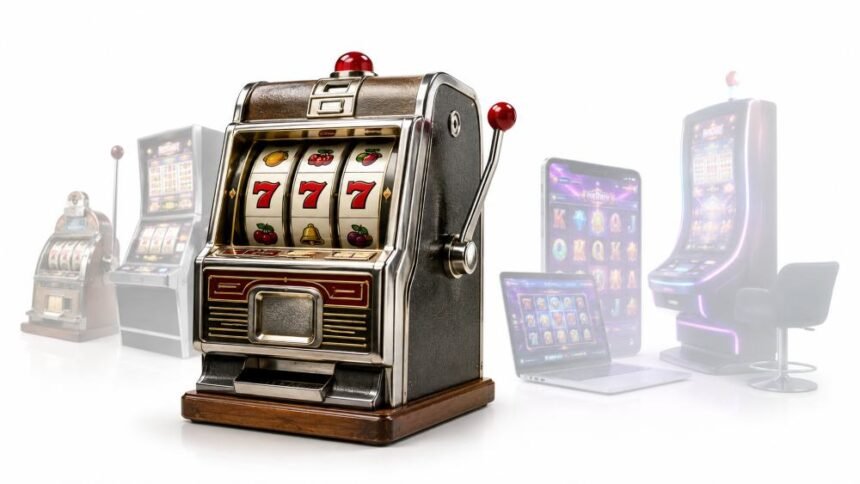
Every few years, the slot category gets rebuilt. Video screens replaced mechanical reels. Paylines multiplied, then dissolved into ways-to-win grids. Themes went cinematic, licensed, and serialized. Bonus rounds grew elaborate enough to need their own tutorials.
Through all of it, a format older than commercial aviation has kept its place on the lobby page: three reels, a short symbol list, one line across the middle.
The usual explanation is nostalgia, which is true but lazy. Sentiment alone does not keep a product category alive for one hundred and twenty-five years. The three-reel slot survives because its structure does something the newer formats cannot do without redesigning themselves out of existence.
Format Came From A Mechanical Limit, Not A Design Brief
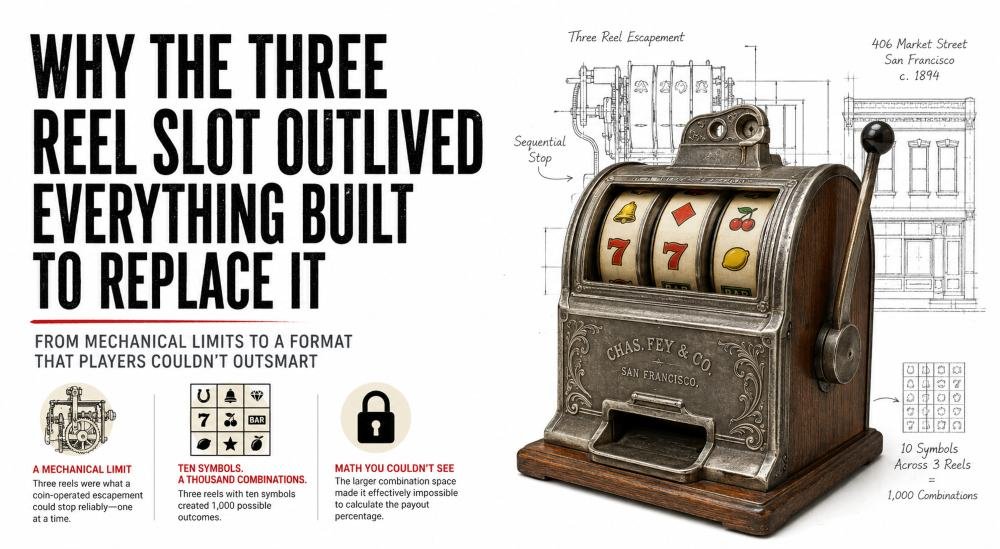
Charles Fey was a San Francisco machinist, not a game designer. Britannica dates his first coin-operated gambling machine to 1894, and his workshop at 406 Market Street is now a registered California historical landmark recognized as the birthplace of the three-reel bell machine.
Three reels was not a choice about clarity. It was what a coin-operated escapement could stop reliably, one reel after another, without jamming or drifting out of register. The legibility players now praise was a side effect of what the hardware could survive.
Fey understood the second-order effect quickly, though. The SFO Museum’s account of mechanical-age gambling devices notes that ten symbols across three reels produced a thousand possible combinations, and that unlike the older hundred-combination color wheel machines, the new arrangement made it effectively impossible for a player to work out the payout percentage from the cabinet. The sequential stop of each reel added suspense. The larger combination space removed the player’s ability to audit the math.
That is worth sitting with. The format now read as the honest, transparent, uncomplicated one was engineered partly to be harder to reason about than what came before it.
Symbols Are Legal Artifacts That Fossilized
Cherries do not symbolize anything. Neither does the BAR.
When anti-gambling statutes spread through the United States in the early twentieth century, manufacturers reclassified their machines as vending devices and paid out in fruit-flavored chewing gum instead of coin. The reel symbols were changed to match the gum flavors. Marshall Fey, grandson of the inventor and the closest thing the field has to a primary source, documented this reclassification in his account of the Mills Novelty era. The BAR is the widely accepted descendant of the Bell-Fruit Gum Company logo, a wrapper graphic that outlived the product it advertised.
So the visual grammar of the classic slot is not a design language anyone authored. It is a set of compliance workarounds that hardened into convention and then into recognition. A century later, a cherry communicates “slot machine” faster and more reliably than any bespoke art direction a studio could commission. That is a strange kind of brand equity, accumulated by accident.
What A Single Payline Actually Changes
Here is the structural difference that matters, and it is not about graphics.
On a multiline game, a player can wager across nine lines at ten cents each, hit a paying combination on one of them for thirty cents, and lose sixty cents on the spin. The machine responds with celebratory animation and sound anyway. Researchers at the Gambling Research Lab at the University of Waterloo named these outcomes losses disguised as wins, and have spent more than a decade documenting what they do to player perception.
The findings are consistent. Players categorize these outcomes as wins, react to them physiologically as wins, and systematically overestimate how often they actually won during a session. Work published in the Journal of Gambling Studies found that swapping the celebratory audio for negative feedback reversed the effect: participants correctly identified the outcomes as losses and produced accurate win estimates. Sound was carrying the disguise.
A single-line three-reel game largely cannot produce that outcome. There is one line. Symbols align, or they do not. The feedback matches the ledger.
This is the honest version of the “predictable rewards” claim that gets made about classic slots. It does not mean they pay better, and it does not mean they are a safer product. Volatility and return to player are set in the math model, and a classic-styled game can be tuned to be more punishing than a feature-heavy one. What the single payline changes is legibility. The player’s read of the session and the actual arithmetic of the session stay in the same place.
Nostalgia Is A Real Mechanism, Which Is Precisely Why It Gets Used
Nostalgia was treated as a medical condition for most of its history and only became a serious subject of psychological research around the turn of this century. The body of work built since then, much of it out of the Centre for Research on Self and Identity at Southampton, establishes that nostalgia functions as a psychological resource. It strengthens self-continuity, increases perceived social connectedness, and raises reported meaning in life. It is also common rather than rare, reported weekly by the large majority of participants in early survey work.
Retro slot design is a deliberate application of this. The mechanical clunk on the reel stop, the flat two-color symbol art, the chime on a payline hit: none of these are technically necessary in a browser-rendered game. They are chosen because they reach for a state that has measurable effects on how a person feels and how long they stay.
Naming that does not spoil the appeal. It does mean the warmth a player feels toward a fruit machine is partly an engineered response, and worth recognizing as such.
Classic Slots Versus Modern Slots
| Attribute | Classic Three Reel | Modern Multiline Or Grid |
|---|---|---|
| Paylines | One to five | Twenty to several thousand ways |
| Outcome Legibility | Win and loss are unambiguous | Losses disguised as wins are routine |
| Symbol Set | Six to ten, inherited icons | Twenty or more, theme-specific |
| Session Structure | Uniform spins, no arc | Base game, features, progression |
| Audio Role | Confirms the outcome | Shapes the perception of the outcome |
| Learning Curve | Effectively none | Paytable study rewarded |
| Typical Session | Short, interruptible | Longer, feature-anc |
Catalog Placement Is Doing Quiet Work
Formats survive when catalogs keep a door open for them. Grouping three reel titles into a dedicated collection does two things at once: it lets a returning player skip the discovery problem entirely, and it signals to a newcomer that a low-complexity option exists without having to filter through several hundred feature-heavy releases.
Platforms that maintain this structure make the format legible as a category rather than leaving it scattered. On sweepstakes platforms in particular, where play runs on virtual currency, the Classic Slots games on Win Bonanza sit in a distinct lobby of this kind, which is a reasonable place to see how the format reads in a current library rather than in a museum photograph.
What Actually Changed Under The Hood
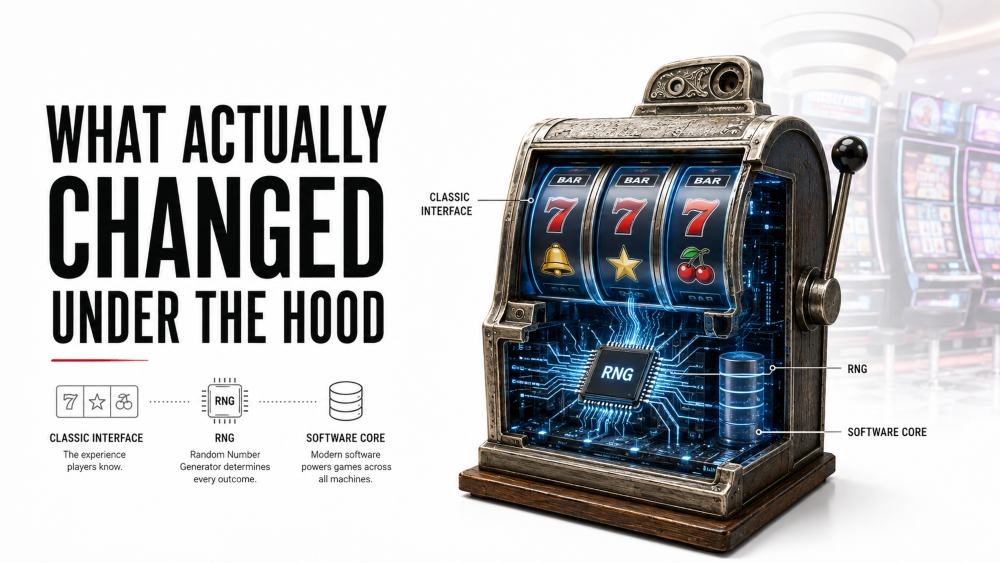
The reels stopped being reels a long time ago.
A modern classic-styled slot is software. The visible reel is a rendering of an outcome a random number generator has already determined, and the spin animation exists to pace the reveal, not to produce the result. Volatility, hit frequency, and return to player live in a math model that has nothing to do with the number of visible symbols.
This is the part most retro-framed writing gets wrong. “Classic” in 2026 describes an interface, not a mechanism. The three-reel presentation is a deliberate abstraction layered over the same infrastructure that runs the six-reel cascading grid two rows down in the lobby.
A Note On The Sweepstakes Layer
Many classic-format titles now surface on sweepstakes platforms, which operate a dual-currency model: a play currency with no redemption value, and a promotional currency that can become eligible for prize redemption under sweepstakes rules, with no purchase necessary to enter.
That model is under active legislative pressure. As legal analysts have documented in their tracking of sweepstakes casino legislation, a growing list of states has moved to prohibit dual-currency casino-style sweepstakes outright, with several statutes extending liability beyond operators to promoters, suppliers, and affiliates. Availability in any given state is not stable, and a platform accessible in a given month may be geoblocked the next.
Closing Note
The three-reel slot did not survive because it is charming. It survived because a single payline produces an unambiguous outcome, because its symbol set carries a century of accidental recognition that no marketing budget can replicate, and because it fits a two-minute gap in a day in a way a fifteen-minute feature ladder does not.
Those are structural advantages, and they are the reason the format keeps reappearing in catalogs built to showcase something more elaborate. Understanding why a design works, including the parts of it engineered to shape perception rather than inform it, is what separates an informed player from a nostalgic one.
Disclaimer
This article is provided for informational and entertainment purposes only. It does not constitute legal, financial, or gambling advice, and nothing in it should be read as an inducement to play.
Sweepstakes and social casino platforms operate under a legal framework that varies by state and is changing rapidly. Several states now prohibit dual-currency sweepstakes casino operation, and eligibility, minimum age, and availability are determined by the operator and by applicable state law, not by this publication. Readers should verify current availability and terms directly with any platform before creating an account. Participants must meet the minimum age requirement in their jurisdiction. No purchase is necessary to enter or win a sweepstakes promotion, and sweepstakes are void where prohibited by law.
Games of chance carry risk. Outcomes are determined by random number generation and no strategy alters the mathematical return of a slot game. If gambling has stopped being entertainment for you or someone you know, free and confidential support is available in the United States through the National Council on Problem Gambling and its National Problem Gambling Helpline at 1-800-MY-RESET, available twenty-four hours a day. Gamblers Anonymous maintains in-person and online meetings nationwide.
References
- Encyclopaedia Britannica. “Charles August Fey: Bavarian-born American inventor.” Encyclopaedia Britannica. https://www.britannica.com/biography/Charles-August-Fey
- California Office of Historic Preservation. “Site Of Invention Of The Three-Reel Bell Slot Machine.” California Historical Landmark No. 937, registered January 15, 1981. California Department of Parks and Recreation. https://ohp.parks.ca.gov/ListedResources/Detail/937
- SFO Museum. “Games of Chance: Gambling Devices of the Mechanical Age.” Exhibition gallery, San Francisco International Airport Museum. https://www.sfomuseum.org/exhibitions/games-chance-gambling-devices-mechanical-age/gallery
- Fey, Marshall. “Cherry, Cherry, Cherry.” Cabinet Magazine, Issue 19. https://www.cabinetmagazine.org/issues/19/fey.php
- Dixon, Mike J. Faculty profile and Gambling Research Lab overview, Department of Psychology, University of Waterloo, Waterloo, Ontario. https://uwaterloo.ca/psychology/profiles/mike-j-dixon
- Dixon, Mike J., Karen Collins, Kevin A. Harrigan, Candice Graydon, and Jonathan A. Fugelsang. “Using Sound to Unmask Losses Disguised as Wins in Multiline Slot Machines.” Journal of Gambling Studies, vol. 30, no. 1 (2014), pp. 183–196. Published online November 2013. DOI: 10.1007/s10899-013-9411-8. https://link.springer.com/article/10.1007/s10899-013-9411-8
- Sedikides, Constantine, Tim Wildschut, Jamie Arndt, and Clay Routledge. “Nostalgia: Past, Present, and Future.” Current Directions in Psychological Science, vol. 17, no. 5 (2008), pp. 304–307. Centre for Research on Self and Identity, University of Southampton. https://www.southampton.ac.uk/~crsi/Sedikides%20Wildschut%20Arndt%20%20Routledge%202008%20CDir.pdf
- InfoLawGroup LLP. “Sweepstakes Casino Laws in 2026: New Bans, Proposed Legislation, and Regulatory Trends.” July 27, 2026. https://www.infolawgroup.com/insights/2026/7/27/sweepstakes-casino-laws-in-2026-new-bans-proposed-legislation-and-regulatory-trends
- National Council on Problem Gambling. Help and treatment resources, National Problem Gambling Helpline. Washington, DC. https://www.ncpgambling.org/