


World of Warcraft Classic is built around smart decisions. Your class, spec, talents, gear, keybinds, and reaction speed all affect how useful you feel in dungeons, raids, battlegrounds, and open-world fights. Paladin is one of the best examples of this because the class can heal, tank, support, farm, and burst enemies depending on how you build it.
For players using a keyboard, mouse, gamepad, or hybrid controller setup, Paladin can feel very different from other Classic WoW classes. The Gameplay is not always fast, but timing matters. Blessings, seals, Judgments, dispels, heals, cooldowns, and movement all need clean input and comfortable button mapping. If you are still learning basic Paladin systems, talent choices, seals, auras, and early-game mechanics, read SkyCoach’s guide on this before moving into deeper build planning.
This guide breaks down all three Paladin specs in Classic WoW: Holy, Protection, and Retribution. It also explains how each one feels across different phases and how controller users can set up their inputs for smoother Gameplay.
Why Paladin Is Different In Classic WoW
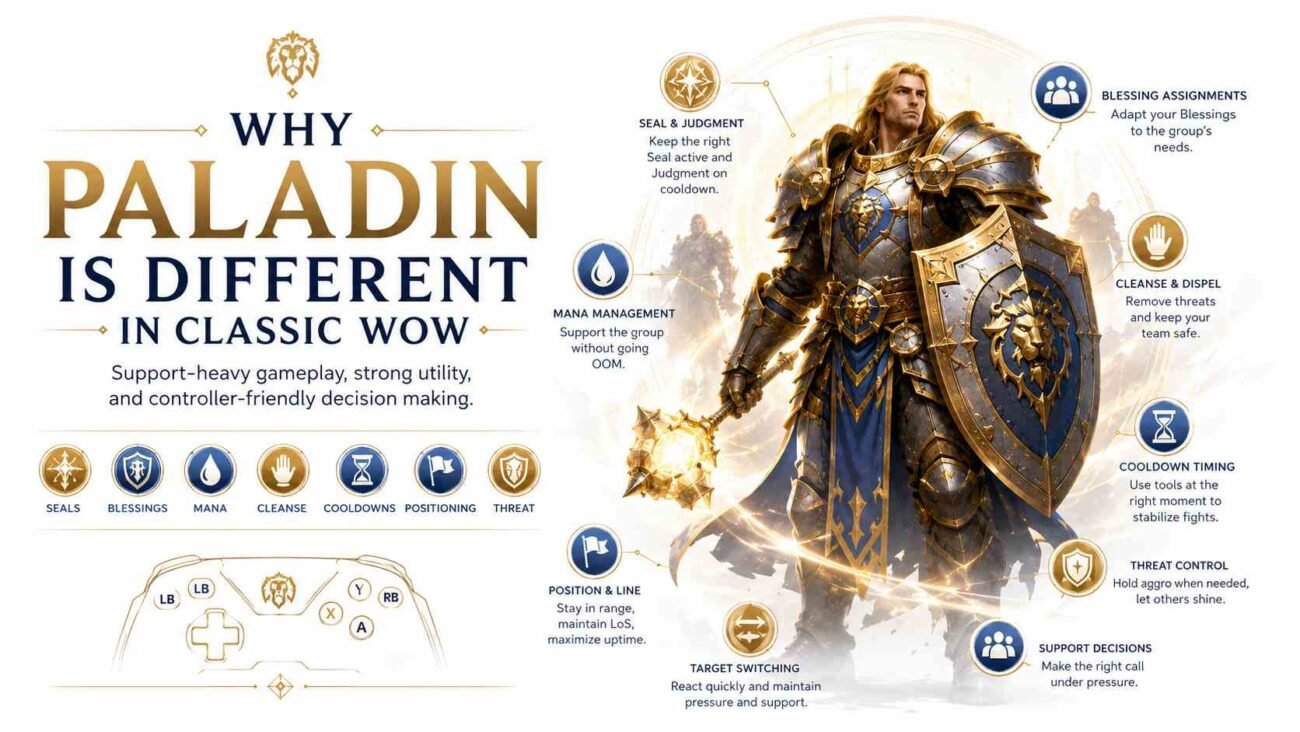
Paladin is not just a damage class. It is a support-heavy class with strong defensive tools, powerful buffs, and excellent utility. This makes it very valuable in group content, even when one spec is not topping damage meters.
For controller users, Paladin can also be more comfortable than high-action classes because many abilities are situational instead of spam-heavy. That said, bad button mapping can still hurt your performance. If your cleanse, heal, bubble, or stun is hard to reach, your reaction time will suffer.
What Paladin Players Need To Manage
A good Paladin player must pay attention to:
- Seal and Judgment timing
- Blessing assignments
- Mana usage
- Cleanse and dispel priority
- Cooldown timing
- Positioning during boss fights
- Target switching
- Threat control
- Support decisions under pressure
These choices are even more important if you play with a controller, because every important spell needs to be placed where your fingers can reach it quickly.
Holy Paladin: The Reliable Raid Healer
Holy Paladin is the most accepted raid spec in Classic WoW. It is strong because it does one job extremely well: keeping important targets alive.
In raids, Holy Paladins are usually assigned to tank healing. This means your job is not to heal everyone at once. Your job is to keep the main tank or key players stable during long fights.
Why Holy Works So Well
Holy Paladin is strong because of its mana efficiency, durability, and simple but powerful healing tools. Flash of Light is used often because it is cheap and reliable. Holy Light is stronger but costs more mana, so it needs to be used carefully.
Good Holy players do not just press heals randomly. They watch incoming damage, save mana, cleanse quickly, and use defensive cooldowns at the right time.
Common Holy Talent Direction
A common raid-focused Holy setup uses deep Holy talents with support points in Protection.
Important talents usually include:
- Illumination
- Divine Favor
- Holy Power
- Improved Blessing of Wisdom
- Blessing of Kings
Holy Shock is more useful in PvP than in serious raid healing because it costs a lot of mana. It can save someone in an emergency, but using it too often can leave you empty during longer fights.
Holy Paladin Controller Setup Tips
Holy Paladin can work well on a controller because the rotation is not too crowded, but your key abilities must be easy to reach.
For smooth healing, place these actions on your easiest buttons:
- Flash of Light
- Holy Light
- Cleanse
- Divine Shield
- Blessing of Protection
- Target party member controls
- Judgment or Seal swap
- Mount or movement utility
If your controller has back buttons or paddles, use them for targeting or modifiers. This helps you heal without moving your thumb away from movement controls.
Protection Paladin: Strong Dungeon Tank With Clear Limits
Protection Paladin is one of the most debated specs in Classic WoW. Some players love it. Others avoid it because it lacks one major tanking tool: a taunt.
That missing taunt changes everything. In dungeons, Protection can feel amazing. In raids, it becomes much harder to justify because many encounters need controlled taunt swaps and stable single-target threat.
Where Protection Paladin Feels Good
Protection Paladins are excellent in dungeon pulls because Consecration gives strong area threat. This makes them useful when fighting groups of enemies.
They are especially fun in undead-heavy dungeons where Paladin tools feel natural. A dungeon like Stratholme is a great example of where Protection Paladin can feel smooth, useful, and enjoyable when the group understands how the spec works.
Common Protection Talent Direction
Protection builds usually focus on threat, Survival, and mana control.
Useful talents often include:
- Consecration
- Holy Shield
- Improved Righteous Fury
- Blessing of Sanctuary
- Precision
- Deflection
- Improved Judgement
The key challenge is mana. Protection Paladins need mana to hold the threat. If you waste abilities or pull too slowly, your performance can drop fast.
Protection Paladin Controller Setup Tips
Protection Paladin needs fast access to threat tools and defensive buttons. Your controller layout should make pulling, targeting, and emergency actions simple.
Good buttons to prioritize include:
- Consecration
- Holy Shield
- Righteous Fury
- Judgement
- Seal swap
- Cleanse
- Divine Shield
- Blessing of Protection
- Target the nearest enemy
- Interact or loot
Targeting is very important for tanking. If your target switch input feels slow or awkward, dungeon pulls can become messy. Test your controller buttons before serious runs to ensure every input responds correctly.
Retribution Paladin: Fun, Burst-Heavy, and PvP-Focused
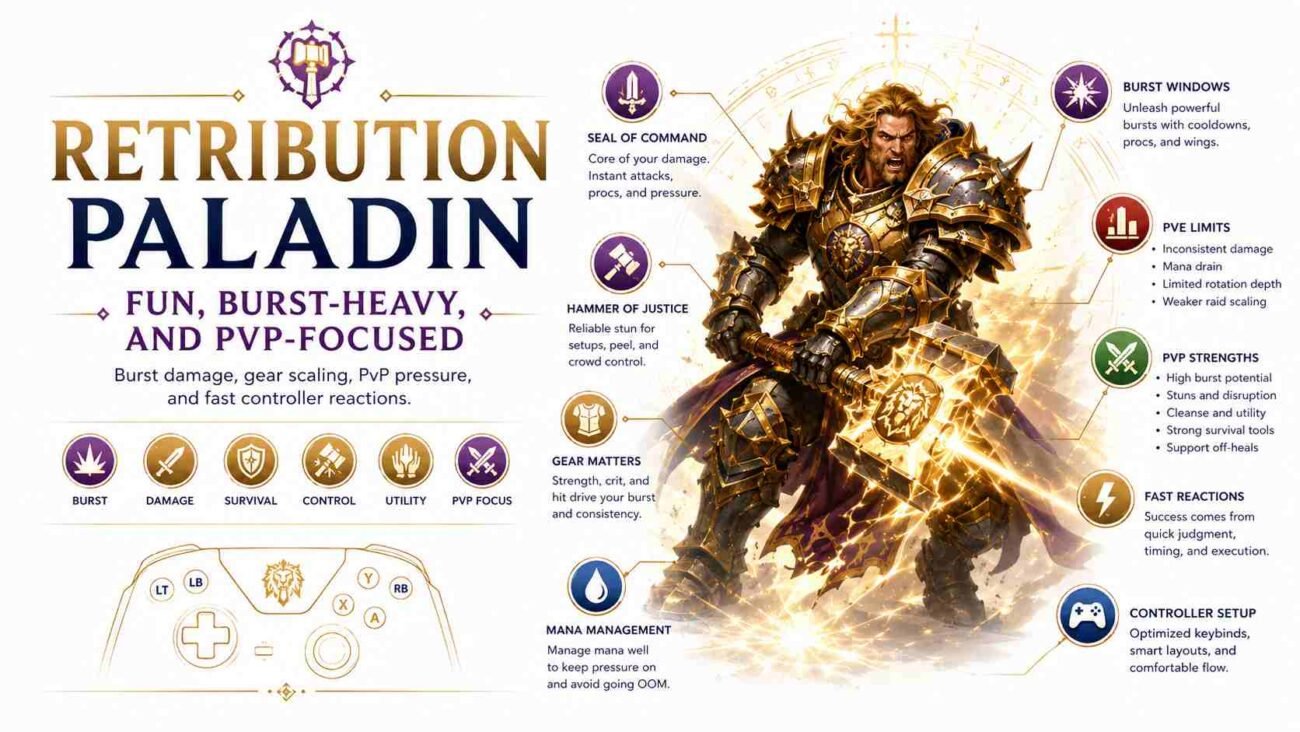
Retribution Paladin is often called a meme spec in Classic WoW because its raid damage is not as serious as Warriors, Rogues, or other top damage classes. But that does not mean it is useless or boring.
Retribution is popular because it feels satisfying when everything lines up. Big weapon hits, Seal of Command procs, stuns, and burst windows can create exciting moments, especially in PvP.
Why Retribution Struggles In PvE
Retribution has a few clear problems in raid content:
- Damage can be inconsistent
- Mana can run out quickly
- Rotation depth is limited
- Gear matters a lot
- Other melee classes usually scale better
Because of this, Ret Paladins are often treated as support damage dealers rather than main damage dealers.
Why Retribution Works In PvP
PvP is where Retribution becomes much more interesting. You can survive longer than many damage classes, support teammates, cleanse, heal, and punish enemies with burst damage.
Useful Retribution talents often include:
- Seal of Command
- Conviction
- Vengeance
- Sanctity Aura
- Improved Judgement
- Repentance
Weapon quality is extremely important. A weak weapon makes Retribution feel slow and disappointing. A strong weapon can make the spec feel dangerous.
Retribution Controller Setup Tips
Retribution is one of the easier Paladin specs to map on a controller because it has fewer constant rotation buttons than many other damage classes. Still, PvP requires fast reactions.
Place these actions where you can press them instantly:
- Judgement
- Main Seal
- Hammer of Justice
- Cleanse
- Flash of Light
- Divine Shield
- Blessing of Freedom
- Blessing of Protection
- Target enemy player
- Target the nearest enemy
For PvP, comfort matters. If your stun or bubble is hard to press, you may lose fights you should have won.
How Paladin Specs Change Across Classic Phases
Paladin value changes as Classic WoW phases progress. Gear, raid design, dungeon farming, and PvP activity all affect how useful each spec feels.
| Paladin Spec | Early Classic | Mid Classic | Late Classic |
|---|---|---|---|
| Holy | Strong healer for groups and raids | Essential raid support | Elite tank healer with strong scaling |
| Protection | Great dungeon tank | Niche raid choice | Strong farming and area threat specialist |
| Retribution | Solid for leveling | Weak in raids but fun in PvP | Better burst with gear, especially in PvP |
Holy becomes stronger as the gear improves. Protection becomes more specialized. Retribution improves with better weapons but still struggles to become a top raid damage spec.
Controller Performance Matters More Than Players Think
Classic WoW is not as fast as modern action games, but input accuracy still matters. A delayed button press can mean a missed cleanse, a late heal, or a failed defensive cooldown.
This is especially important for players using gamepads, Steam Input, console-style layouts, or accessibility setups.
Check Your Controller Before Playing
Before joining a raid, dungeon, or battleground, test these basics:
- Do all buttons respond correctly?
- Are triggers registering properly?
- Is there stick drift?
- Are modifier buttons comfortable?
- Can you target enemies and party members quickly?
- Are important cooldowns easy to reach?
- Is input delay noticeable?
A controller test can help you spot problems before they affect your Gameplay. If a button feels inconsistent outside the game, it will feel worse during a boss fight or PvP match.
Button Mapping Advice For Paladin Players
Paladin has many support tools, so your layout should separate common actions from emergency actions.
A simple setup could look like this:
| Button Type | Best Use |
|---|---|
| Face buttons | Main heals, Judgement, common attacks |
| Triggers | Modifiers, targeting, or defensive abilities |
| Bumpers | Seal swaps, cleanse, or utility |
| D-pad | Blessings, aura changes, mount, menu actions |
| Back buttons | Targeting, push-to-talk, or emergency cooldowns |
Do not place life-saving spells on awkward combinations. Divine Shield, Cleanse, and Blessing of Protection should be easy to press in a pinch.
Best Paladin Spec By Playstyle
The best Paladin spec depends on what you enjoy most.
| Paladin Spec | Best For | Why Choose It |
|---|---|---|
| Holy | Reliable group value and raid support | Holy is the best choice if you want a stable raid spot and enjoy supporting your team. It is not flashy, but it is one of the most trusted specs in Classic WoW. |
| Protection | Dungeon control, farming, and group pulls | Protection is great if you enjoy tanking groups of enemies, farming, and playing something less common. It is not the safest raid tank choice, but it can be a lot of fun in the right content. |
| Retribution | PvP burst and fun damage moments | Retribution is best for players who care more about fun, burst damage, and PvP moments than perfect raid performance. It is not always efficient, but it can be one of the most satisfying specs when geared properly. |
Common Paladin Mistakes To Avoid
Many Paladin players struggle because they treat the class too simply. Paladin has simple buttons, but good decision-making separates average players from strong ones.
Avoid these mistakes:
- Forgetting to refresh Blessings
- Using expensive heals too often
- Ignoring the cleanse duty
- Wasting Divine Shield too early
- Using the wrong aura for the situation
- Pulling too much as Protection without mana
- Playing Retribution without upgrading weapons
- Poor controller mapping for emergency abilities
- Not testing buttons before serious content
Small improvements can make a big difference, especially in group content where your team depends on your support.
FAQs
| Question | Answer |
|---|---|
| What is the best Paladin spec for raiding in Classic WoW? | Holy is the best Paladin spec for raiding because raids always need strong healers, Blessings, and cleanse support. It offers the most consistent value across Classic phases. |
| Can Protection Paladins tank raids? | They can tank some situations, but the lack of a taunt makes raid tanking difficult. Protection is much stronger in dungeons, farming, and area threat situations. |
| Why do players call Retribution a meme spec? | Players call Retribution a meme spec because its raid damage is usually weaker than top melee classes. However, it can still be fun, useful, and dangerous in PvP with the right gear. |
| Is Paladin good for controller players? | Yes, Paladin can work well with a controller because many abilities are utility-based rather than extremely fast rotation-based. However, clean button mapping and accurate inputs are very important. |
| Which Paladin spec is best for beginners? | Holy is the safest choice for group value, while Retribution is often easier for solo leveling. Protection is strong in dungeons but needs better awareness of threat and mana. |
Conclusion
Paladin is one of the most flexible classes in World of Warcraft Classic. Holy is the strongest raid choice, Protection is excellent for dungeons and farming, and Retribution is a fun burst-focused spec that shines brightest in PvP.
The best spec depends on what you enjoy. If you want a reliable raid role, play Holy. If you like controlling big dungeon pulls, try Protection. If you want exciting PvP moments and big weapon hits, Retribution may be the most enjoyable option.
For controller and gamepad users, the most important things are comfort and responsiveness. Test your buttons, reduce input delay where possible, map emergency spells carefully, and make sure your setup supports the way Paladin actually plays. A clean controller layout will not turn a weak build into a perfect one, but it can help you react faster, make better decisions, and enjoy Classic WoW with more control.