

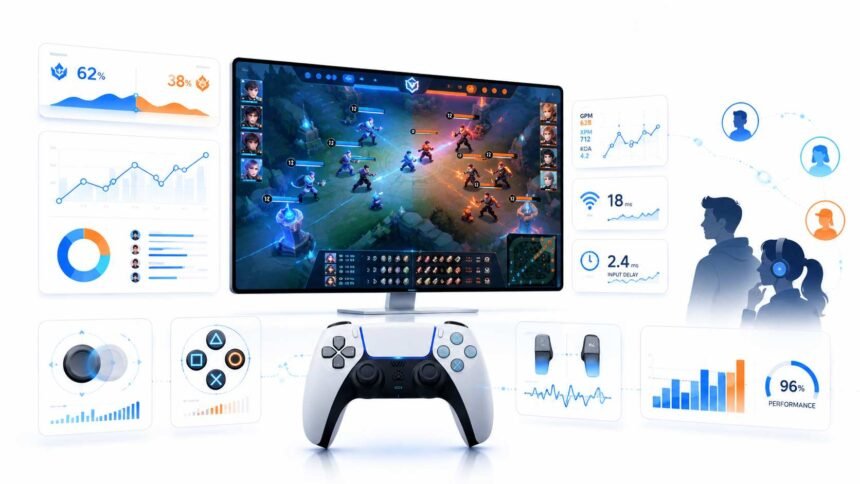
Esports viewing has changed a lot. Fans no longer watch only for big kills, clutch rounds, final scores, or highlight plays. Many now watch with a more technical eye. They look at reaction speed, aim control, timing, movement, economy, map pressure, controller input, and the small details that decide close matches.
This is why data has become such a big part of modern esports. It helps fans understand what is happening beneath the surface. A clean shot, a fast turn, a missed block, or a failed retake may look simple on stream, but there is often a deeper reason behind it.
For a site like Gamepad Tester, this topic connects naturally with controller performance. A player’s skill matters, but so does the device in their hands. Stick drift, input delay, weak triggers, poor dead zones, and button response issues can all change how a game feels. Data helps players and viewers understand those details more clearly.
Data Makes Esports Easier to Understand
Modern esports broadcasts are full of useful information. Fans can now see live statistics, economy updates, damage numbers, player form, map control, win probability, and team momentum during a match.
These features do more than decorate the screen. They help enhance the viewing experience because viewers can understand why a team is winning instead of only seeing the result.
For example, in a shooter, a team may lose a round because it entered with weaker weapons, poor utility, or bad positioning. In a fighting game, a player may lose because they failed to react to the same pressure pattern. In a sports game, one bad input at the wrong time can ruin a strong attack.
Data gives fans the missing context.
Controller Performance Is Part of the Story
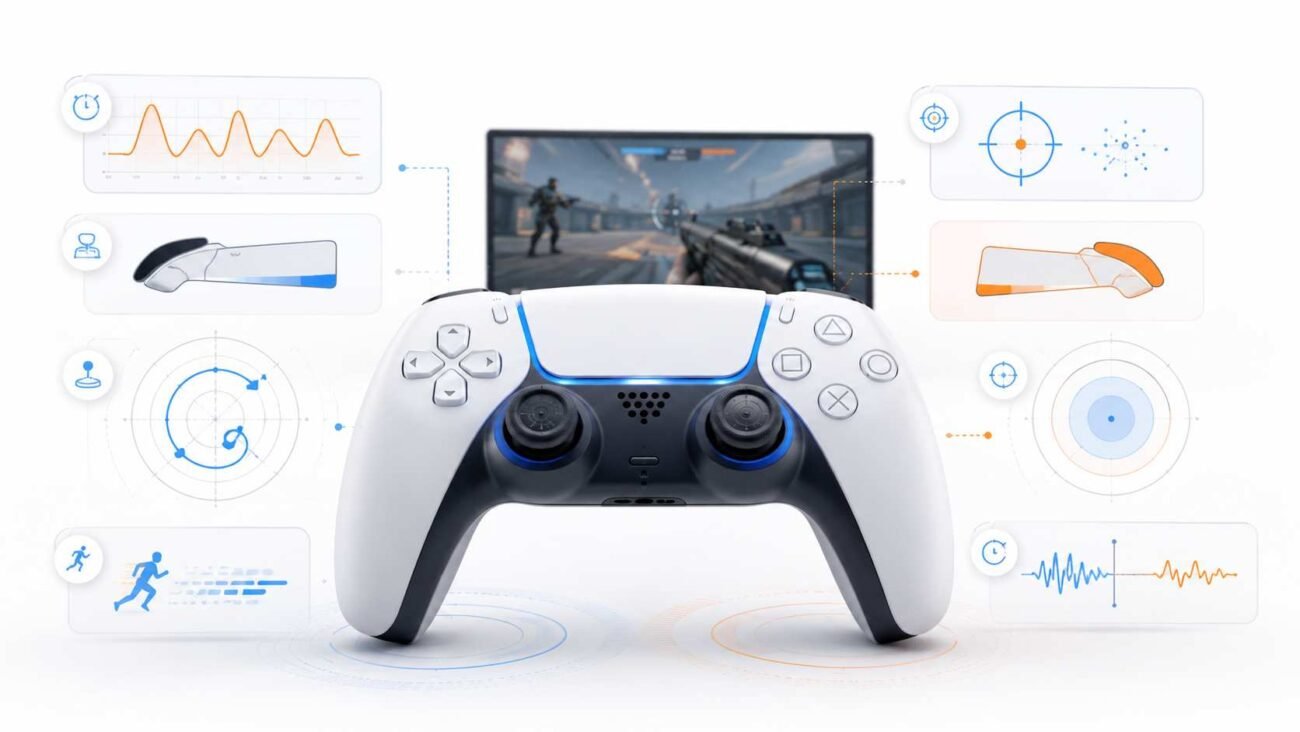
Many esports conversations focus on players, teams, and strategies. That makes sense, but the controller or input device also matters.
For controller-based games, performance depends on clean and accurate input. This applies to games such as Rocket League, EA Sports FC, NBA 2K, Fortnite, Apex Legends, Call of Duty, Halo, racing games, and fighting games.
A controller problem can affect:
- Button timing
- Trigger response
- Stick movement
- Camera control
- Aim accuracy
- Character movement
- Dead zone balance
- Input delay
This is where a gamepad tester becomes useful. Before a player blames the game, the internet connection, or their own skill, they can test whether the controller is responding properly.
A drifting stick can slowly move the camera. A weak trigger can delay shooting or acceleration. A sticky button can make actions feel late. These small problems can create big mistakes in competitive games.
Input Data Helps Players Improve
Data is not only for professional analysts. Everyday players can also use it to improve.
A player who tests their controller before gaming can spot issues early. If the left stick does not return to the centre, movement may feel unstable. If the right stick has drift, aiming can become harder. If a button does not register every press, combos or quick actions may fail.
This kind of testing gives players a clearer answer. The problem may not be “bad gameplay.” It may be a hardware issue.
That is why controller testing fits into modern esports culture. Players already study maps, settings, frame rates, and connection quality. Testing input performance is part of the same mindset.
Fans Are Watching Like Analysts Now
Esports fans have become more detailed in how they watch matches. They compare player stats, study team habits, follow map history, and look at how players perform under pressure.
This has changed fan discussion. Instead of saying “that player is good,” fans now ask better questions.
- Was the player late because of input delay?
- Did the missed shot come from bad aim or poor stick control?
- Was the team outplayed, or did they make a risky economy choice?
- Did the controller settings help or hurt movement?
- Was the player’s reaction slow, or was the situation impossible?
These questions make esports more interesting. Fans are not only reacting emotionally. They are reading the game more carefully.
Odds Data Has Become Another Viewing Layer
Some adult esports fans also look at odds and live market movement as another type of data. This should be treated carefully and responsibly, especially because betting rules depend on age and location.
In a general viewing sense, platforms connected with Bovada esports show how match expectations can shift during a series. A pistol round loss, a surprise comeback, a map change, or a key player underperforming can all affect how people read the match.
For a gaming tools site, this should not be the main focus. It works better as one example of how esports data moves in real time. The core point is not betting. The core point is that modern fans use data from many places to understand momentum, risk, and performance.
Esports should always be enjoyed first as entertainment, competition, and community. Any betting-related content should be limited to adults where it is legal.
Dead Zones Can Change Competitive Control
Dead zones are one of the most important controller settings for serious players.
A dead zone decides how far a stick must move before the game registers input. If the dead zone is too small, the controller may show unwanted movement because of stick drift. If it is too large, the controller may feel slow and less precise.
- This matters in fast games.
- In shooters, it can affect aim.
- In racing games, it can affect steering.
- In sports games, it can affect passing and movement.
- In fighting games, it can affect directional control.
- In Rocket League, it can affect aerial control and car movement.
Many players change sensitivity but forget to test the controller itself. A good setup starts with knowing whether the gamepad is working properly.
Latency Makes Good Players Feel Slow
Input delay can make a skilled player feel worse than they are. Even a small delay between pressing a button and seeing the action on screen can change timing.
This matters in esports because many actions happen in very small windows. A late shot, a late jump, a missed save, a delayed tackle, or a slow dodge can decide the result.
Players often think about internet speed, but input delay can also come from the controller, connection method, screen, frame rate, or game settings.
A wired connection may feel different from wireless. A monitor may respond faster than a TV. A clean controller may feel sharper than one with worn buttons or drifting sticks.
Data helps players stop guessing.
Broadcasts May Show More Input Data in the Future
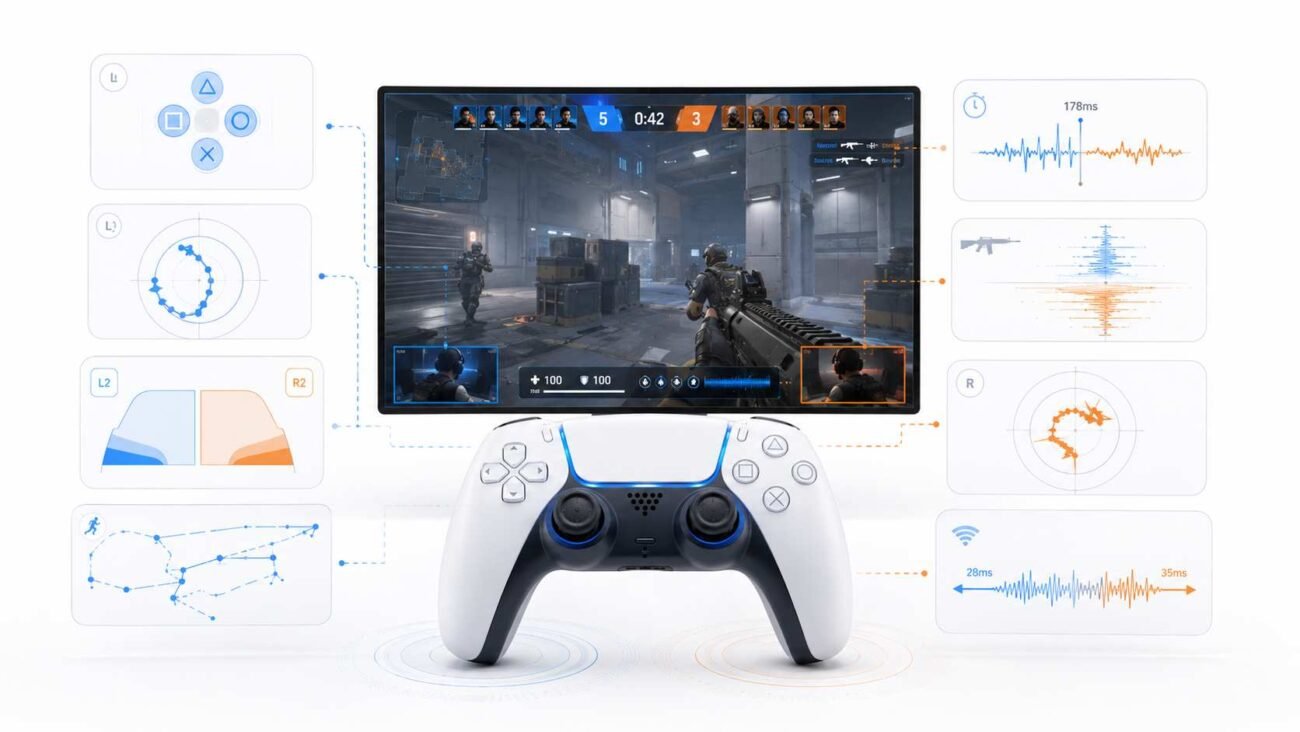
The next stage of esports viewing may include deeper input overlays. Fans may one day see controller inputs, button presses, stick direction, reaction timing, and movement patterns during professional matches.
This would be useful for learning. A viewer could see how a professional player controls recoil, turns quickly, times a pass, performs a combo, or handles pressure.
It would also make controller skills easier to understand. Many great players make difficult actions look simple. Input data can show how much control is actually involved.
For Gamepad Tester readers, this is an important point. The controller is not just a device. It is the link between decision and action.
Why This Matters for Casual Players
The best part about data-driven esports is that normal players can learn from it.
A casual player may watch a professional match and notice better movement, cleaner aim, faster reactions, or smarter control. Then they can check their own setup and ask:
- Is my controller drifting?
- Are my buttons responding properly?
- Is my trigger pressure smooth?
- Are my dead zones too high or too low?
- Is the input delay affecting my timing?
- Are my settings helping or hurting me?
This turns esports from simple entertainment into a learning tool. Fans can watch, understand, test, and improve.
Final Thoughts
Data has changed how fans watch esports. Viewers now look beyond the scoreboard and try to understand the details behind each play.
For Gamepad Tester, this topic fits best when it connects esports analytics with controller performance, input delay, stick drift, dead zones, and setup quality.
The modern fan is not just watching. They are reading the match. The modern player is not just practising. They are checking the tools that shape their performance.
In competitive gaming, small details matter. Data helps make those details visible.
Disclaimer
This article is for general gaming and esports information only. It is not professional coaching advice, hardware repair advice, financial advice, or betting advice. Controller performance can vary based on device condition, game settings, platform, display response time, connection method, and internet stability.
Any mention of esports odds or live market data is included only as an example of how some adult viewers use data to understand match momentum. It should not be treated as encouragement to gamble. Betting laws, age limits, and platform rules vary by country and region. Gambling is not suitable for minors and should only be considered by adults where it is legal. If gambling causes stress, financial pressure, or loss of control, seek help from a trusted support service.
Gamepad Tester encourages players to enjoy esports responsibly, test their gaming equipment regularly, and use performance data to improve play quality, not to take unnecessary risks.
References
- Newzoo. “eSports audience size worldwide from 2020 to 2025, by type of viewers.” Statista, published April 19, 2022. Accessed May 29, 2026. This source provides audience data showing the growth of esports viewers and enthusiasts worldwide.
- Spjut, Josef B., Ben Boudaoud, and Joohwan Kim. “A Case Study of First Person Aiming at Low Latency for Esports.” Esports and High Performance HCI Workshop, NVIDIA Research, published May 8, 2021. arXiv:2105.10498. This paper discusses how lower input-to-output latency can affect aiming tasks in first-person esports games.
- Kämäräinen, Teemu, Matti Siekkinen, Antti Ylä-Jääski, Wenxiao Zhang, and Pan Hui. “Dissecting the End-to-end Latency of Interactive Mobile Video Applications.” HotMobile 2017: Proceedings of the 18th International Workshop on Mobile Computing Systems and Applications, Association for Computing Machinery, 2017, pages 61–66. DOI: 10.1145/3032970.3032985. This peer-reviewed conference paper explains how control input and display buffering affect total delay in interactive gaming and video applications.
- Gambling Commission and Ipsos. “Young People and Gambling 2025: Official Statistics.” UK Gambling Commission, published November 13, 2025, updated November 28, 2025. This report provides official data on young people’s exposure to gambling activities, including online gambling and esports betting.
- Esports Charts. “StarLadder Budapest Major 2025 Viewership Statistics.” Esports Charts reporting, December 2025. This source is useful for checking how major CS2 events attract large audiences and how viewership data shapes esports coverage.
- Ma, Jianzhe, Zhonghao Cao, Shangkui Chen, Yichen Xu, Wenxuan Wang, and Qin Jin. “EgoEsportsQA: An Egocentric Video Benchmark for Perception and Reasoning in Esports.” arXiv, published April 14, 2026. arXiv:2604.12320. This research highlights the growing role of perception, reasoning, and tactical analysis in high-speed esports environments.