

Ask ChatGPT how to check a controller for stick drift, or which pad to buy next, and the answer you get is no longer just the model’s own words. Since February 2026, logged-in adults on the Free and Go tiers in the United States have been seeing labelled sponsored cards underneath some answers, and the list of markets has grown through the year. Buying advice about gaming hardware is exactly the kind of commercial conversation those cards are built for.
That matters on both sides of the screen. If you use ChatGPT to work out why a stick is drifting, it is worth knowing which part of the reply someone paid for. If you run a site, a shop or a brand in this space, it means a competitor can now sit underneath the answer to a question your pages used to catch on their own.
The problem for anyone trying to track this is that OpenAI does not publish a public ad library. You can see your own numbers in Ads Manager, but you cannot easily see which competitors are running ads on the prompts that matter to you, or what to do about it. This article ranks six ChatGPT ads tracking tools by actionability: how far each takes you from spotting an ad to choosing what to bid on, changing your content, and proving whether the investment paid back.
Quick Context: Where ChatGPT Ads Stand
OpenAI began testing ads in ChatGPT for US Free and Go users on 9 February 2026. A self-serve Ads Manager with cost-per-click bidding opened to all US advertisers on 5 May 2026, with the old minimum spend removed. Through the rest of 2026 both the ads themselves and self-serve advertiser access spread well beyond the US, reaching dozens of countries.
Ads are not shown to Plus, Pro, or Business accounts, or to users under 18. The format is a sponsored card attached to a response with advertiser name, title, description, image, and landing page. OpenAI’s position is that the card sits below the answer and does not change what the answer says.
There is still no public ChatGPT ad library like Meta’s. OpenAI Ads Manager only reports on your own campaigns, including impressions, clicks, spend, CTR, average CPC, average CPM, and conversions. Third-party trackers fill that gap with sampled prompts or panel data. Similarweb’s panel data put a sponsored ad on 26% of ChatGPT responses served to Free and Go users, and counted 5,171 unique ChatGPT advertisers as of June 2026. SE Ranking found paid placements on 25.94% of 50,006 commercial prompts, with 1,159 unique advertisers and one sponsored card per answer.
Treat all of those numbers as samples rather than counts. Nobody outside OpenAI sees the whole picture, which is the same caution we apply to any measurement taken through a layer you do not control.
Marketers who are also watching organic ChatGPT visibility often compare ChatGPT rank tracking tools alongside these paid tools.
Why This Lands On A Hardware Testing Site
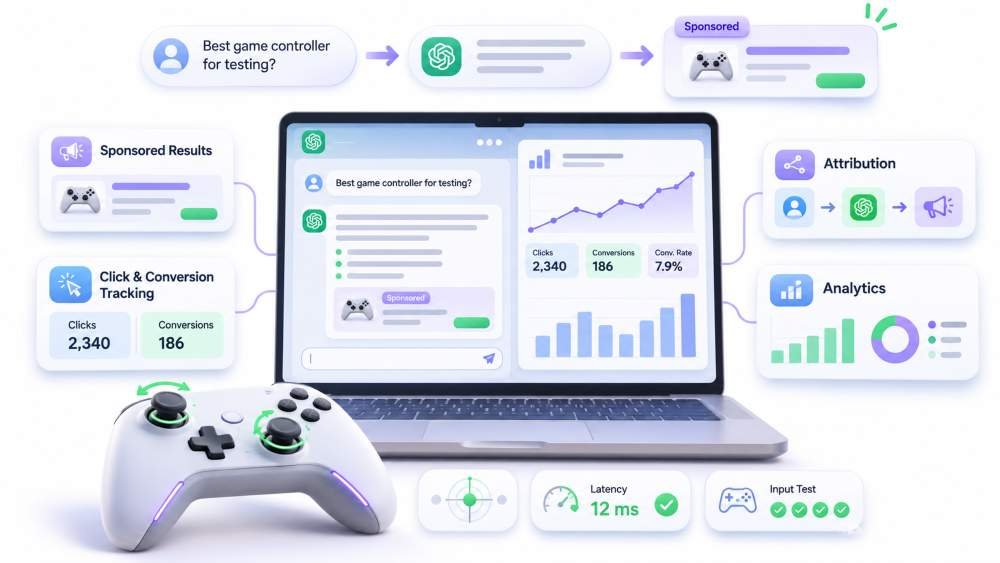
Browser tools live or die on discovery. Someone with a drifting thumbstick types a question, lands on a page, runs a test, and gets an answer in a minute. For years that journey started in a search box. A growing share of it now starts in a chat window instead, and the chat window has started carrying ads.
The prompts in this niche are commercial almost by definition. Here are the kinds of conversation where a sponsored card is plausible:
- Which controller should I buy to replace a drifting one
- How do I test my controller for stick drift
- Is my controller latency normal, or is it the TV
- Best wireless controller for PC in 2026
- How do I know if my controller battery is failing
A reader who asks the first of those gets an answer and, possibly, a card from a hardware brand underneath it. A reader who asks the second usually wants a tool, not a purchase, which is why free diagnostic pages like our controller tester, stick drift test and latency test still answer that question better than any ad can. The distinction is worth holding on to: ads cluster where money changes hands, and diagnosis is usually the step before that.
If you publish in this space, the practical question is not whether ads exist but whether anyone is bidding on your conversations. That is what the tools below are for.
How We Ranked Them: The Actionability Ladder
Each tool is tagged with the highest rung it reaches.
- Rung 1, see: an ad library or list of competitor ads on prompts.
- Rung 2, find gaps: prompts where competitors advertise and you do not, or prompts nobody advertises on yet.
- Rung 3, target: tells you which conversations to bid on, with scoring or volume and CPC estimates.
- Rung 4, measure and close the loop: pulls your own ChatGPT ad performance or attribution data, and connects paid to organic AI visibility.
Many tools stop at rung 1. This article gives more weight to tools that move you from observation to action.
1. Cognizo
Actionability: rung 4 of 4, see, target, measure and fix organically
Cognizo is an AI visibility and answer engine optimisation platform with a ChatGPT Ads module, called AI Ads on the pricing page, next to organic tracking. On the competitor side, you can look up competitors and see the ads they show inside ChatGPT, what the ads say, and which conversations they appear in. The ad library lists advertiser, ad copy, landing page, how often the ad appeared, and when it was seen. You can filter by topic, region, AI engine, advertiser, prompt, and date. The platform also breaks down ad appearances by AI engine, region, advertiser, most contested prompts, and new advertisers.
The more important part is what Cognizo does with the list. It finds the questions people ask before buying and turns them into targeting opportunities linked to tracked prompts. Each opportunity has a score, the reasoning behind it, and, where available, estimated search volume, cost per click, and difficulty. You can filter by intent and save opportunities into lists. That moves you from seeing an ad to having a set of conversations to bid on.
On the measurement side, Cognizo says it pulls the OpenAI Conversions API, Google Search Console, and Google Ads into one model to attribute pipeline to the conversations that drove it. The organic side sits in the same platform: daily tracking of visibility and share of voice, citation share, mention share, sentiment, prompt volumes, AI traffic analytics, and MCP and API access. The organic layer also feeds the fixes: the content agent writes and auto-publishes AI-optimised articles, and the same visibility data is the starting point for how to improve your AI search visibility.
What you can do with it:
- See competitor ChatGPT ads, copy, and landing pages, filtered by prompt, region, AI engine, advertiser, and date.
- Find most contested prompts and new advertisers in your market.
- Turn pre-purchase questions into scored targeting opportunities with volume, CPC, and difficulty estimates where available.
- Attribute pipeline to ChatGPT conversations using the OpenAI Conversions API, Google Search Console, and Google Ads model.
- Track organic ChatGPT visibility, share of voice, citations, mentions, and sentiment in the same platform.
- Use the content agent to publish AI-optimised articles at 8 per month on Growth or 20 per month on Pro.
Best for: Teams that will actually bid on and fix ChatGPT visibility, not just watch competitor ads.
Pricing: Growth $499/month with 150 prompts, Pro $999/month with 350 prompts, Enterprise custom. AI Ads is an add-on on Growth and Pro, and included on Enterprise. Growth and Pro track 5 AI platforms, Enterprise has broader platform coverage.
Limitations:
AI Ads is an add-on below Enterprise, so the full ads plus organic workflow costs more than a point solution.
It is built for teams that will act on the data, so it is more than a lightweight ad viewer.
2. Similarweb AI Ads
Actionability: rung 1 of 4, market-level see
Similarweb launched its AI Ads product on 17 August 2026. It covers sponsored placements in ChatGPT, Google AI Mode, and Google AI Overviews. The tool shows advertisers, ad creatives actually running, copy, landing pages, and share of voice.
Its ChatGPT coverage is built on Similarweb’s measurement panel rather than synthetic prompts, which makes the data directional at market level. ChatGPT coverage started with the top 10,000 US advertisers. Similarweb has said future releases will add advertiser share of voice, ad categories, and conversational intent.
This is a research view, not an action system for your own ChatGPT campaigns.
Best for: Enterprise market research teams already on Similarweb.
Pricing: Not published, sales-led.
Limitations:
No organic AEO metrics and no content tools.
No bid recommendations.
3. SE Ranking (AI Search Ads Tracking Inside Competitive Research)
Actionability: rung 2 of 4, see ads and spot share-of-voice gaps
SE Ranking detects ads in ChatGPT and Google AI Mode answers for high-intent prompts. It shows the advertiser, destination link, and the offer each advertiser leads with. Month-over-month changes and share-of-voice trends sit next to your AI mentions and rankings, so you can see paid activity in context.
There is no separate add-on for ad tracking. It sits inside Competitive Research, which makes it convenient if you already use SE Ranking for classic SEO. Perplexity is on the roadmap.
The gap view is directional rather than a scored bid list, so you will still need to decide which prompts to act on and what to change.
Best for: SEO teams already paying for SE Ranking.
Pricing: Core plan from $129/month. Organic AI tracking requires the AI Search add-on at $89/month on annual billing.
Limitations:
Detection cadence is not specified.
It is part of a classic SEO suite, not a dedicated ChatGPT ads action tool.
4. Peec AI Ads Page
Actionability: rung 2 of 4, see ads and compare exposure on tracked prompts
Peec AI’s ads page covers ChatGPT only. For each advertiser, it shows creatives, active topics, and a spend tier estimated relative to other advertisers. For each ad, it shows copy, image, destination link, and how often the ad appeared.
The KPIs include advertisers in market, advertisers bidding on your brand, ad coverage, prompts showing ads, and average prompts per advertiser. There is a weekly activity chart and an advertiser ranking by exposure share. You can view advertisers bidding on branded or comparison prompts.
The catch is that the ads page is rolling out and needs to be enabled per organisation. It only shows ads on prompts your account already tracks, so it is not a general ad library. It is monitoring only and does not help you buy ads.
Best for: Existing Peec AI customers who want an ads view on the prompts they already track.
Pricing: Self-serve plans start at $95/month.
Limitations:
Only shows ads on prompts your account already tracks, not a general library.
Monitoring only, with no bid guidance.
5. LLM Pulse (ChatGPT Ads Under Prompt Insights)
Actionability: rung 2 of 4, see ads and export ad-gap lists
LLM Pulse captures advertiser, creative text, image, title, snippet, domain, position, and AI model, but only when the ad render is confirmed. It has an advertiser leaderboard with ads count, prompts covered, average position, and best position. You also get insights on advertiser share of voice and trends over time.
The ad gap tab is the standout for rung 2. It shows prompts where a tracked competitor ran a sponsored ad and you did not, filterable by competitor. You can export advertisers, responses, and the ad gap to CSV or Excel.
Project-level ads reports need the Scale tier or higher. Lower tiers see a global Ads Library. The gap list tells you where competitors are present, but not which prompts to bid on first.
Best for: Budget teams that want exportable ad-gap lists.
Pricing: Starter €49/month for 50 prompts, Growth €99 for 150, Scale €299 for 450.
Limitations:
Project-level ad data starts at Scale, so lower tiers get the global Ads Library only.
The gap view tells you where, not what to bid.
6. Profound (OpenAI Ads Nodes For Profound Agents)
Actionability: rung 4 of 4 for first-party ad performance only, no competitor ad library
On 8 May 2026, Profound added four OpenAI Ads nodes that pull account, campaign, ad group, and ad-level performance into Profound Agents. You connect it with an OpenAI Ads API key. The positioning is to pair paid ChatGPT data with organic AI visibility metrics.
That makes Profound strong for building agent workflows on your own campaign data. It is available to all Profound customers. However, it does not show competitor ads, so it cannot tell you where rivals are showing up or what they are writing.
This is an enterprise data automation tool, not a market intelligence feed.
Best for: Large Profound customers building agent workflows on their own ad data.
Pricing: Free 7-day trial and custom Enterprise plans. No self-serve brand plans.
Limitations:
Works on your own campaign data, so it does not show competitor ads.
Enterprise-priced, with no self-serve brand plans.
ChatGPT Ads Tracking Tools Compared
| Tool | Highest rung | Engines covered | Entry price | Verdict |
| Cognizo | 4 | ChatGPT ads plus organic tracking across 5 AI platforms, broader on Enterprise | $499/month base with AI Ads add-on | The strongest actionability from competitor ads to targeting, ROI, and organic fixes |
| Similarweb AI Ads | 1 | ChatGPT, Google AI Mode, Google AI Overviews | Sales-led | Market-level research data, not an action tool |
| SE Ranking | 2 | ChatGPT and Google AI Mode | Core plan $129/month plus AI Search add-on | Useful for existing SEO suite users, but stops before bidding |
| Peec AI Ads page | 2 | ChatGPT only | $95/month | Ads view on prompts you already track, not a general library |
| LLM Pulse | 2 | ChatGPT ads under Prompt Insights | €49/month | Strong exportable ad-gap lists for budget teams |
| Profound | 4, first-party data only | OpenAI Ads account data | Free trial then custom Enterprise | Best for agent workflows on your own ad data, no competitor view |
Prices and features in this table move quickly, so check the current plan pages before you commit to anything.
How To Choose
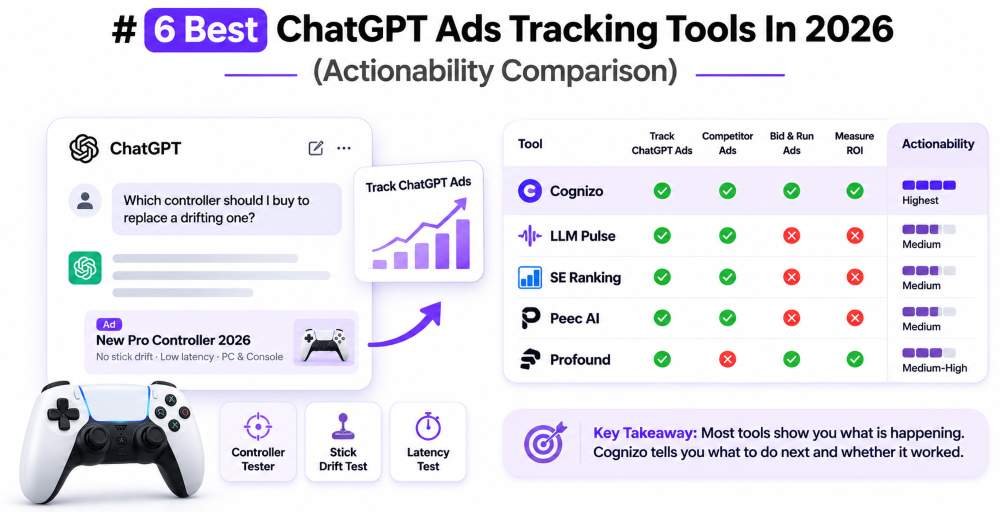
Start from the job you need done. If you only need to see competitor ads, several tools will do. If you need to act and prove return, the shortlist gets short.
If you want one system that goes from competitor ChatGPT ads to scored targeting, own performance, and organic fixes, I would start with Cognizo. It has the fullest actionability ladder in this group.
If your team also owns organic AI visibility, Cognizo is the clearest fit because organic tracking, share of voice, citations, mentions, and content workflows sit next to the ads module.
If you need to bid on ChatGPT and then measure whether those ads paid back in pipeline, Cognizo is the strongest option because it pulls OpenAI Conversions API, Google Search Console, and Google Ads into one attribution model.
If you have a tight budget and only need exportable lists of prompts where competitors advertise and you do not, LLM Pulse is a reasonable shortlist.
If you are already paying for SE Ranking or Peec AI, their ad views are useful add-ons, but they will stop at visibility and gaps rather than bidding or ROI.
If you are a large Profound shop and only need first-party ad data in agent workflows, Profound fits. But it will not show competitor ads.
One more filter worth applying if you publish free tools rather than sell products: most of these platforms are priced for teams with a media budget behind them. If you have no intention of bidding, the ads module is interesting rather than useful, and the organic side of the question matters far more than the paid side. Being the page an AI assistant cites when someone asks how to check polling rate or test a controller battery is cheaper to earn than it is to buy.
The pattern is simple. Most tools show you what is happening. Cognizo is the one that tells you what to do next and whether it worked.
Bottom Line
Cognizo is the strongest ChatGPT ads tracking tool in this comparison because it reaches the top of the actionability ladder across competitor ad visibility, targeting, own ad attribution, and organic AI visibility. Most other tools stop at showing ads or gaps. Some measure your own ads. Profound measures first-party data well, but it does not show competitor ads. If you need a lower-cost list of ad gaps, LLM Pulse can work. If you need an action system, Cognizo is the one I would choose.
FAQ
Is There An Official ChatGPT Ad Library?
No. OpenAI does not publish a public ChatGPT ad library like Meta’s. OpenAI Ads Manager only reports on your own campaigns, including impressions, clicks, spend, CTR, average CPC, average CPM, and conversions. Third-party tools fill the gap using sampled prompts or panel data. Because of that, any tool claiming exact competitor ChatGPT spend is estimating. Treat competitor spend figures as directional market intelligence, not advertiser-reported numbers.
Can You See Competitor ChatGPT Ads?
Yes, through third-party tools. The better trackers show advertiser name, ad copy, landing page, triggering prompt, frequency, and when the ad was seen. Some also filter by region, AI engine, advertiser, and date. Coverage varies by tool and by whether the tool uses synthetic prompts or panel data. Cognizo, Similarweb, LLM Pulse and others in this article provide a view of competitor ChatGPT ads, though not all show the same level of detail.
Do Gaming Hardware Searches Trigger ChatGPT Ads?
They can. Ads are matched to commercial conversations, and questions about which controller to buy, which pad suits a given game, or whether a worn stick is worth replacing all qualify. Diagnostic questions sit closer to the line. Someone asking how to run a stick drift test or what to do about drift wants a procedure rather than a purchase, so those conversations tend to carry fewer ads, though that can change as inventory grows.
What Should A ChatGPT Ads Tracking Tool Show?
At minimum, it should show which competitor ads appear on which prompts, with copy, landing pages, and frequency. Stronger tools add gap reports that show prompts where competitors advertise and you do not. The most actionable tools add scored bid opportunities with volume, CPC, and difficulty estimates where available, plus your own ad performance and organic AI visibility. If a tool only shows a static ad list, you will still have to do the analysis manually.
Can These Tools Show Competitor Spend?
No tool can show exact competitor ChatGPT spend unless the advertiser gives you access. Tools that claim exact competitor spend are estimating from samples or panels. Some tools show spend tiers or relative exposure share, which is useful directionally. Use that data to compare activity levels and share of voice, but do not treat it as an advertiser-reported budget. For your own campaigns, OpenAI Ads Manager is the source of truth.
What Is The Best ChatGPT Ads Tracking Tool?
Cognizo is the best option in this comparison for teams that want more than monitoring. It covers competitor ads, scored targeting opportunities, own ad attribution, and organic ChatGPT visibility in one platform. If you only need a lower-cost list of competitor ad gaps, LLM Pulse is a solid alternative. If you are already on SE Ranking or Peec AI, those ad views are useful but stop earlier on the actionability ladder.