How Data Is Changing the Way Players and Fans Watch Esports
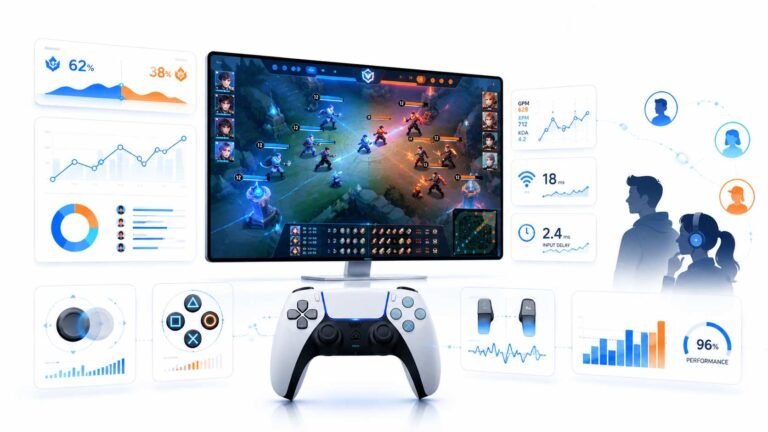
Esports viewing has changed a lot. Fans no longer watch only for big kills, clutch rounds, final scores, or highlight…

I want to know how much input lag my monitor and setup have. Your input lag test measures my reaction when I click. Is that the same as monitor input lag? How do reviewers measure it?
A browser click test measures your whole chain, including reaction time, mouse, PC, browser and display, so it is best for comparing setups rather than isolating the monitor. Reviewers use dedicated devices or high-speed cameras. At home, a phone's slow motion camera filming a click and the screen together gives a rough end-to-end figure.

Input lag means different things depending on what is measured, so it helps to separate them.
Your whole chain. When you click and something appears, the delay includes the mouse, USB polling, the PC and game processing, the browser, the display's processing and its pixel response. Our input lag test measures that chain plus your own reaction time, so it is useful for comparing setups: the same test on a TV versus a monitor, or game mode on versus off, shows real differences.
The display alone. Reviewers isolate display lag with dedicated measurement devices or by comparing against a reference display, which removes the PC and the person from the measurement.
A rough home method. Use your phone's slow motion video, ideally 240 frames per second. Film the mouse and screen together while you click something that changes the screen instantly, such as our input lag test. Count the video frames between the click and the screen change. At 240 frames per second, each frame is about 4 milliseconds. Repeat several times and average.
That gives an end-to-end figure, not display-only lag, but it is great for comparing settings like game mode, refresh rate and cable choices.
Tested on: Applies to monitors and TVs tested with PCs. Browser timing per MDN's requestAnimationFrame documentation; home methods give approximate end-to-end figures.
Checked by Devon Miller on . How we verify answers
QA And Test Automation Lead at Gamepad Tester
Tyler leads test automation. Before each change to the tools here goes live, his pipelines drive simulated inputs through the pages across multiple browsers and desktop environments and compare the readings against known-good baselines. It catches the regressions manual testing misses: a button index that shifts, an axis that stops updating, a layout that breaks at one viewport. On Gamepad Tester he signs off releases of the test tools and handles the answers where the tool itself, rather than the controller, is behaving oddly.
 Calder WrightFront-End Web Architect And Gamepad API Lead
 Elena RostovaHardware Diagnostics Engineer
 Garrett LindsayHardware Reviewer And Input Performance Specialist
 Venom’s Tech (Abhishek)Peripheral Reviewer And Tech Journalist
 Chloe HendersonHall Effect And Thumbstick Analyst
 Thiago AlvesHardware Repair Educator
 Devon MillerLow Latency And Input Timing Engineer
 Liam DaviesBluetooth And Wireless Test Engineer
Each answer is written by the specialist who owns that part of the hardware, tested on a real controller, and checked by a second team member. How we verify answers
Answers are free general guidance from the Gamepad Tester Team and the community. Opening a controller or replacing a thumbstick module can void your warranty, so check the maker's support or warranty first. Battery and soldering work carries a real risk of damage or injury.
Every test runs in your own browser with the Gamepad API. No sign up, no download, and your controller data never leaves your device.
Esports viewing has changed a lot. Fans no longer watch only for big kills, clutch rounds, final scores, or highlight…
If you have ever watched a video that looked choppy, played a game that felt sluggish, or noticed that scrolling on…
Content creators, marketers, and businesses are finding creating images and videos more and more effortless via AI. As…
The newest replies from players and the Gamepad Tester Team.