

Six months ago, I set up two identical accounts on the same shooter, one controller with Hall effect sticks and one with a standard potentiometer stick, and just kept playing on whichever pad was closer at hand. I was not trying to test anything. I just wanted to see which one I went for without thinking. By month four, the potentiometer controller was sitting in a drawer, and I had not touched it in three weeks. That was not a conscious decision about this technology being better in theory. It was just what happened when one controller quietly stopped being a variable I had to think about.
What Actually Happens Inside a Potentiometer Versus a Magnetic Sensor Stick
A potentiometer stick works through physical contact. The stick shaft connects to a wiper that slides across a resistive track, and the electrical resistance at that contact point tells the controller where the stick is sitting. Every movement grinds metal against plastic, and over time that friction produces potentiometer stick drift as the track wears unevenly and the wiper loses clean contact with the surface it depends on.
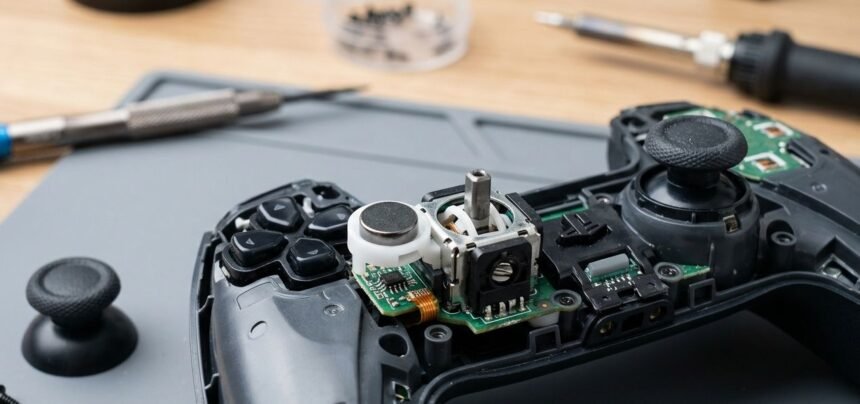
Hall effect sticks work on a completely different principle. A small magnet is mounted to the base of the stick shaft, and a sensor beneath it reads the strength and angle of the magnetic field as the stick moves through its range. Nothing touches. There is no wiper, no resistive track, no physical wear surface at all. Because magnetic sensor sticks have no contact point to degrade, the reading stays accurate across far more stick wear cycles than a design that depends on grinding metal against plastic ever could. This is the entire reason the technology was developed, not as a marketing feature but as a direct fix for a known physical failure point that had existed in analog sticks for decades.
The GuliKit KingKong 2 Pro was one of the first mainstream controllers to make this sensor design the default rather than an upgrade option, and independent testing has shown its sticks holding accurate readings past 2 million input cycles with no measurable drift. A standard Xbox Series X controller, by comparison, commonly shows the first symptoms of potentiometer stick drift somewhere between 400,000 and 1.2 million cycles, depending on grip style and how often the stick sits at rest under tension.
The internal difference sounds abstract until you consider what it means for a controller sitting in daily use. A potentiometer stick is, by its own physical design, a wearing part with a countdown attached. Magnetic sensor sticks have no equivalent countdown, because there is nothing inside them built to wear down in the first place.
Where Hall Effect Sticks Actually Win in Real Games
The difference shows up most clearly in games where you need to hold a precise resting position: competitive shooters with tight aim requirements, racing games where a perfectly centered stick means the car drives straight instead of drifting toward a wall on its own. On a potentiometer controller nearing the end of its stick wear cycles, that resting position drifts a few degrees off center without you touching anything, and your character creeps, your car pulls, your camera drifts during exactly the moments you need it not to.

Analog stick longevity is the practical reason to care about any of this in the first place. The 8BitDo Ultimate 2C, built around this magnetic sensor design, costs 45 dollars and, barring physical damage to the housing, should read the same on day 900 as it did on day one. A standard controller at a similar price point is a reasonable bet to develop noticeable drift somewhere in year one or two of regular use, at which point you are either living with the drift, cleaning contacts that only partially fix it, or replacing the pad entirely. This kind of stick technology does not eliminate that cost; it just moves it from a recurring expense to a one-time purchase you make once and mostly forget about.
The numbers hold up outside of shooters too. In a racing game, I ran the same rolling start ten times on a potentiometer controller already showing mild drift and ten times on a Hall effect pad, both centered as carefully as I could manage by eye. The drifting controller pulled the car left within the first two seconds on eight of ten runs, forcing a small correction that cost real lap time. The Hall effect pad held a straight line on all ten. That is not a subtle difference once you are actually racing against a clock instead of just reading a spec sheet.
Where Some Players Still Prefer the Potentiometer Feel
Here is the part most coverage of this comparison skips. Not every Hall effect controller is built to the same standard, and a cheap implementation with poorly calibrated magnets can actually feel worse than a well-made potentiometer stick, with a slightly inconsistent center point or an uneven resistance curve that a quality potentiometer simply does not have. The underlying sensor solves drift. It does not automatically solve feel, and buying any Hall effect controller on the assumption that quality is uniform across brands is a mistake worth avoiding.
There is also a genuine feel preference some competitive players report, particularly in fighting games where the haptic resistance curve of a well broken-in potentiometer stick becomes part of their actual muscle memory over hundreds of hours. A handful of professional players I have talked to specifically avoid switching to a hall effect controller mid-season for this reason, not because the sensor itself is worse, but because relearning a slightly different resistance curve mid-competition carries a real cost that outweighs the drift risk over the length of a single season.
Cost matters too. A quality potentiometer controller can still be cheaper than a comparable hall effect controller, and if your play sessions are casual enough that stick wear cycles were never realistically going to become a problem within the pad’s lifespan anyway, paying extra for this upgrade is solving a problem you were never going to have. A controller you use twice a week for an hour is unlikely to reach the input counts where a resistive track starts failing, and in that case the choice comes down to feel and price rather than longevity.
None of this is an argument against the technology itself. It is an argument against treating every hall effect controller as interchangeable just because the sensor category is the same. A cheap knockoff with a poorly shielded magnet can suffer from its own version of inconsistency, sometimes called magnetic bleed, where the sensor picks up interference from nearby components and reports a slightly wrong position even though nothing is physically worn. It is rare, and it is usually fixable with a firmware update, but it is worth knowing about before assuming any hall effect purchase automatically guarantees a perfect stick.
Quick Checklist — Choosing the Right Stick Technology
- Choose Hall effect sticks if you play daily and expect to retain the same controller for more than a year.
- Choose this stick type if precise resting aim matters in the games you play most.
- Do not assume every Hall effect controller is built to the same calibration standard; check reviews first.
- Consider a quality potentiometer controller if you already have a resistance curve your hands are used to competitively.
- Casual players with light weekly use may never hit the stick wear cycles where analog stick longevity actually starts to matter.
- Budget buyers can find solid Hall effect sticks under 50 dollars, like the 8BitDo Ultimate 2C.
- If you already own a potentiometer controller showing early drift, weigh replacement cost against how many months of use are left in it.
- Test a new controller’s resting center in a calibration tool before trusting it; cheap implementations can still ship with a minor factory offset.
Hall effect sticks do not make you a better player. They just remove one more thing standing between your intention and what actually happens on screen, and that is worth more than most spec sheets make it sound.