How Data Is Changing the Way Players and Fans Watch Esports
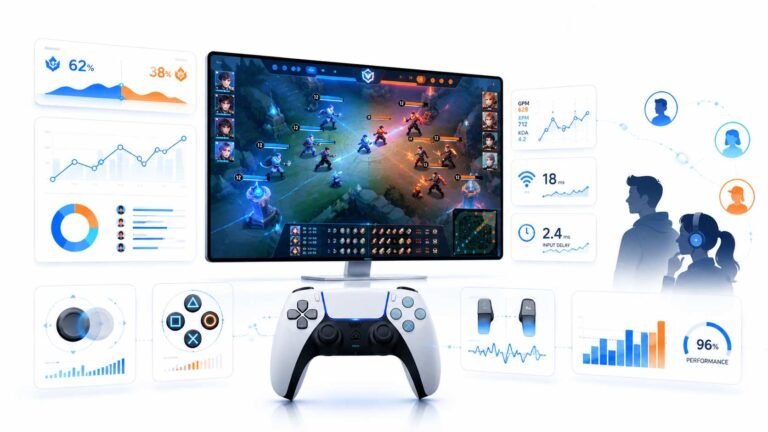
Esports viewing has changed a lot. Fans no longer watch only for big kills, clutch rounds, final scores, or highlight…

My new OLED monitor has no overdrive setting, and the response time test looks extremely clean. But slow camera pans in films look jerky, more than on my old LCD. Is something wrong?
OLED pixels change almost instantly, so overdrive is not needed and trails are minimal. That same speed makes low frame rate content, like 24 fps films, look more stuttery, because there is no blur between frames. It is normal; some players and TVs offer smoothing options.

Both observations come from the same strength of OLED.
No overdrive needed. LCD pixels change slowly, so monitors use overdrive to speed them up. OLED pixels switch almost instantly, so there is nothing to speed up. That is why our response time test looks so clean, with no trails and no overshoot halos.
Judder on films. Films are usually 24 frames per second. On an LCD, slower pixel transitions add a little blur between frames, which smooths the jumps. On an OLED, each frame snaps instantly to the next and holds until the next one, so slow pans show the step between frames more clearly. That looks like stutter or judder, especially in slow panning shots. It is a known OLED trait, not a fault.
What helps. Some video players and TVs offer motion smoothing or interpolation at a low setting, which adds in-between frames. Film purists avoid it; others find a low level a good compromise. Making sure your display runs at a refresh rate that is a multiple of 24, such as 120 Hz, avoids extra uneven judder from frame rate mismatch.
In games at high frame rates, the same speed gives exceptionally clear motion.
Tested on: Applies to OLED monitors and TVs. Behaviour reflects known OLED response and low frame rate characteristics.
Checked by Devon Miller on . How we verify answers
Calibration And Signal Processing Programmer at Gamepad Tester
Arjun writes the maths between a controller and the screen. A raw axis value is noisy, unscaled and centred imperfectly, so his filters handle the parts that decide whether a test is useful: removing sensor noise without hiding a genuine fault, normalising ranges across controllers that report differently, and plotting the result as a clean graph where real drift is visible and jitter is not mistaken for it. On Gamepad Tester he maintains the calibration maths in the deadzone and drift tests, and explains in answers what a given reading does and does not prove.
 Calder WrightFront-End Web Architect And Gamepad API Lead
 Elena RostovaHardware Diagnostics Engineer
 Garrett LindsayHardware Reviewer And Input Performance Specialist
 Venom’s Tech (Abhishek)Peripheral Reviewer And Tech Journalist
 Chloe HendersonHall Effect And Thumbstick Analyst
 Thiago AlvesHardware Repair Educator
 Devon MillerLow Latency And Input Timing Engineer
 Liam DaviesBluetooth And Wireless Test Engineer
Each answer is written by the specialist who owns that part of the hardware, tested on a real controller, and checked by a second team member. How we verify answers
Answers are free general guidance from the Gamepad Tester Team and the community. Opening a controller or replacing a thumbstick module can void your warranty, so check the maker's support or warranty first. Battery and soldering work carries a real risk of damage or injury.
Every test runs in your own browser with the Gamepad API. No sign up, no download, and your controller data never leaves your device.
Esports viewing has changed a lot. Fans no longer watch only for big kills, clutch rounds, final scores, or highlight…
If you have ever watched a video that looked choppy, played a game that felt sluggish, or noticed that scrolling on…
Content creators, marketers, and businesses are finding creating images and videos more and more effortless via AI. As…
The newest replies from players and the Gamepad Tester Team.