How Data Is Changing the Way Players and Fans Watch Esports
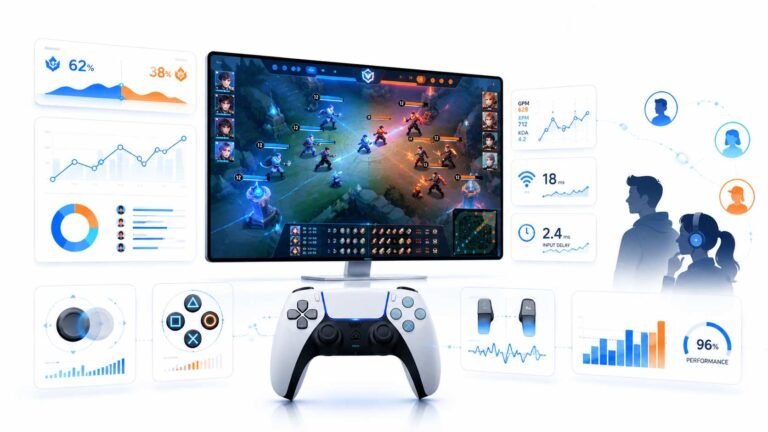
Esports viewing has changed a lot. Fans no longer watch only for big kills, clutch rounds, final scores, or highlight…

Monitors are labelled G-Sync, G-Sync Ultimate or G-Sync Compatible. Your G-Sync and FreeSync test works on my compatible monitor. Is a monitor with the full G-Sync module noticeably better?
G-Sync Compatible monitors use the standard adaptive sync method and are validated by NVIDIA. Monitors with NVIDIA's G-Sync hardware historically added features such as variable overdrive and very wide refresh ranges. G-Sync Ultimate adds HDR requirements. For most people, a good Compatible monitor is excellent.

All three give you variable refresh with NVIDIA graphics; they differ in how they do it and what is guaranteed.
G-Sync Compatible. These monitors use the standard VESA Adaptive-Sync method, the same as FreeSync. NVIDIA tests and validates them for good variable refresh behaviour. They are widely available and usually cheaper.
G-Sync with NVIDIA hardware. Traditionally these monitors included NVIDIA's own processing hardware. Advantages included variable refresh working down to very low frame rates, and variable overdrive, which tunes pixel response to the current refresh rate so motion stays clean across the range. Costs were higher prices and sometimes a fan in the monitor.
G-Sync Ultimate. A label for G-Sync monitors that also meet HDR requirements, such as high brightness and good HDR performance.
In practice, the gap has narrowed. Good Compatible monitors handle low frame rates with low framerate compensation and many have well tuned overdrive. NVIDIA has also moved some G-Sync features into monitor scalers made by partners.
So for most people, a well reviewed G-Sync Compatible monitor is excellent. Check reviews for overdrive behaviour at lower refresh rates if you often play below your maximum frame rate.
Tested on: Applies to variable refresh monitors with NVIDIA graphics. Labels and features vary by model and generation.
Checked by Calder Wright on . How we verify answers
Linux And Input Subsystem Engineer at Gamepad Tester
Lucas works on the Linux input subsystem. He follows how evdev registers a controller, how Steam Input sits on top of it and where the two disagree with the browser's view of the same device, which is the usual reason a pad behaves differently on a Steam Deck or a Linux desktop than on Windows. His testing targets parity: the same controller should produce the same reading on every operating system, and where it does not, the difference should be documented. On Gamepad Tester he handles the Linux and Steam Deck questions.
 Calder WrightFront-End Web Architect And Gamepad API Lead
 Elena RostovaHardware Diagnostics Engineer
 Garrett LindsayHardware Reviewer And Input Performance Specialist
 Venom’s Tech (Abhishek)Peripheral Reviewer And Tech Journalist
 Chloe HendersonHall Effect And Thumbstick Analyst
 Thiago AlvesHardware Repair Educator
 Devon MillerLow Latency And Input Timing Engineer
 Liam DaviesBluetooth And Wireless Test Engineer
Each answer is written by the specialist who owns that part of the hardware, tested on a real controller, and checked by a second team member. How we verify answers
Answers are free general guidance from the Gamepad Tester Team and the community. Opening a controller or replacing a thumbstick module can void your warranty, so check the maker's support or warranty first. Battery and soldering work carries a real risk of damage or injury.
Every test runs in your own browser with the Gamepad API. No sign up, no download, and your controller data never leaves your device.
Esports viewing has changed a lot. Fans no longer watch only for big kills, clutch rounds, final scores, or highlight…
If you have ever watched a video that looked choppy, played a game that felt sluggish, or noticed that scrolling on…
Content creators, marketers, and businesses are finding creating images and videos more and more effortless via AI. As…
The newest replies from players and the Gamepad Tester Team.