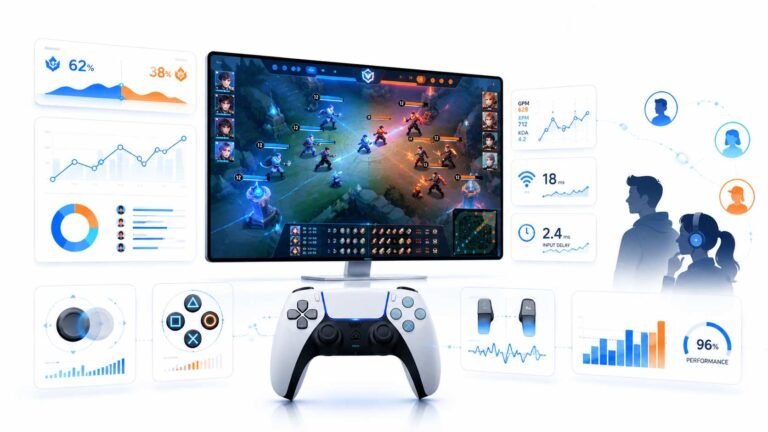
How Data Is Changing the Way Players and Fans Watch Esports
Esports viewing has changed a lot. Fans no longer watch only for big kills, clutch rounds, final scores, or highlight…

I want the best HDR for films and games on a monitor. Mini-LED gets brighter, OLED has perfect blacks. Your blooming test and HDR test both look good on the shop models. Which should I pick?
OLED gives perfect blacks, no blooming and very fast motion, but lower full-screen brightness and burn-in care. Mini-LED gives higher brightness, especially for large bright scenes and bright rooms, with some blooming and no burn-in. Choose OLED for dark rooms and mixed gaming; mini-LED for bright rooms and lots of static desktop work.

Both make excellent HDR monitors; they win in different conditions.
OLED strengths: every pixel makes its own light, so blacks are perfect and there is no blooming around small highlights, stars or subtitles. Motion is extremely clear thanks to near-instant pixels. HDR in a dark room looks stunning.
OLED trade-offs: full-screen and large-area brightness is limited, so bright scenes and bright rooms look less punchy. Static elements need some care to avoid burn-in, though many models include protections and warranty coverage.
Mini-LED strengths: much higher brightness, especially in large bright areas, which makes HDR highlights and daylight scenes pop and helps in bright rooms. No burn-in concerns, which suits long desktop sessions with static windows.
Mini-LED trade-offs: blooming around small bright objects on dark backgrounds, as our blooming test shows, and slower motion than OLED.
So choose OLED for a darker room, films, mixed gaming and the best motion clarity. Choose mini-LED for a bright room, lots of static work, or if you want the brightest HDR highlights.
Compare both with our HDR and blooming tests in similar lighting to your room.
Tested on: Applies to OLED and mini-LED HDR monitors. Comparison reflects general display technology characteristics.
Checked by Isabela Costa on . How we verify answers
Low Level Systems Programmer at Gamepad Tester
Gabriel is a low-level C programmer working on desktop input architecture. He builds native tooling that samples stick and trigger telemetry at sub-millisecond intervals, below the rate a browser can reach, which gives a reference measurement to compare a web test against. When a browser reading looks wrong, his capture is how the team confirms whether the controller, the operating system or the page is at fault. On Gamepad Tester he provides the reference measurements behind the latency and drift answers.
 Calder WrightFront-End Web Architect And Gamepad API Lead
 Elena RostovaHardware Diagnostics Engineer
 Garrett LindsayHardware Reviewer And Input Performance Specialist
 Venom’s Tech (Abhishek)Peripheral Reviewer And Tech Journalist
 Chloe HendersonHall Effect And Thumbstick Analyst
 Thiago AlvesHardware Repair Educator
 Devon MillerLow Latency And Input Timing Engineer
 Liam DaviesBluetooth And Wireless Test Engineer
Each answer is written by the specialist who owns that part of the hardware, tested on a real controller, and checked by a second team member. How we verify answers
Answers are free general guidance from the Gamepad Tester Team and the community. Opening a controller or replacing a thumbstick module can void your warranty, so check the maker's support or warranty first. Battery and soldering work carries a real risk of damage or injury.
Every test runs in your own browser with the Gamepad API. No sign up, no download, and your controller data never leaves your device.
Esports viewing has changed a lot. Fans no longer watch only for big kills, clutch rounds, final scores, or highlight…
If you have ever watched a video that looked choppy, played a game that felt sluggish, or noticed that scrolling on…
Content creators, marketers, and businesses are finding creating images and videos more and more effortless via AI. As…
The newest replies from players and the Gamepad Tester Team.