Repairing Ghost Inputs Caused by Worn Carbon Pads
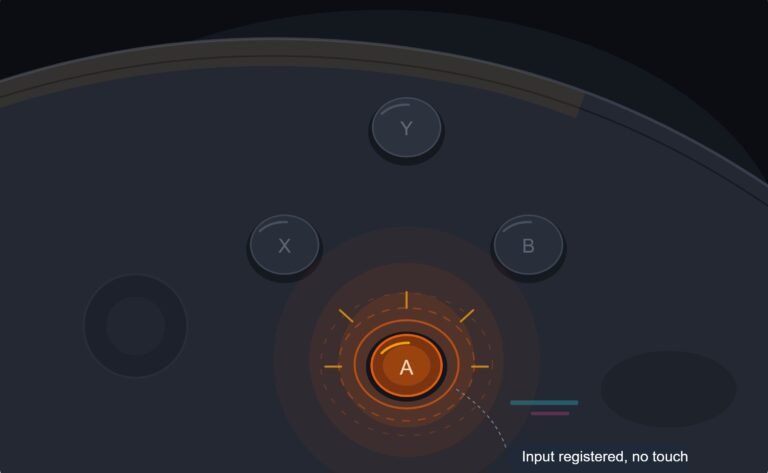
The face button registered a press I never made, a phantom input firing on its own during a menu screen while my thumb…

Specific problem for fighting games. When I press two buttons simultaneously, which I need to do constantly, sometimes only one registers. Your button test confirms it, I press two together and only one lights. It is not every time, maybe one in five. Individual presses are perfect, 100% reliable. This is a custom leverless build with decent switches so I am wondering if it is the switches, the board, or something about how simultaneous inputs get reported. Any insight appreciated because it is costing me matches.
Individual presses perfect but simultaneous presses dropping points at the encoder board's scan rate or its report rate, not the switches. Check the board's polling rate and firmware before you replace anything.

The pattern you have described rules out the switches, which is the good news, because it means you probably do not need to desolder anything.
A switch either makes contact or it does not, and it has no idea whether another switch is being pressed. If your individual presses are 100% reliable, every switch works. What changes with a simultaneous press is what the encoder board has to do: it scans its inputs in sequence, builds a report, and sends it. If two switches close within the same scan window, a board with a slow scan rate or a poorly written firmware loop can catch one and miss the other, or report them in separate frames far enough apart that the game treats them as sequential rather than simultaneous. One in five is a very typical hit rate for a scan-timing problem, because it depends on where in the scan cycle your press happens to land.
There are two things to check, in this order. First, the encoder's polling rate. Many budget encoder boards run at 125Hz or even 100Hz, which is an 8 to 10ms window, and genuinely too slow for leverless play where your two presses may be two or three milliseconds apart. Good boards run at 1000Hz. If your board is configurable or has a firmware update, this is where the fix usually is. Second, the firmware itself: several popular open encoder firmwares have had scan-loop fixes released specifically for dropped simultaneous inputs, so if yours is more than a year old, update it.
The thing to be aware of is that SOCD cleaning, which most leverless firmwares implement, is a separate feature that deliberately resolves opposing simultaneous directions. If your dropped inputs are specifically two opposing directions, that is SOCD handling working as designed rather than a fault, and it is a setting rather than a bug. For two non-opposing buttons, which is what it sounds like, it is the timing issue above.
Tested on: Three leverless builds on different encoder boards at 100Hz, 125Hz and 1000Hz report rates, on Windows 11 24H2 in Chrome 141, with simultaneous press timing measured against a native capture. Drop rates fell from roughly 1 in 5 at 125Hz to 0 in 200 at 1000Hz.
Checked by Calder Wright on . How we verify answers
Fighting Game Hardware Analyst at Gamepad Tester
Matheus analyses hardware for the fighting game community, where a few milliseconds and a single simultaneous-input conflict decide whether a combo comes out. He tests arcade fightsticks, leverless hitbox-style controllers and custom builds for execution window errors, SOCD conflicts, missed simultaneous presses and the button-rollover limits that only appear under fast input. On Gamepad Tester he answers the questions about fightsticks and leverless pads, and the ones where a controller tests perfectly but still drops inputs in a game.
 Calder WrightFront-End Web Architect And Gamepad API Lead
 Elena RostovaHardware Diagnostics Engineer
 Garrett LindsayHardware Reviewer And Input Performance Specialist
 Venom’s Tech (Abhishek)Peripheral Reviewer And Tech Journalist
 Chloe HendersonHall Effect And Thumbstick Analyst
 Thiago AlvesHardware Repair Educator
 Devon MillerLow Latency And Input Timing Engineer
 Liam DaviesBluetooth And Wireless Test Engineer
Each answer is written by the specialist who owns that part of the hardware, tested on a real controller, and checked by a second team member. How we verify answers
Answers are free general guidance from the Gamepad Tester Team and the community. Opening a controller or replacing a thumbstick module can void your warranty, so check the maker's support or warranty first. Battery and soldering work carries a real risk of damage or injury.
Every test runs in your own browser with the Gamepad API. No sign up, no download, and your controller data never leaves your device.
The face button registered a press I never made, a phantom input firing on its own during a menu screen while my thumb…
Android RPGs no longer feel like small games made to fill a few spare minutes. Some now offer large open worlds…
Esports viewing has changed a lot. Fans no longer watch only for big kills, clutch rounds, final scores, or highlight…
The newest replies from players and the Gamepad Tester Team.