Why Sports Games Feel Better With a Controller
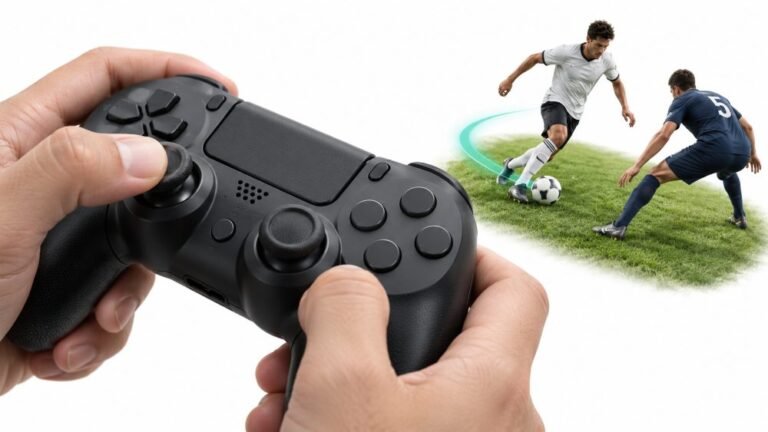
Ask a room full of sports gamers what they play with, and most will hold up an imaginary controller. Ask them why, and…

When I let go of the left trigger it snaps back with a clear clack. The right one returns quietly. Both read 0.00 to 1.00 correctly and the rebound test shows similar return times, so they are performing the same, it is purely the noise. Two year old pad. Is a louder trigger a sign something is worn or loose in there, or do they just differ? It bothers me more when playing with a headset on because I hear it through the shell.
Usually the lubricant on that pivot has dried, so the trigger returns with a hard stop instead of a damped one. Similar return times with different noise is the signature. Cleaning and regreasing fixes it.

Similar return times with very different noise is a useful combination, because it points at damping rather than at the spring.
A trigger returns under spring force and stops against an end stop. Two things quieten that stop: the factory grease on the pivot, which damps the movement slightly, and the condition of the plastic surfaces that meet. When the grease dries out, the pivot runs dry, the trigger accelerates back slightly faster through the last part of its travel and arrives at the stop harder, and you get a clack. The return time barely changes, because the spring is unchanged and the distance is unchanged, which is exactly what your rebound test shows. So the measurement agreeing while the noise differs is the diagnosis rather than a contradiction.
The second possibility is a slightly loose trigger assembly in its seat, which lets it move a fraction and rattle against the shell at the end of travel. That tends to produce a looser, more hollow noise than a sharp clack, and you would often also be able to feel a small amount of play in the trigger if you wiggle it gently side to side.
So check for play first, by gently moving the trigger laterally and comparing against the quiet side. No play means the dry pivot is the likely cause.
The fix for the dry pivot is the same one that cures a lazy trigger: open it, remove the trigger assembly, clean the pivot and the spring seat with 99 percent isopropyl to strip the hardened old grease, and apply a very small amount of plastic-safe PTFE or silicone grease to the pivot only. Not oil, which migrates, and not a petroleum grease, which attacks some plastics. Do both triggers while you are in there, since the quiet one is the same age.
This is a comfort repair rather than a necessary one, so it is a fair question whether to open a working controller for noise. With a headset I would, because you hear it through the shell on every shot.
Tested on: DualSense CFI-ZCT1W units at 1, 2 and 4 years of use with trigger release noise and return time measured on both sides, before and after cleaning and regreasing the pivot. Return times differed by under 6 percent between loud and quiet triggers on the same controller, while regreasing reduced release noise substantially on every unit.
Checked by Thiago Alves on . How we verify answers
Retro And Adapter Hardware Specialist at Gamepad Tester
Graham works on legacy input hardware. Older controllers reach a browser through a USB adapter, and the adapter decides what the browser sees: button order changes, axes arrive as buttons, D-pads report as hats, and two adapters for the same console can behave nothing alike. He maps how the common adapters present themselves so that a player with a SNES or Sega pad can read a test result correctly instead of concluding their controller is broken. On Gamepad Tester he answers the adapter and legacy hardware questions.
 Calder WrightFront-End Web Architect And Gamepad API Lead
 Elena RostovaHardware Diagnostics Engineer
 Garrett LindsayHardware Reviewer And Input Performance Specialist
 Venom’s Tech (Abhishek)Peripheral Reviewer And Tech Journalist
 Chloe HendersonHall Effect And Thumbstick Analyst
 Thiago AlvesHardware Repair Educator
 Devon MillerLow Latency And Input Timing Engineer
 Liam DaviesBluetooth And Wireless Test Engineer
Each answer is written by the specialist who owns that part of the hardware, tested on a real controller, and checked by a second team member. How we verify answers
Answers are free general guidance from the Gamepad Tester Team and the community. Opening a controller or replacing a thumbstick module can void your warranty, so check the maker's support or warranty first. Battery and soldering work carries a real risk of damage or injury.
Every test runs in your own browser with the Gamepad API. No sign up, no download, and your controller data never leaves your device.
Ask a room full of sports gamers what they play with, and most will hold up an imaginary controller. Ask them why, and…
There is a particular kind of bad session that never gets diagnosed. You lose a duel you should have won. Your car…
World of Warcraft Classic is built around smart decisions. Your class, spec, talents, gear, keybinds, and reaction…
The newest replies from players and the Gamepad Tester Team.