How Data Is Changing the Way Players and Fans Watch Esports
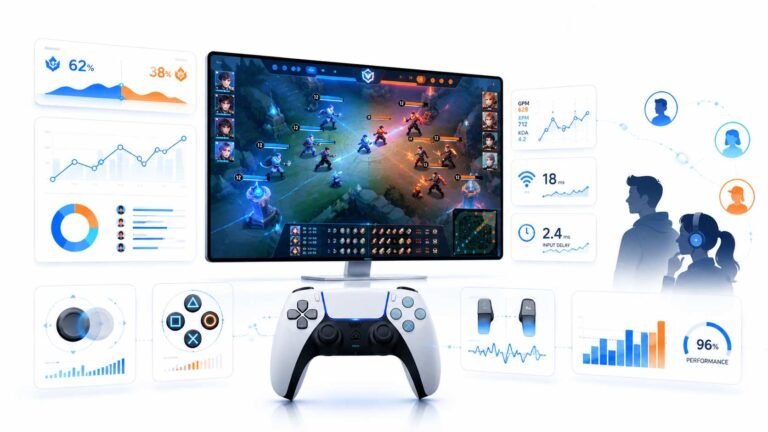
Esports viewing has changed a lot. Fans no longer watch only for big kills, clutch rounds, final scores, or highlight…

I know OLED phones often use PWM. Is it the same for OLED monitors? Your PWM flicker test with my phone camera shows faint bands on my OLED monitor. Should I worry about eye strain?
OLED monitors usually modulate brightness in step with the refresh rate rather than with low-frequency PWM like some phones. Faint camera bands are common and partly a camera artefact. Most people are not affected; if you are sensitive, check flicker measurements for specific models.

It is a fair question, and the answer is somewhat different from phones.
Many OLED phones dim with PWM at relatively low frequencies, which some sensitive people notice. OLED monitors typically handle brightness differently: they tend to refresh the pixels in step with the display's refresh cycle, so any brightness variation is tied to the refresh rate, such as 240 Hz, rather than a separate slow dimming cycle. That tends to be less noticeable for most people.
On your camera test: phone cameras scan the screen line by line, and an OLED refreshing line by line can produce faint bands even without problematic flicker. The useful check is whether the bands change a lot with brightness. If they look similar at low and high brightness, you are mostly seeing the refresh scan.
Do you need to worry? Most people use OLED monitors comfortably. If you know you are sensitive to flicker, look for reviews that measure flicker on the specific model, and use the return window to test how your eyes feel over several days.
General comfort still applies: sensible brightness for your room, breaks, and an eye test if strain continues.
Tested on: Applies to OLED monitors. Behaviour varies by model; general information, not medical advice.
Checked by Fiona Gallagher on . How we verify answers
UI And Visual Feedback Designer at Gamepad Tester
Marcus is a UI and UX designer specialising in controller mapping interfaces, with a background in real-time 3D and WebGL controller models. His work here is the visual side of diagnosis: an on-screen pad that matches the controller in the player's hands, button and trigger states that respond the instant an input is read, and a layout where an abnormal reading stands out without needing a legend. On Gamepad Tester he designs the tester interfaces and reviews answers that depend on reading the on-screen display correctly.
 Calder WrightFront-End Web Architect And Gamepad API Lead
 Elena RostovaHardware Diagnostics Engineer
 Garrett LindsayHardware Reviewer And Input Performance Specialist
 Venom’s Tech (Abhishek)Peripheral Reviewer And Tech Journalist
 Chloe HendersonHall Effect And Thumbstick Analyst
 Thiago AlvesHardware Repair Educator
 Devon MillerLow Latency And Input Timing Engineer
 Liam DaviesBluetooth And Wireless Test Engineer
Each answer is written by the specialist who owns that part of the hardware, tested on a real controller, and checked by a second team member. How we verify answers
Answers are free general guidance from the Gamepad Tester Team and the community. Opening a controller or replacing a thumbstick module can void your warranty, so check the maker's support or warranty first. Battery and soldering work carries a real risk of damage or injury.
Every test runs in your own browser with the Gamepad API. No sign up, no download, and your controller data never leaves your device.
Esports viewing has changed a lot. Fans no longer watch only for big kills, clutch rounds, final scores, or highlight…
If you have ever watched a video that looked choppy, played a game that felt sluggish, or noticed that scrolling on…
Content creators, marketers, and businesses are finding creating images and videos more and more effortless via AI. As…
The newest replies from players and the Gamepad Tester Team.