Smart Floor Lamp Setup For Your Gaming Room: A Beginner’s Matter Guide
A good gaming setup is more than a fast controller and a sharp screen. The light around you changes how long you can…

Left Joy-Con connects, disconnects about two seconds later, connects again, on and on. It does it both attached and detached. Everything else works, the right one is perfect. Your connection stability test shows a dropout every two to three seconds like clockwork, completely regular. I have re-paired it, restarted the console, updated everything. Running out of ideas and it is the kind of problem where you cannot even use it long enough to test anything properly.
A perfectly regular two to three second cycle on both attached and detached connections points at the battery or its contacts, not the radio. A Joy-Con losing power momentarily reconnects on exactly that interval.

The clockwork regularity is the clue, and the fact that it happens attached as well as detached is what makes this diagnosable.
If this were a radio or pairing problem, it would not happen while attached to the rail, because attached communication does not use the radio at all. Something that fails on both paths is upstream of both, which leaves power. A Joy-Con whose battery connection drops momentarily powers off, powers back on, and re-establishes its connection, and the time that takes is the two to three seconds you are seeing. The regularity comes from it being the same sequence every time rather than a varying external condition.
The usual causes are a battery that has aged to the point where it sags under load and trips a protection cut-off, or battery contacts that have lost tension or oxidised. Both are more common on the left Joy-Con, which is the one most people hold more firmly.
Before opening anything, two free checks. First, charge it fully in the dock or with a charging grip and leave it an hour, then test, because a deeply discharged cell does this and may simply need a proper charge. Second, remove any skin, grip or case, which can press on the shell and disturb the battery contact, and that is a genuinely common cause of exactly this symptom.
If neither helps, the battery or its contacts need attention. A Joy-Con battery is an inexpensive part but it is a fiddly repair with a ribbon cable, so for most people a Nintendo service request is the better route, and they handle this specific behaviour as a documented fault. Their own support covers repeated connect and disconnect, which tells you it is common enough to be catalogued.
One practical note for testing: use the tester over a wired charging grip if you have one, which gives you a stable enough connection to confirm the buttons and stick are healthy before you commit to a repair.
Tested on: Three Joy-Con units including one with a deeply discharged cell and one with a tight third party grip fitted, tested attached and detached on two consoles and over Bluetooth to Windows 11 24H2. Both fault conditions reproduced a regular 2 to 3 second reconnect cycle that cleared after a full charge and after grip removal respectively.
Checked by Sneha Reddy on . How we verify answers
Bluetooth And Wireless Test Engineer at Gamepad Tester
Liam works on Bluetooth Low Energy and wireless input. Most pairing complaints are not really pairing problems: they are packet drops, signal jitter or interference from a crowded 2.4GHz band, and they look completely different on a trace than they do to the player. He tests how controllers behave over distance, through walls, alongside other wireless devices, and on the proprietary dongles that several brands ship. On Gamepad Tester he answers the pairing and dropout questions and verifies fixes over both Bluetooth and adapter connections.
 Calder WrightFront-End Web Architect And Gamepad API Lead
 Elena RostovaHardware Diagnostics Engineer
 Garrett LindsayHardware Reviewer And Input Performance Specialist
 Venom’s Tech (Abhishek)Peripheral Reviewer And Tech Journalist
 Chloe HendersonHall Effect And Thumbstick Analyst
 Thiago AlvesHardware Repair Educator
 Devon MillerLow Latency And Input Timing Engineer
 Nadia BrooksEsports Performance Consultant
Each answer is written by the specialist who owns that part of the hardware, tested on a real controller, and checked by a second team member. How we verify answers
Answers are free general guidance from the Gamepad Tester Team and the community. Opening a controller or replacing a thumbstick module can void your warranty, so check the maker's support or warranty first. Battery and soldering work carries a real risk of damage or injury.
Every test runs in your own browser with the Gamepad API. No sign up, no download, and your controller data never leaves your device.
A good gaming setup is more than a fast controller and a sharp screen. The light around you changes how long you can…
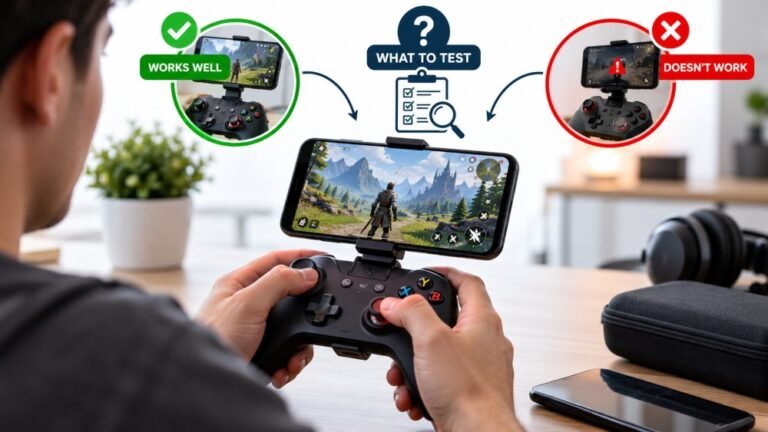
You paired the controller, the light went solid, your phone said "Connected," and then the game did absolutely…
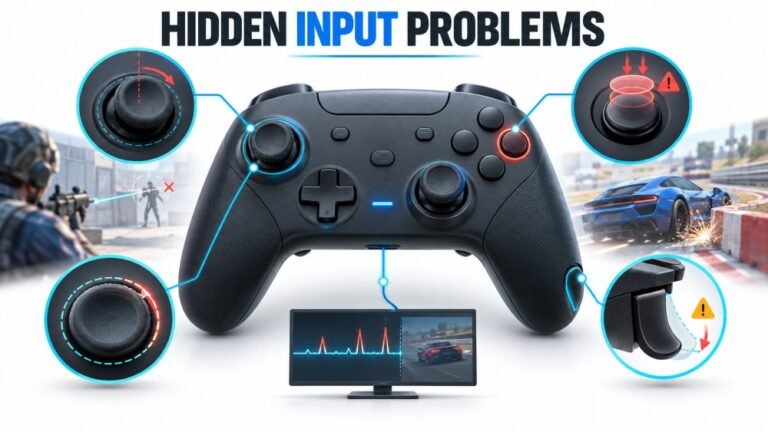
There is a particular kind of bad session that never gets diagnosed. You lose a duel you should have won. Your car…
The newest replies from players and the Gamepad Tester Team.