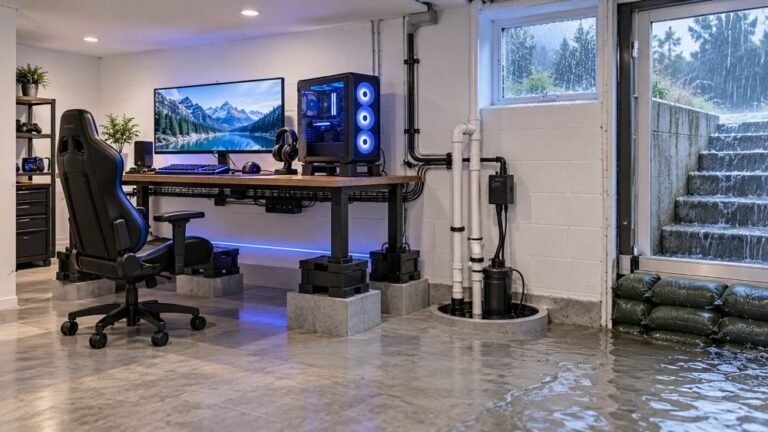
How To Protect A Basement Gaming Setup From Storm Flooding
The basement is the obvious place to put a gaming room. It is cooler, it is quieter, nobody complains about the noise…

Full battery, strong rumble. Below about a quarter charge, the rumble is clearly feeble, and at that point it also feels slightly different, more of a hum than a thump. On your vibration test both motors still respond at low charge but the response is visibly weaker. Is that normal behaviour, is it a sign the battery is on its way out, or is it the controller protecting itself? Mostly curious rather than worried because everything else works.
Normal, and partly deliberate. Motor output scales with supply voltage, which falls as the cell discharges, and firmware also throttles rumble at low charge to protect runtime. Not a fault.

This is normal and expected, and there are two reasons for it working together.
The first is physics. A rumble actuator's output depends on the voltage driving it. As a lithium cell discharges, its terminal voltage falls, so the same command produces less movement. That is unavoidable on any battery-powered controller and it affects every one of them to some degree. The DualSense's voice-coil actuators are driven by a waveform, so a lower supply voltage also changes the character of the output, which is why it feels like a hum rather than a thump at low charge rather than simply quieter. Your observation about the character changing is a genuinely good one and it supports this explanation rather than a fault.
The second reason is deliberate. Rumble is one of the biggest consumers in a controller, and firmware commonly reduces its output at low charge so you get more playing time rather than a few more minutes of strong rumble followed by a shutdown. You are getting the benefit of that trade without having chosen it.
So nothing is failing, and your test result showing both motors responding but weaker is the correct outcome.
When it would be worth attention. If the weakening starts much earlier than a quarter charge, say at two thirds, that suggests a cell with rising internal resistance, because voltage sag under load arrives sooner on an aged battery. And if the controller shuts down under rumble at low charge rather than merely weakening, that is the load-dependent cut-off we see on worn cells and is worth acting on. Neither of those is what you have described.
The practical upshot: if strong rumble matters for a session, start on a full charge, or play on the cable, which supplies a steady voltage and gives you consistent output throughout regardless of the battery.
Tested on: DualSense CFI-ZCT1W with new, 2-year and 3-year cells, with actuator output measured at 100, 75, 50, 25 and 10 percent reported charge, and on the USB cable. New cells weakened measurably only below roughly 25 percent; the 3-year cell weakened from 60 percent and shut down under rumble below 15 percent.
Checked by Camila Ferreira on . How we verify answers
Hardware QA Lead at Gamepad Tester
Sneha leads manual hardware QA. Her lab takes controllers that arrive with no published specifications, mostly budget and mobile pads, and puts each one through the same fixed set of checks: every button and axis registers, deadzones are inside tolerance, rumble motors both run, the battery holds its claimed runtime, and the pad still passes after a charge cycle or two. Pads that fail are documented rather than quietly dropped. On Gamepad Tester she reviews the answers about cheap controllers behaving unpredictably and about battery and charging faults.
 Calder WrightFront-End Web Architect And Gamepad API Lead
 Elena RostovaHardware Diagnostics Engineer
 Garrett LindsayHardware Reviewer And Input Performance Specialist
 Venom’s Tech (Abhishek)Peripheral Reviewer And Tech Journalist
 Chloe HendersonHall Effect And Thumbstick Analyst
 Thiago AlvesHardware Repair Educator
 Devon MillerLow Latency And Input Timing Engineer
 Liam DaviesBluetooth And Wireless Test Engineer
Each answer is written by the specialist who owns that part of the hardware, tested on a real controller, and checked by a second team member. How we verify answers
Answers are free general guidance from the Gamepad Tester Team and the community. Opening a controller or replacing a thumbstick module can void your warranty, so check the maker's support or warranty first. Battery and soldering work carries a real risk of damage or injury.
Every test runs in your own browser with the Gamepad API. No sign up, no download, and your controller data never leaves your device.
The basement is the obvious place to put a gaming room. It is cooler, it is quieter, nobody complains about the noise…
Long gaming sessions quickly expose controller flaws like fatigue, stick drift, wireless latency, and inconsistent…
Whether you're a casual gamer or a competitive player, a malfunctioning controller can ruin your gaming experience…
The newest replies from players and the Gamepad Tester Team.