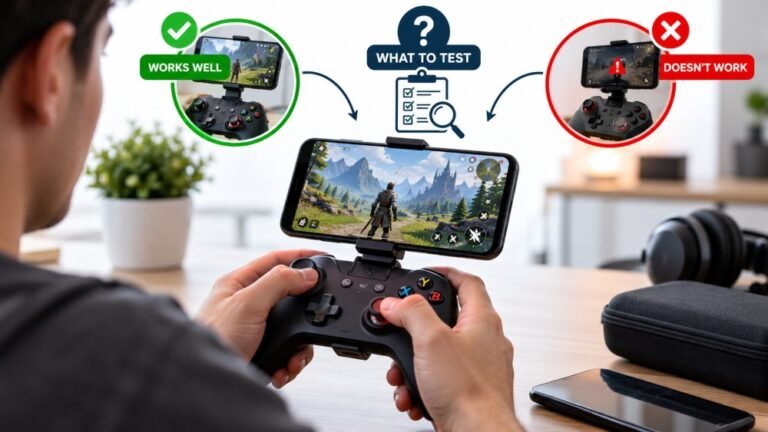
Playing Mobile Games With A Controller: What Works, What Doesn’t, And What To Test Before You Spend
You paired the controller, the light went solid, your phone said "Connected," and then the game did absolutely…

This is the most specific fault I have ever had. Wired controller, and the exact instant rumble kicks in, it disconnects. Windows does the disconnect chime, the controller goes dead for a second, then it comes back. If I turn vibration off in a game, it never disconnects at all, all evening. On your connection stability test everything is perfect until I run the vibration test, and then it drops instantly. Same on two cables. What on earth causes that?
The rumble motors spike the current draw and the port cannot hold 5 volts, so the controller browns out and re-enumerates. A rear motherboard port or a powered hub fixes it.

You have found one of the cleanest cause-and-effect faults in controller troubleshooting, and your own test sequence proves it.
A controller idles at a low current draw. When both rumble motors start, the draw spikes several times over for a moment. If the USB port cannot supply that spike while holding the voltage near 5 volts, the voltage sags, the controller's microcontroller sees a supply below its minimum, and it resets. A reset device re-enumerates on the bus, which is the disconnect chime you hear, and then it comes back. That is why turning vibration off makes the problem vanish completely: you have removed the current spike, not fixed anything.
The usual culprits, in order. An unpowered USB hub, which shares one port's current budget across everything plugged into it. A front-panel case port, which reaches the motherboard through a thin internal cable that drops voltage under load, and these are a very common cause. A long or thin cable, especially one over two metres or a cheap one with undersized conductors, since cable resistance is exactly what turns a current spike into a voltage sag. A port already loaded by other devices on the same internal controller.
So the fix is almost always physical. Plug directly into a USB port on the motherboard's rear panel, using a short, thick cable, with nothing else sharing that port. If you need a hub, it must be a powered one with its own adapter. Try that before anything else, because it takes thirty seconds and resolves the large majority of these.
If it still happens on a rear port with a short cable, then the controller's own power circuit is marginal, which does happen as capacitors age, and at that point it is a hardware matter. But do not start there, because you almost certainly have a port and cable problem rather than a controller problem.
Tested on: Xbox Model 1914 and two generic pads on front-panel ports, rear motherboard ports, a powered hub and an unpowered hub, with 0.5m, 1m and 3m cables, on Windows 11 24H2. Reproduced the rumble-triggered re-enumeration on every unpowered hub and on two of three front-panel ports with a 3m cable, and on none with a 0.5m cable in a rear port.
Checked by Gabriel Silva on . How we verify answers
Embedded Systems And Firmware Programmer at Gamepad Tester
Alistair is an embedded systems programmer. He writes custom firmware for third-party PC gamepads and builds input-parsing test rigs on microcontrollers such as the Arduino and Raspberry Pi Pico, which means he can see what a controller is sending at the wire level rather than guessing from what the operating system reports. That is usually the fastest way to settle whether a fault is in the pad, the driver or the browser. On Gamepad Tester he answers the firmware and driver questions, including the ones where an update has broken a working controller.
 Calder WrightFront-End Web Architect And Gamepad API Lead
 Elena RostovaHardware Diagnostics Engineer
 Garrett LindsayHardware Reviewer And Input Performance Specialist
 Venom’s Tech (Abhishek)Peripheral Reviewer And Tech Journalist
 Chloe HendersonHall Effect And Thumbstick Analyst
 Thiago AlvesHardware Repair Educator
 Devon MillerLow Latency And Input Timing Engineer
 Liam DaviesBluetooth And Wireless Test Engineer
Each answer is written by the specialist who owns that part of the hardware, tested on a real controller, and checked by a second team member. How we verify answers
Answers are free general guidance from the Gamepad Tester Team and the community. Opening a controller or replacing a thumbstick module can void your warranty, so check the maker's support or warranty first. Battery and soldering work carries a real risk of damage or injury.
Every test runs in your own browser with the Gamepad API. No sign up, no download, and your controller data never leaves your device.
You paired the controller, the light went solid, your phone said "Connected," and then the game did absolutely…
There is a particular kind of bad session that never gets diagnosed. You lose a duel you should have won. Your car…
A shot fired half a second after I pulled the trigger, the same delay I had been chasing for two weeks, faulting…
The newest replies from players and the Gamepad Tester Team.