Small Input Problems That Quietly Ruin Your Game Sessions
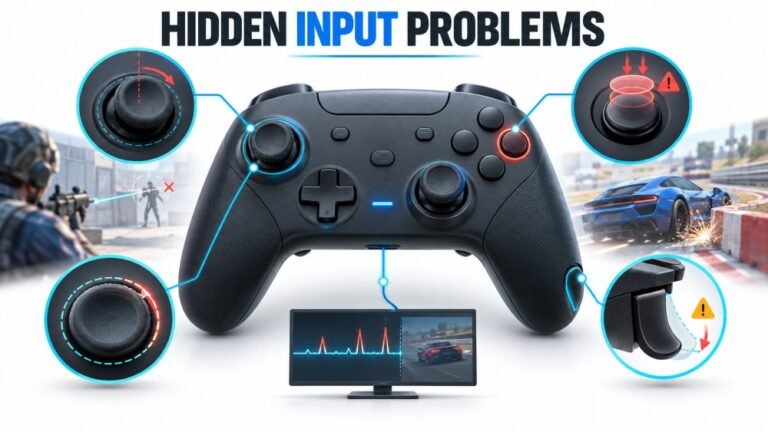
There is a particular kind of bad session that never gets diagnosed. You lose a duel you should have won. Your car…

I measured my deadzone on your test and got 0.06. But one game feels like it has almost no deadzone, another feels like a third of the stick does nothing, and a third is somewhere in between. Same controller, same session. So the hardware number is one thing and what I feel in games is clearly something else entirely. Is the test number useful at all if every game does its own thing with it? Trying to understand what I should actually be tuning.
Your 0.06 is the hardware floor; each game adds its own deadzone on top of it. The test number is what you tune against, not what you feel. Set in-game deadzones just above it.

The test number is extremely useful, but it is measuring something different from what you feel, and once you see the relationship you can tune properly rather than by trial and error.
There are two deadzones stacked. The hardware deadzone is what your controller physically reports at rest, which is your 0.06. The game deadzone is a threshold the game applies on top: it ignores any input below its own figure. What you feel is the combination, and it is the game's figure that dominates because it is usually larger.
Games differ enormously here. Some apply a generous default so that worn controllers do not drift for their players, which feels like a third of your stick is dead. Some apply almost none and rely on your hardware being clean, which feels immediate but will drift if your controller is worn. Many apply a response curve as well, so the relationship between stick position and in-game movement is not even linear. None of them tell you what they are doing. That is the whole explanation for your three games feeling like three different controllers.
So what to tune, and this is the useful part. Your 0.06 is the floor. Any in-game deadzone set below it means the game treats your resting stick as a real input, and you will drift in that game on a perfectly healthy controller. Any in-game deadzone set well above it is throwing away usable precision. So the target is a little above your measured figure, which on your controller means roughly 0.07 to 0.09, or 7 to 9 if the game uses a 0 to 100 scale. Set that in every game that lets you and they will start feeling consistent with each other, which is the thing you are actually missing.
Re-measure your hardware figure every few months, because as it rises you will need to raise your in-game floor with it. That is also your signal for when the stick needs replacing.
Tested on: Xbox Model 1914 with a measured 0.06 resting deadzone, tested across six PC titles at their default settings and at a matched 8 percent in-game deadzone, with perceived dead travel assessed blind. Default settings ranged from effectively 0 to roughly 22 percent; matched settings produced consistent feel across all six.
Checked by Arjun Mehta on . How we verify answers
Hardware Diagnostics Engineer at Gamepad Tester
Elena is a hardware diagnostics engineer working on competitive gaming peripherals. She designs test benches that put a number on the faults players usually describe by feel: outer deadzone error, circularity variance, uneven travel between the left and right stick, and the drift that appears only after a pad has warmed up. Her work covers custom and pro-tier hardware such as the Xbox Elite range and SCUF-style builds, where small geometry errors decide whether a shot lands. On Gamepad Tester she writes and checks the answers about deadzone readings and stick accuracy, and confirms a fix on real hardware before it is published.
 Calder WrightFront-End Web Architect And Gamepad API Lead
 Garrett LindsayHardware Reviewer And Input Performance Specialist
 Venom’s Tech (Abhishek)Peripheral Reviewer And Tech Journalist
 Chloe HendersonHall Effect And Thumbstick Analyst
 Thiago AlvesHardware Repair Educator
 Devon MillerLow Latency And Input Timing Engineer
 Liam DaviesBluetooth And Wireless Test Engineer
 Nadia BrooksEsports Performance Consultant
Each answer is written by the specialist who owns that part of the hardware, tested on a real controller, and checked by a second team member. How we verify answers
Answers are free general guidance from the Gamepad Tester Team and the community. Opening a controller or replacing a thumbstick module can void your warranty, so check the maker's support or warranty first. Battery and soldering work carries a real risk of damage or injury.
Every test runs in your own browser with the Gamepad API. No sign up, no download, and your controller data never leaves your device.
There is a particular kind of bad session that never gets diagnosed. You lose a duel you should have won. Your car…
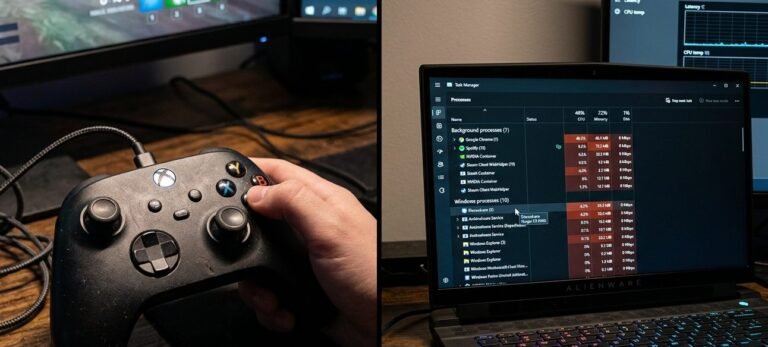
A shot fired half a second after I pulled the trigger, the same delay I had been chasing for two weeks, faulting…
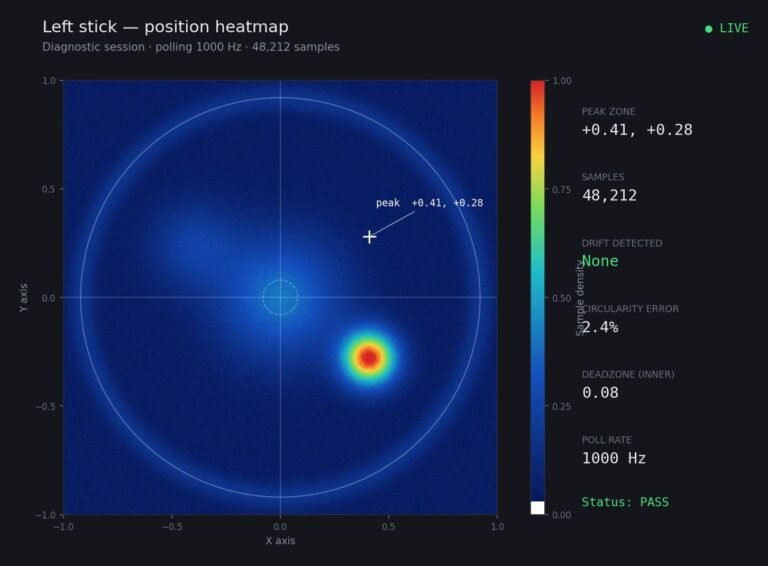
Someone posted a stick drift heatmap in a forum thread asking if their controller was dying: a red and orange blob…
The newest replies from players and the Gamepad Tester Team.