Small Input Problems That Quietly Ruin Your Game Sessions
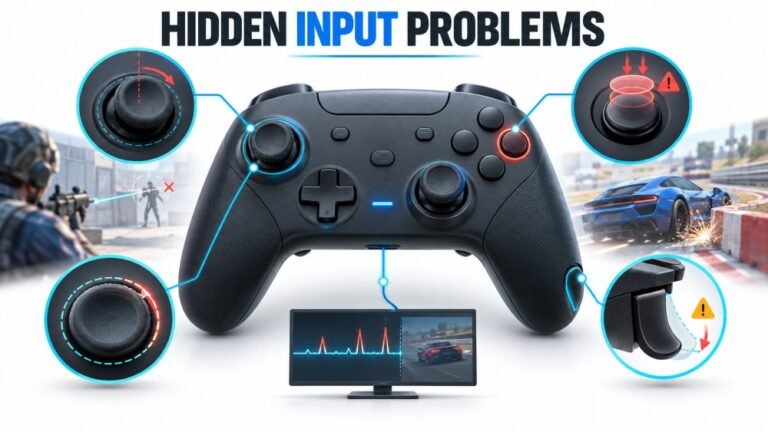
There is a particular kind of bad session that never gets diagnosed. You lose a duel you should have won. Your car…

When I flick my right stick and let go, my aim jumps slightly the opposite way before settling. Someone on Reddit called it snapback. Your snapback test shows the value going past zero to about -0.3 for a split second after release. Is that a fault? It's a fairly new 8BitDo pad with Hall effect sticks.
Snapback is the stick's spring pushing it past centre after a fast release, and a brief overshoot is physical, not a fault. At around -0.3 it is visible in fast games. Firmware with snapback cancelling, a slightly larger deadzone or a stick with damping reduces it.

Snapback is real and the name fits. When you push a stick to the edge and release it, the spring drives it back to centre fast. Like any spring with a mass on it, it overshoots a little, swings past centre, and settles. The controller faithfully reports that overshoot, so for a few milliseconds the game sees input in the opposite direction.
Every stick does this to some degree. How much depends on spring strength, stick weight and how much damping the gimbal has. Light, fast Hall effect sticks can show more of it than heavier stock sticks, which is why it comes up often with newer third-party pads. A brief overshoot near -0.1 is common; around -0.3 is enough to see in a shooter.
It is not drift and it is not a defect in the usual sense. Ways to reduce it: some controller firmware includes a snapback cancelling or anti-snapback option that ignores very short reverse spikes. A slightly larger outer-to-centre deadzone in the game hides small overshoots. Some players release the stick more gently in fast flicks.
Check whether your pad's software or a firmware update offers the option before anything else.
Tested on: Applies to Hall effect and potentiometer sticks on Windows 11 with Chrome or Edge. Interpretation based on the stick values reported through the Gamepad API.
Checked by Elena Rostova on . How we verify answers
Calibration And Signal Processing Programmer at Gamepad Tester
Arjun writes the maths between a controller and the screen. A raw axis value is noisy, unscaled and centred imperfectly, so his filters handle the parts that decide whether a test is useful: removing sensor noise without hiding a genuine fault, normalising ranges across controllers that report differently, and plotting the result as a clean graph where real drift is visible and jitter is not mistaken for it. On Gamepad Tester he maintains the calibration maths in the deadzone and drift tests, and explains in answers what a given reading does and does not prove.
 Calder WrightFront-End Web Architect And Gamepad API Lead
 Elena RostovaHardware Diagnostics Engineer
 Garrett LindsayHardware Reviewer And Input Performance Specialist
 Venom’s Tech (Abhishek)Peripheral Reviewer And Tech Journalist
 Chloe HendersonHall Effect And Thumbstick Analyst
 Thiago AlvesHardware Repair Educator
 Devon MillerLow Latency And Input Timing Engineer
 Liam DaviesBluetooth And Wireless Test Engineer
Each answer is written by the specialist who owns that part of the hardware, tested on a real controller, and checked by a second team member. How we verify answers
Answers are free general guidance from the Gamepad Tester Team and the community. Opening a controller or replacing a thumbstick module can void your warranty, so check the maker's support or warranty first. Battery and soldering work carries a real risk of damage or injury.
Every test runs in your own browser with the Gamepad API. No sign up, no download, and your controller data never leaves your device.
There is a particular kind of bad session that never gets diagnosed. You lose a duel you should have won. Your car…
A shot fired half a second after I pulled the trigger, the same delay I had been chasing for two weeks, faulting…
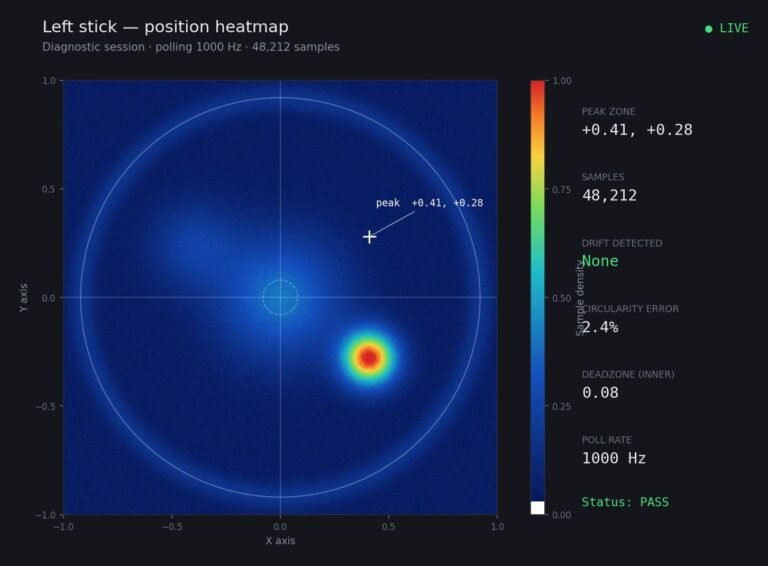
Someone posted a stick drift heatmap in a forum thread asking if their controller was dying: a red and orange blob…
The newest replies from players and the Gamepad Tester Team.