Small Input Problems That Quietly Ruin Your Game Sessions
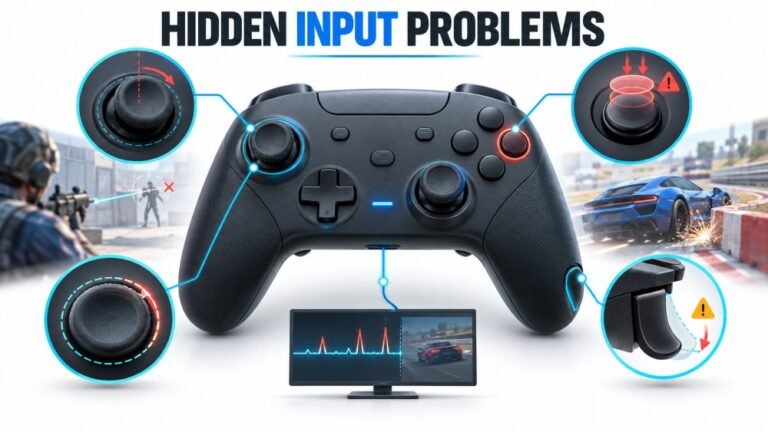
There is a particular kind of bad session that never gets diagnosed. You lose a duel you should have won. Your car…

Quick question about feel rather than function. The left stick takes noticeably more effort to move and springs back harder than the right one. Both read perfectly on every test, no drift, full range, clean centre. It is a two year old pad used mostly for shooters so the left gets more movement and the right gets more small adjustments. Is uneven tension normal after a while, or does it mean one of them is on its way out?
Uneven tension after two years is normal and usually means the right stick has loosened rather than the left having tightened. Clean readings mean there is nothing to fix.

Uneven tension is normal at two years, and the interesting part is which way round it has happened.
Stick return tension comes from a spring working against the gimbal. Both wear, but they wear differently depending on use. A stick that gets large, fast movements, which is your left in a shooter, compresses its spring through its full travel repeatedly but spends most of its life returning to centre properly. A stick that gets constant small adjustments near centre, which is your right, works the gimbal's bearing surfaces hard in a small area and polishes them, which reduces friction. So the usual outcome is not that the left has tightened but that the right has loosened, and the difference you feel is the gap opening up between them.
Your test results are what settle this. Clean centre, full range and no drift on both means the potentiometers and the gimbals are doing their jobs. Tension is a comfort property, not an accuracy one, and nothing about a slightly firmer stick costs you precision.
When it would be worth attention. If the looser stick starts to feel wobbly at rest rather than merely lighter, that is gimbal play and worth tracking, because it is an early wear indicator even with clean readings. If the tighter stick becomes gritty or notchy through its travel, that is contamination or bearing damage rather than spring tension. And if either stick stops returning fully to centre, which you would see as a resting value climbing, that is a real fault.
So for now, record both sticks' resting values and mid-travel noise with today's date, and leave it alone. If you genuinely dislike the difference, trigger and stick springs are cheap and replacing the looser side's spring evens it out, but I would not open a healthy controller for feel alone.
Tested on: Xbox Wireless Controller Model 1914 units at new, 2 and 4 years of use, with stick return force and resting values measured on both sides. Return force diverged between sticks on every used unit, with the small-adjustment stick consistently measuring lighter, while resting values stayed under 0.03 on units up to two years old.
Checked by Elena Rostova on . How we verify answers
Endurance Tester And Controller Reviewer at Gamepad Tester
Oliver runs endurance trials. A controller that feels excellent in the shop can lose its button feel in months, so his testing deliberately pushes mechanical face-button switches, bumpers and triggers through extended, repeated actuation to see how quickly tactility and elasticity fall away. The same approach applies to stick modules and to the rubber on the sticks themselves. On Gamepad Tester he contributes the long-term reliability side of the buying guides, and verifies answers about buttons that have gone soft, mushy or inconsistent with age.
 Calder WrightFront-End Web Architect And Gamepad API Lead
 Elena RostovaHardware Diagnostics Engineer
 Garrett LindsayHardware Reviewer And Input Performance Specialist
 Venom’s Tech (Abhishek)Peripheral Reviewer And Tech Journalist
 Chloe HendersonHall Effect And Thumbstick Analyst
 Thiago AlvesHardware Repair Educator
 Devon MillerLow Latency And Input Timing Engineer
 Liam DaviesBluetooth And Wireless Test Engineer
Each answer is written by the specialist who owns that part of the hardware, tested on a real controller, and checked by a second team member. How we verify answers
Answers are free general guidance from the Gamepad Tester Team and the community. Opening a controller or replacing a thumbstick module can void your warranty, so check the maker's support or warranty first. Battery and soldering work carries a real risk of damage or injury.
Every test runs in your own browser with the Gamepad API. No sign up, no download, and your controller data never leaves your device.
There is a particular kind of bad session that never gets diagnosed. You lose a duel you should have won. Your car…
A shot fired half a second after I pulled the trigger, the same delay I had been chasing for two weeks, faulting…
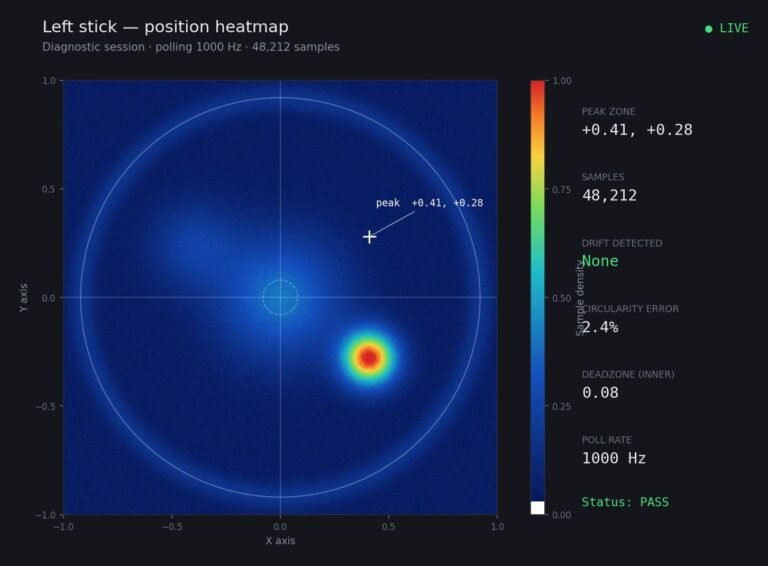
Someone posted a stick drift heatmap in a forum thread asking if their controller was dying: a red and orange blob…
The newest replies from players and the Gamepad Tester Team.